
Commercial aviation operates under strict global safety standards designed to prevent risk escalation during flight. When United Flight UA967 diverted, it triggered widespread attention from aviation observers, passengers, and news outlets. Diversions on transatlantic routes are rare but not unusual, and they often reflect the industry’s precaution-first safety culture.
Understanding what happened requires examining the flight route, aircraft type, mid-flight events, and the timeline that led the crew to divert the aircraft.
What Is United Flight UA967?
United Airlines operates Flight UA967 as a scheduled international route connecting Southern Europe with the United States. The service normally runs between Naples International Airport (NAP) in Italy and Newark Liberty International Airport (EWR) in New Jersey.
The route crosses the North Atlantic and typically lasts around 9 hours, depending on weather conditions and air traffic flow. The aircraft used on the route is generally a Boeing 767-300ER, a wide-body jet designed for long-haul flights.
When United Flight UA967 diverted, it was operating a routine transatlantic segment with passengers and crew onboard, following its standard flight path across the Atlantic corridor used by many North American and European airlines.
Flight Overview
| Detail | Information |
|---|---|
| Airline | United Airlines |
| Flight Number | UA967 |
| Departure Airport | Naples International Airport (NAP) |
| Destination Airport | Newark Liberty International Airport (EWR) |
| Aircraft Type | Boeing 767-300ER |
| Route Type | Transatlantic long-haul |
| Approximate Distance | ~7,000 km |
The aircraft departed Naples as scheduled and initially proceeded normally along the planned oceanic route.
Timeline of the UA967 Diversion
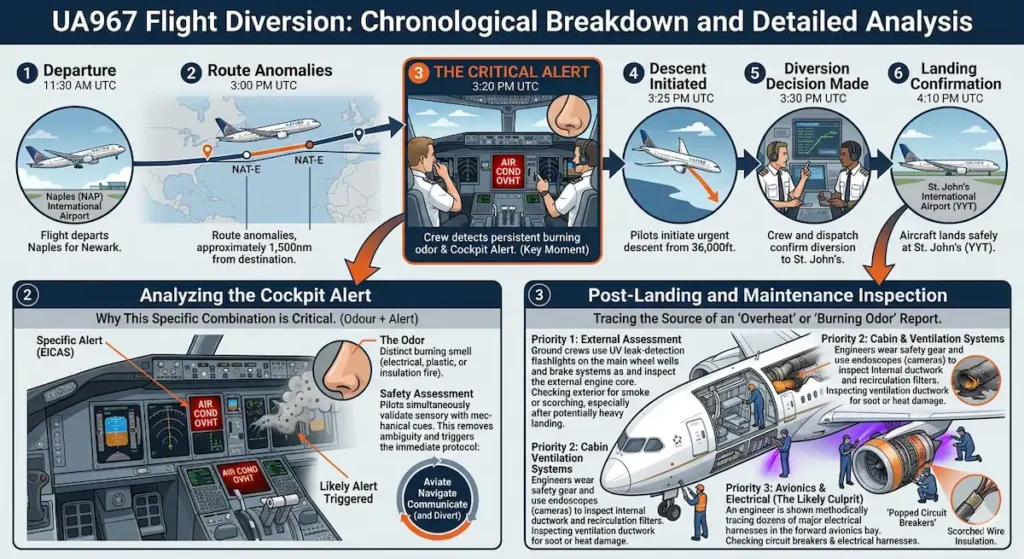
To understand why United Flight UA967 diverted, it is helpful to look at the chronological sequence of events that unfolded during the flight.
Key Event Timeline
| Stage | Event |
|---|---|
| Departure | Aircraft departs Naples for Newark |
| Mid-Atlantic | Crew detects unusual burning odor |
| Cockpit Alert | Aircraft monitoring system signals warning |
| Safety Assessment | Pilots evaluate situation and consult procedures |
| Diversion Decision | Crew selects alternate airport |
| Landing | Aircraft lands safely at St. John’s International Airport |
| Post-Landing | Maintenance inspection begins |
The most important moment occurred when the crew detected a burning odor accompanied by a cockpit alert, prompting immediate safety protocols.
What Triggered the Diversion
Aircraft systems continuously monitor thousands of components during flight. When United Flight UA967 diverted, the decision was linked to an onboard alert that required precautionary action.
Reports indicate that the pilots noticed:
- A burning or electrical odor
- A cockpit system alert
- Potential equipment ventilation issue
Aircraft cockpits include integrated monitoring systems designed to detect anomalies in electrical, mechanical, and environmental components. When these alerts occur during long-haul flights, the standard procedure is to evaluate whether the aircraft should continue or divert.
Pilots must consider several factors:
- Severity of the warning
- Potential system failure
- Distance to the nearest suitable airport
- Weather conditions
- Aircraft performance
In this situation, the crew determined that diverting the aircraft was the safest option.
According to aviation safety procedures, any unexplained electrical smell or warning indicator can justify a diversion because it may indicate overheating equipment, electrical faults, or environmental control system issues.
Also Read: ReadMyManga.com Guide: Safety, Features, Legality & Best Alternatives
Why St. John’s Was Chosen as the Diversion Airport
When United Flight UA967 diverted, the aircraft landed at St. John’s International Airport (YYT) in Newfoundland, Canada.
This location is one of the most important transatlantic diversion airports. Aircraft flying between Europe and North America frequently designate St. John’s as an alternate landing location because of its strategic geography.
Factors That Made St. John’s Suitable
| Factor | Reason |
|---|---|
| Geographic position | Located along major North Atlantic flight paths |
| Runway capability | Long runways capable of handling wide-body jets |
| Emergency services | Equipped for international diversion operations |
| Maintenance access | Ability to inspect large commercial aircraft |
Airlines operating across the Atlantic must always plan alternate airports within safe diversion distance in case of emergencies or mechanical issues. St. John’s, along with airports in Iceland and Greenland, forms part of this safety network.
Because of these factors, it was a logical choice when United Flight UA967 diverted during the Atlantic crossing.
Passenger Experience During the Diversion
When an aircraft diverts, passengers typically receive limited information while the crew focuses on safety procedures.
Passengers aboard the flight reported a typical sequence of events:
- Cabin crew announced that the aircraft would land at an alternate airport for precautionary checks.
- The plane changed course and began descending toward Newfoundland.
- Emergency services were present upon arrival as a precaution.
- The aircraft landed safely without incident.
Although the situation may feel alarming to travelers, diversions like this are handled routinely within aviation safety frameworks.
Cabin crews are trained to:
- Keep passengers calm
- Provide updates when available
- Prepare the cabin for landing
Importantly, no injuries were reported, and the aircraft completed a normal landing sequence.
Aircraft Inspection After Landing

Once United Flight UA967 diverted and landed, airline maintenance teams began evaluating the aircraft to identify the source of the warning.
Standard inspection procedures involve:
- Checking electrical systems
- Examining ventilation equipment
- Reviewing cockpit warning logs
- Inspecting environmental control systems
Modern aircraft store detailed diagnostic information, allowing engineers to analyze what triggered the alert.
Maintenance teams often prioritize checking components related to:
- Equipment cooling fans
- Electrical wiring
- air conditioning and ventilation systems
Even minor issues can trigger alerts, and airlines prefer to inspect the aircraft thoroughly before allowing it to resume service.
What Happens to Passengers After a Diversion
Once the aircraft landed and inspections began, the airline had to determine how passengers would continue their journey.
Airlines typically follow several steps when a flight diversion occurs:
- Technical evaluation of the aircraft
- Decision to repair or replace the aircraft
- Passenger rebooking or continuation plan
In many diversion cases, airlines arrange:
- Replacement aircraft
- Alternate connecting flights
- Passenger accommodations if necessary
Passengers on transatlantic routes are usually assisted with meals, accommodation, and rebooking depending on the length of the delay.
Key Facts About the UA967 Diversion
Summary
- Flight: United Airlines UA967
- Route: Naples → Newark
- Aircraft: Boeing 767-300ER
- Issue: cockpit alert and burning odor
- Diversion airport: St. John’s International Airport
- Outcome: safe landing and inspection
This sequence illustrates how modern aviation prioritizes precaution over schedule. Even when the issue is minor, airlines follow strict procedures to ensure passenger safety.
Why Diversions Are Part of Aviation Safety
Although the phrase “United Flight UA967 diverted” may sound dramatic, diversions are actually an essential component of aviation risk management.
Pilots are trained to act conservatively when any abnormal situation arises. Continuing a flight without inspection could allow a small technical issue to develop into a larger problem.
Aviation regulators such as the Federal Aviation Administration (FAA) and the International Civil Aviation Organization (ICAO) require airlines to maintain diversion plans and alternate airports throughout every flight.
This precautionary framework has contributed to the airline industry becoming one of the safest transportation systems in the world.
Key Takeaway
The moment United Flight UA967 diverted, the crew followed established safety procedures designed to protect passengers, crew, and aircraft.
What may appear to passengers as an unexpected disruption is actually evidence that aviation safety systems are working exactly as intended.
Why United Flight UA967 Diverted: Aviation Safety Systems, Regulations, and Passenger Impact
When United Flight UA967 diverted, the decision reflected a fundamental rule in commercial aviation: safety takes priority over schedule or operational convenience. Modern aircraft are equipped with advanced monitoring systems, and airline crews follow standardized procedures designed to detect and address potential risks before they escalate.
Understanding why United Flight UA967 diverted requires examining the technical systems that monitor aircraft health, the regulations governing transatlantic operations, and the structured decision-making process pilots follow during unexpected events.
Common Reasons Commercial Flights Are Diverted
Flight diversions occur for several operational and safety reasons. While the phrase United Flight UA967 diverted gained public attention, the reality is that diversions are a routine safety tool used across the aviation industry.
Airlines divert aircraft when continuing the flight may introduce risk or operational complications.
Major Causes of Flight Diversions
| Cause | Description | Example Scenario |
|---|---|---|
| Mechanical alerts | System warnings or abnormal readings | Equipment cooling failure |
| Medical emergencies | Passenger illness requiring urgent care | Heart attack or severe injury |
| Weather disruptions | Severe storms or turbulence | Atlantic storm systems |
| Security concerns | Potential threats onboard | Passenger disturbance |
| Operational constraints | Airport closures or runway restrictions | Destination airport shutdown |
Mechanical alerts are among the most common triggers. When United Flight UA967 diverted, the crew responded to an alert that required inspection before the aircraft could safely continue across the Atlantic.
Even minor alerts can lead to diversions because aviation safety protocols emphasize early intervention.
Aircraft Monitoring Systems That Detect Problems
Modern commercial aircraft constantly monitor their internal systems using sophisticated onboard computers. When United Flight UA967 diverted, these automated monitoring systems played a key role in alerting the crew.
Aircraft such as the Boeing 767-300ER use integrated alert systems that track:
- electrical systems
- environmental controls
- equipment ventilation
- engine performance
- cabin pressure
The cockpit alert system evaluates thousands of data points every second. If the system detects abnormal temperature levels, airflow problems, or electrical irregularities, it immediately notifies the pilots.
These alerts appear on cockpit displays and include:
- warning messages
- caution alerts
- system diagnostics
Because of this technology, pilots receive early warnings that allow them to take action long before a problem becomes dangerous.
This monitoring capability explains why United Flight UA967 diverted even though no visible emergency occurred. Preventive diversions reduce risk and protect passengers.
Understanding ETOPS and Transatlantic Flight Safety
Long-distance flights between Europe and North America must follow special operational rules known as ETOPS (Extended-range Twin-engine Operational Performance Standards).
These regulations ensure that twin-engine aircraft can always reach a safe landing location if a problem occurs.
When United Flight UA967 diverted, the aircraft was operating within an ETOPS-approved route across the North Atlantic.
Key ETOPS Requirements
| Requirement | Explanation |
|---|---|
| Alternate airports | Aircraft must remain within diversion range of approved airports |
| Aircraft reliability | Airlines must demonstrate high engine reliability |
| Crew training | Pilots receive special ETOPS procedures training |
| Maintenance standards | Aircraft undergo enhanced inspection protocols |
Because ETOPS rules require diversion planning, pilots already know which airports can handle a wide-body aircraft during an unexpected situation.
St. John’s International Airport is one of the primary ETOPS alternates for flights crossing the Atlantic. That is why United Flight UA967 diverted to this airport instead of continuing toward Newark.
Decision-Making Process When a Flight Diverts
Diversion decisions involve coordination between multiple aviation professionals. When United Flight UA967 diverted, the process followed a structured evaluation procedure.
Steps in the Diversion Decision
- System alert or abnormal condition detected
- Pilots analyze cockpit data
- Airline operations center consulted
- Risk assessment performed
- Nearest suitable airport selected
- Air traffic control coordinates landing
Pilots are trained to choose the safest and closest appropriate airport, not necessarily the final destination.
Several factors influence the decision:
- distance to alternate airport
- runway length
- emergency response capability
- weather conditions
- aircraft weight and fuel status
When United Flight UA967 diverted, the crew determined that landing in Newfoundland offered the safest and most efficient solution.
Role of Airline Operations Centers
Airlines operate centralized operations control centers that assist pilots during unusual situations.
When United Flight UA967 diverted, the airline’s operational team likely monitored the situation in real time. These centers provide support by:
- analyzing aircraft data
- coordinating maintenance resources
- arranging passenger rebooking
- communicating with airport authorities
The collaboration between flight crews and operations specialists ensures that diversions are handled efficiently while maintaining safety.
Passenger Rights After a Flight Diversion
Passengers often wonder what happens after a diversion occurs. When United Flight UA967 diverted, passengers experienced a delay and rerouting of their travel plans.
Air passenger rights depend on the region of departure and the cause of the disruption.
Passenger Protection Regulations
| Regulation | Coverage |
|---|---|
| EU261 | Compensation for delays departing from EU airports |
| U.S. Department of Transportation rules | Airline assistance requirements |
| Airline policies | Meals, accommodation, and rebooking |
Flights departing from Europe may fall under EU261 passenger protection regulations, which provide compensation for long delays unless the cause is related to safety issues or extraordinary circumstances.
If a diversion occurs because of safety concerns—such as mechanical alerts—compensation may not apply, but airlines still provide assistance such as:
- meal vouchers
- hotel accommodation
- rebooking on alternative flights
These measures help passengers complete their journey even after an unexpected diversion.
Aircraft Maintenance and Fleet Safety
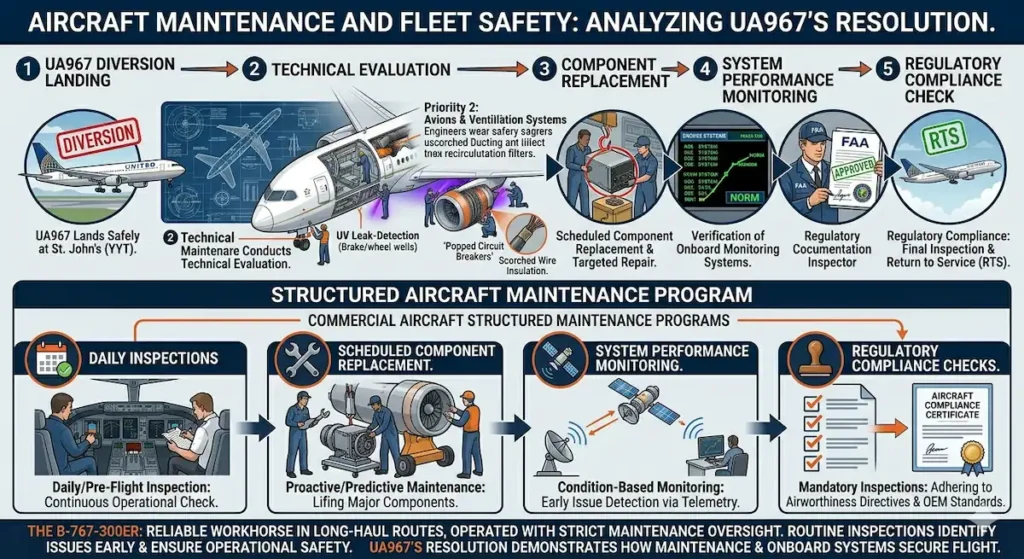
Aircraft used on long-haul routes undergo rigorous inspection schedules. When United Flight UA967 diverted, maintenance teams conducted a technical evaluation before the aircraft could return to service.
Commercial aircraft follow structured maintenance programs that include:
- daily inspections
- scheduled component replacement
- system performance monitoring
- regulatory compliance checks
The Boeing 767-300ER has been widely used for decades because of its reliability and long-range capability. Airlines continue operating the aircraft while maintaining strict maintenance oversight.
Routine inspections ensure that potential issues are identified early and corrected quickly.
The diversion of United Flight UA967 demonstrates how maintenance procedures and onboard monitoring systems work together to maintain operational safety.
Lessons From the UA967 Diversion
The event surrounding United Flight UA967 diverted illustrates several important aspects of modern aviation safety.
Key Safety Principles
- Early detection systems identify potential issues quickly
- Pilots follow precautionary protocols when anomalies appear
- Diversion airports are pre-planned for long-haul routes
- Maintenance teams inspect aircraft immediately after landing
These measures reflect the aviation industry’s layered safety approach. Multiple systems and procedures exist to prevent small problems from becoming serious incidents.
Pros and Cons of Flight Diversions
Although diversions disrupt travel plans, they remain a vital safety practice.
Benefits and Drawbacks
Advantages
- Protect passenger safety
- Allow technical inspection
- Prevent escalation of mechanical issues
Disadvantages
- Travel delays
- Missed connections
- Additional operational costs for airlines
Despite these inconveniences, the aviation industry prioritizes safety above all operational factors. When United Flight UA967 diverted, the decision aligned with standard safety philosophy across global aviation.
Key Takeaways
The phrase United Flight UA967 diverted highlights an important aspect of commercial aviation operations.
- Diversions are precautionary safety measures.
- Aircraft monitoring systems detect issues early.
- Transatlantic flights always plan alternate airports.
- Pilots follow strict international safety procedures.
The safe outcome of this event demonstrates the effectiveness of aviation safety systems and operational protocols.
Conclusion
The incident in which United Flight UA967 diverted shows how commercial aviation manages unexpected technical alerts during long-haul flights. When pilots detected an abnormal condition, they followed established safety procedures and diverted the aircraft to St. John’s International Airport for inspection.
Although the diversion disrupted the journey, the outcome reinforced the aviation industry’s commitment to precautionary safety measures. Through advanced monitoring technology, strict international regulations, and coordinated operational support, airlines ensure that passengers reach their destination safely even when unexpected events occur.
Frequently Asked Questions
Why did United Flight UA967 divert?
United Flight UA967 diverted after pilots detected a cockpit alert and an unusual burning odor during the transatlantic flight. As a precaution, the crew diverted the aircraft to St. John’s International Airport so maintenance teams could inspect the aircraft.
Where did United Flight UA967 land after diverting?
When United Flight UA967 diverted, the aircraft landed at St. John’s International Airport in Newfoundland, Canada, a common alternate airport for transatlantic flights.
Was the UA967 diversion an emergency landing?
The situation was treated as a precautionary diversion rather than a full emergency. Pilots followed safety procedures and landed the aircraft safely for inspection.
How common are transatlantic flight diversions?
Flight diversions are relatively uncommon but occur occasionally due to technical alerts, medical emergencies, or severe weather. Airlines plan alternate airports in advance for long-haul flights.
What aircraft was operating United Flight UA967?
The route was operated by a Boeing 767-300ER, a long-range wide-body aircraft commonly used for transatlantic flights.
Do passengers receive compensation after diversions?
Compensation depends on the cause of the diversion and the applicable regulations. Safety-related diversions may not qualify for compensation, but airlines typically provide assistance such as meals or accommodation.
References
Federal Aviation Administration (FAA) — Aviation Safety Guidelines
International Civil Aviation Organization (ICAO) — Flight Operations Standards
Boeing — 767 Aircraft Technical Overview
United Airlines Operational Safety Procedures
U.S. Department of Transportation — Air Passenger Consumer Protection Regulations