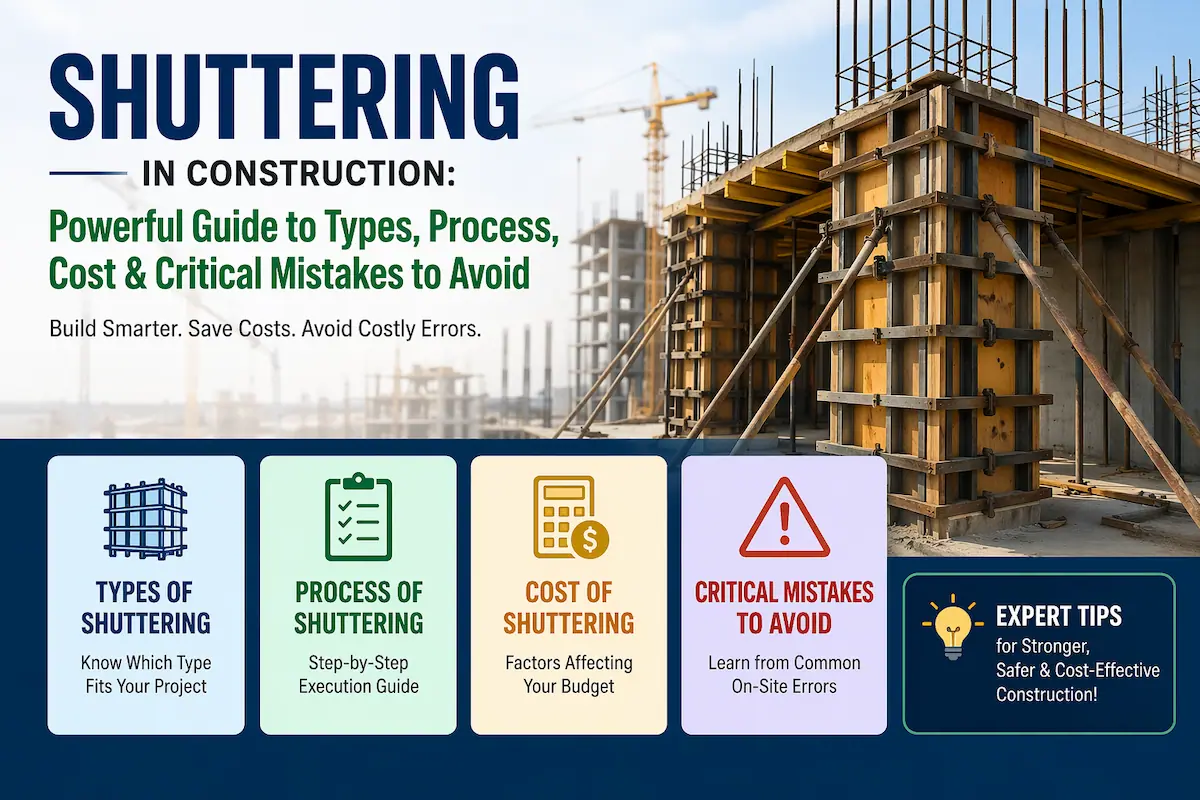
Shuttering is a temporary structural system used in construction to hold freshly poured concrete in position until it gains sufficient strength and stability. It acts as a mold that defines the exact shape, size, and surface finish of concrete elements such as slabs, beams, columns, and foundations. Once the concrete achieves the required strength through curing, it is carefully removed.
In modern construction practices, it plays a critical role in ensuring dimensional accuracy and structural reliability. According to industry standards set by organizations such as the American Concrete Institute and the Bureau of Indian Standards, properly designed and installed shuttering is essential for maintaining safety and performance in reinforced concrete structures.
Purpose and Function in Construction
The primary purpose this, is to support wet concrete until it hardens into a stable and load-bearing structure. However, its function goes beyond simple containment. It ensures that the concrete maintains its intended geometry and alignment during the curing process.
Key functions include:
- Maintaining the desired shape and dimensions of structural components
- Supporting loads from wet concrete and construction activities
- Preventing leakage of cement slurry
- Ensuring a smooth and uniform surface finish
- Providing temporary stability during construction
Concrete is initially in a plastic state and cannot support itself. Without properly installed shuttering, the structure would collapse or deform, leading to significant structural defects. Based on construction engineering practices, the load-bearing capacity of it must be calculated to handle both static and dynamic loads during pouring.
Why Shuttering is Critical for Structural Integrity
It directly influences the quality, strength, and durability of a structure. Improper installation or poor-quality materials can lead to serious defects such as honeycombing, misalignment, or even structural failure.
Key reasons why it is critical:
- Load Distribution: It supports the weight of wet concrete and reinforcement bars
- Dimensional Accuracy: Ensures precise measurements as per design drawings
- Surface Quality: Affects the final finish of concrete surfaces
- Safety: Prevents collapse during construction stages
- Durability: Proper curing shape leads to long-term structural stability
According to engineering practices followed by institutions like the Institution of Civil Engineers, even minor errors in its alignment can significantly impact load distribution in reinforced concrete structures.
Shuttering vs Formwork vs Centering
Key Differences Explained
In construction terminology, shuttering, formwork, and centering are often used interchangeably, but they have distinct meanings.
- Shuttering: Refers specifically to the vertical or side mold used to contain concrete
- Formwork: A broader term that includes all temporary molds used for shaping concrete
- Centering: Refers to horizontal supports used mainly for slabs and beams
Understanding these differences is essential for accurate planning and execution in construction projects.
When Each is Used
- Shuttering is used in vertical elements such as walls and columns
- Formwork is used as a general system covering all concrete molds
- Centering is used for supporting horizontal structures like slabs and beams
Each component works together to ensure structural stability during concrete placement and curing.
Also Read. Denture Reline: Essential Solution to Fix Loose Dentures Effectively
Common Misconceptions
A common misconception is that shuttering and formwork are identical. While it is a part of formwork, not all formwork is shuttering. Another misunderstanding is assuming centering alone can support concrete, whereas it must be integrated with proper systems.
Shuttering vs Formwork vs Centering
| Aspect | Shuttering | Formwork | Centering |
|---|---|---|---|
| Definition | Vertical mold system | Complete mold system | Horizontal support system |
| Usage | Walls, columns | All concrete structures | Slabs, beams |
| Scope | Part of formwork | Broad system | Support component |
| Function | Shape containment | Shape + support | Load-bearing support |
Types of Shuttering in Construction
Timber Shuttering
Timber shuttering is one of the oldest and most widely used systems in construction. It is made from wooden planks or boards and is particularly suitable for small projects.
Advantages:
- Easy to cut and shape
- Readily available
- Cost-effective for small-scale work
Limitations:
- Limited reusability
- Prone to moisture damage
- Requires skilled labor for proper installation
Plywood Shuttering
Plywood shuttering is an improved version of timber shuttering. It uses engineered wood sheets that provide a smoother surface finish.
Advantages:
- Better surface finish
- Lightweight and easy to handle
- Moderate reusability
Limitations:
- Slightly higher cost than timber
- Requires proper storage to prevent damage
Steel Shuttering
Steel shuttering is commonly used in large construction projects due to its durability and strength.
Advantages:
- High strength and durability
- Reusable multiple times
- Provides excellent surface finish
Limitations:
- Higher initial cost
- Heavy and requires machinery for handling
Aluminum Shuttering
Aluminum shuttering systems are widely used in modern construction for high-rise buildings and mass housing projects.
Advantages:
- Lightweight compared to steel
- High reusability
- Fast installation
Limitations:
- Expensive initial investment
- Requires skilled labor
Plastic Shuttering
Plastic shuttering is an innovative solution used for repetitive construction work.
Advantages:
- Lightweight and easy to assemble
- Resistant to water and chemicals
- High reuse potential
Limitations:
- Limited load-bearing capacity
- Not suitable for heavy structures
Types with Features
| Type | Durability | Cost Level | Reusability | Best Use Case |
|---|---|---|---|---|
| Timber | Low | Low | Low | Small projects |
| Plywood | Medium | Medium | Medium | Residential construction |
| Steel | High | High | Very High | Large-scale projects |
| Aluminum | High | High | Very High | High-rise buildings |
| Plastic | Medium | Medium | High | Repetitive structures |
Shuttering Based on Structural Elements
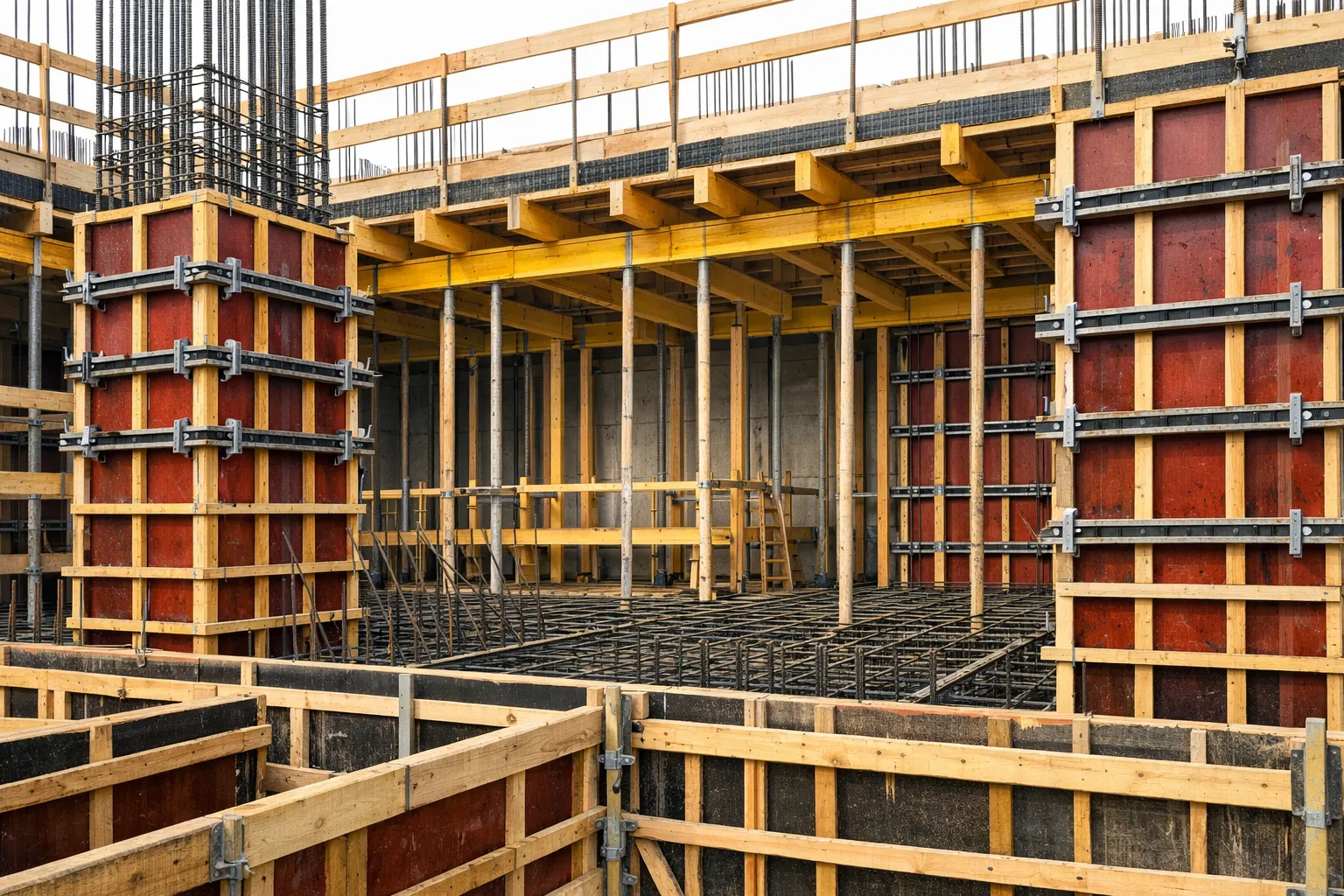
Slab Shuttering
Slab shuttering is used to support horizontal concrete slabs. It involves a combination of panels and supports to distribute the load evenly.
Beam Shuttering
Beam shuttering is designed to support beams during construction. It must handle both vertical and lateral loads effectively.
Column Shuttering
Column shuttering is used for vertical structural elements. It requires precise alignment to ensure structural accuracy.
Footing Shuttering
Footing shuttering is used at the base of structures. It defines the shape and size of the foundation.
Wall Shuttering
Wall shuttering is used for vertical concrete walls. It ensures proper thickness and alignment during construction.
Materials Used in Shuttering
Timber and Wood Panels
Timber remains a widely used material due to its flexibility and availability. However, it requires proper treatment to prevent moisture damage.
Steel Plates
Steel provides strength and durability, making it ideal for heavy construction projects.
Aluminum Systems
Aluminum systems are preferred for modern construction due to their lightweight nature and efficiency.
Engineered Plastic Systems
Plastic systems are gaining popularity for their reusability and resistance to environmental factors.
Material Comparison
| Material | Durability | Cost | Reusability | Weight |
|---|---|---|---|---|
| Timber | Low | Low | Low | Light |
| Plywood | Medium | Medium | Medium | Light |
| Steel | High | High | Very High | Heavy |
| Aluminum | High | High | Very High | Medium |
| Plastic | Medium | Medium | High | Light |
Key Takeaways
- Shuttering is essential for shaping and supporting concrete structures
- It directly affects structural strength, safety, and finish quality
- Material selection impacts cost, durability, and efficiency
- Proper installation is critical to avoid structural defects
Step-by-Step Shuttering Process
Planning and Design
This process begins with detailed planning based on structural drawings and load calculations. Engineers determine the dimensions, shape, and load-bearing requirements of the structure before selecting the appropriate system.
This stage involves:
- Studying architectural and structural drawings
- Calculating loads from wet concrete and reinforcement
- Selecting suitable materials and systems
- Designing support and bracing arrangements
Accurate planning ensures that the this system can withstand construction loads without deformation. According to guidelines followed by the American Concrete Institute, improper design is one of the leading causes of this failure.
Material Selection
Material selection is critical in determining performance, cost, and durability. The choice depends on project scale, complexity, and reuse requirements.
Key considerations include:
- Load-bearing capacity
- Reusability cycles
- Surface finish requirements
- Availability and cost
For example:
- Timber is suitable for small projects
- Steel and aluminum are preferred for large-scale construction
- Plastic systems are used for repetitive designs
Material selection directly affects efficiency and long-term cost control.
Also Read: South Route : Powerful Strategic Guide to a Transformative & Essential Transport Corridor
Assembly and Installation
Once materials are selected, it is assembled on-site or pre-fabricated and installed according to design specifications.
Steps include:
- Cutting and shaping panels
- Fixing panels into position
- Installing supports and props
- Ensuring tight joints to prevent leakage
Precision during assembly is essential. Even minor gaps can lead to cement slurry leakage, which affects concrete strength and finish quality.
Alignment and Support
Proper alignment ensures that the structure meets design specifications. Supports are installed to carry vertical and lateral loads during concrete pouring.
Important checks:
- Vertical alignment using plumb lines
- Horizontal leveling using spirit levels
- Adequate bracing to prevent movement
Misalignment can lead to structural defects such as uneven surfaces and reduced load-bearing capacity.
Concrete Pouring
Once it is securely installed, concrete is poured into the mold. This stage requires careful monitoring to avoid excessive pressure on this system.
Key practices:
- Pour concrete in layers
- Avoid sudden load concentration
- Use vibration to remove air pockets
The pressure exerted by wet concrete increases with depth, making it essential to ensure strong support systems.
Removal (Stripping Time)
After the concrete gains sufficient strength, this is removed carefully to avoid damage.
The timing depends on:
- Type of structural element
- Concrete grade
- Environmental conditions
Premature removal can lead to cracks or collapse, while delayed removal affects project timelines.
Recommended Shuttering Removal Time
| Structural Element | Minimum Removal Time |
|---|---|
| Walls & Columns | 24–48 hours |
| Slabs (Props Left) | 3–7 days |
| Beam Sides | 2–3 days |
| Beam Soffits | 7–14 days |
| Props to Slabs | 14–21 days |
(Based on standard construction practices and environmental conditions.)
Advantages of Proper Shuttering
Structural Strength
Proper shuttering ensures that concrete sets in the correct shape and alignment, which directly impacts structural strength. Uniform load distribution during curing prevents weak zones and structural defects.
Surface Finish Quality
High-quality shuttering results in smooth and defect-free surfaces. Materials like plywood, steel, and aluminum provide better finishing compared to traditional timber.
Safety and Stability
A well-installed shuttering system prevents collapse during construction. It supports both the weight of wet concrete and construction activities, ensuring worker safety.
Organizations like the Occupational Safety and Health Administration emphasize proper shuttering practices to reduce on-site accidents.
Time Efficiency
Efficient shuttering systems reduce construction time by enabling faster installation and removal. Reusable systems such as aluminum and steel significantly improve productivity.
Key Benefits
- Ensures structural accuracy and strength
- Improves surface finish quality
- Enhances construction safety
- Reduces project delays
- Supports efficient resource utilization
Disadvantages and Challenges
Cost Factors
One of the major challenges in this, is cost. High-quality materials like steel and aluminum require significant initial investment.
Cost components include:
- Material purchase or rental
- Labor charges
- Transportation and handling
Labor Requirements
Its installation requires skilled labor for accurate assembly and alignment. Poor workmanship can lead to structural defects.
Risk of Failure if Poorly Installed
Improper installation can result in:
- Collapse during concrete pouring
- Leakage of cement slurry
- Misalignment of structural elements
According to construction safety data, many on-site failures are linked to it’s inadequate design and execution.
Pros vs Cons
| Advantages | Disadvantages |
|---|---|
| High structural accuracy | High initial cost |
| Better surface finish | Skilled labor required |
| Improved safety | Risk if poorly installed |
| Reusability (modern systems) | Maintenance needed |
Shuttering Cost Analysis
Cost per Square Foot/Meter
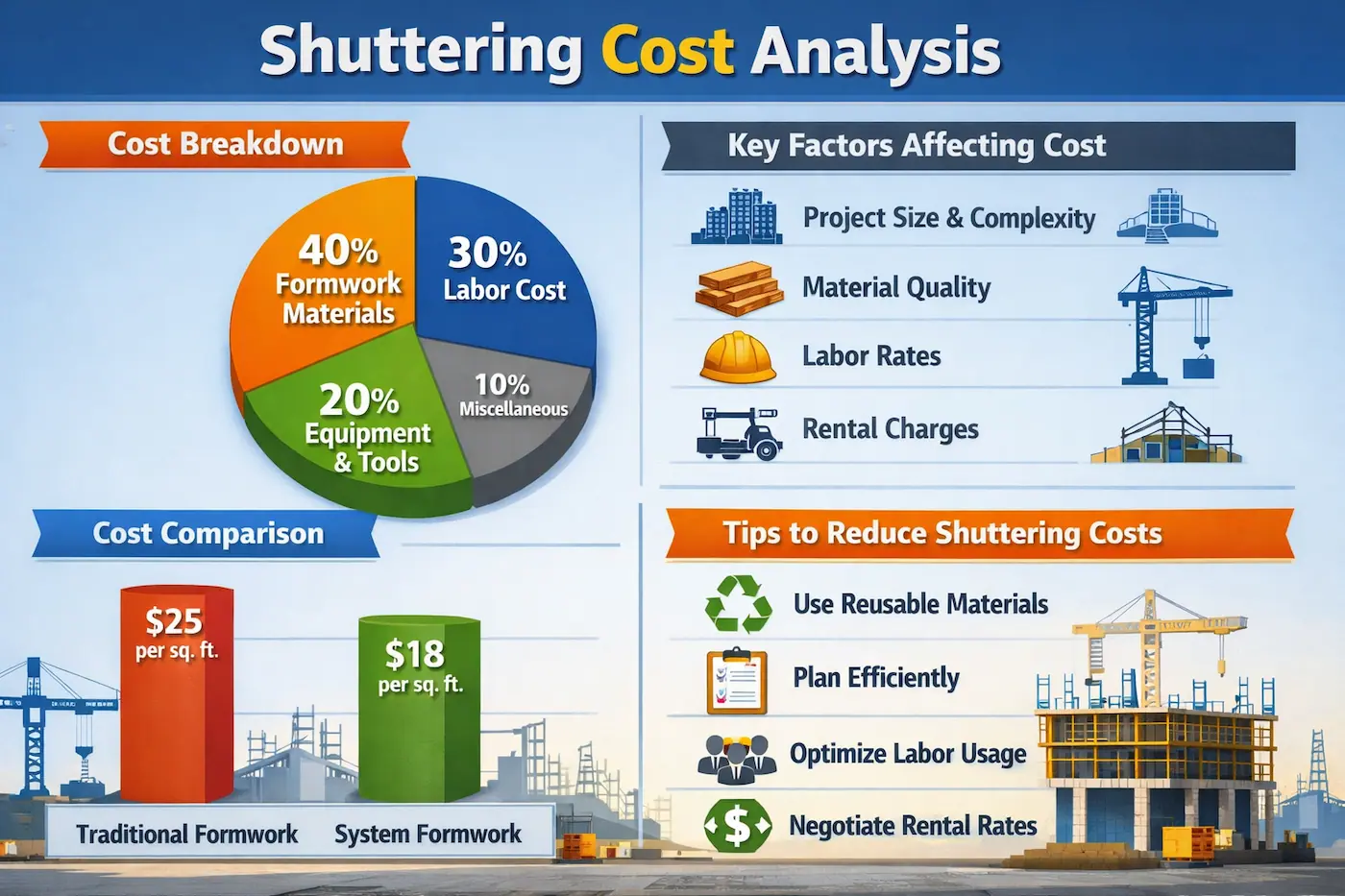
The cost of it varies depending on material and location. On average:
- Timber: Low cost
- Plywood: Moderate cost
- Steel/Aluminum: High initial cost but economical in long term
Material Cost Breakdown
Material costs depend on:
- Quality and thickness
- Reusability cycles
- Availability in the local market
Labor and Equipment Cost
Labor costs include:
- Assembly and installation
- Alignment and inspection
- Removal and maintenance
Factors Affecting Cost
- Project size and complexity
- Type of structure
- Material selection
- Labor availability
- Reusability potential
Estimated Cost Comparison
| Material | Initial Cost | Reusability | Long-Term Cost Efficiency |
|---|---|---|---|
| Timber | Low | Low | Low |
| Plywood | Medium | Medium | Moderate |
| Steel | High | Very High | High |
| Aluminum | High | Very High | Very High |
Safety Guidelines in Shuttering Work
Load-Bearing Considerations
- Weight of wet concrete
- Reinforcement bars
- Workers and equipment
Failure to account for these loads can result in collapse.
Inspection and Quality Checks
Regular inspections ensure structural stability. Checks include:
- Tightness of joints
- Alignment accuracy
- Strength of supports
Worker Safety Measures
Safety measures include:
- Use of protective equipment
- Proper training
- Secure working platforms
Guidelines from the International Labour Organization emphasize strict adherence to safety protocols in construction activities.
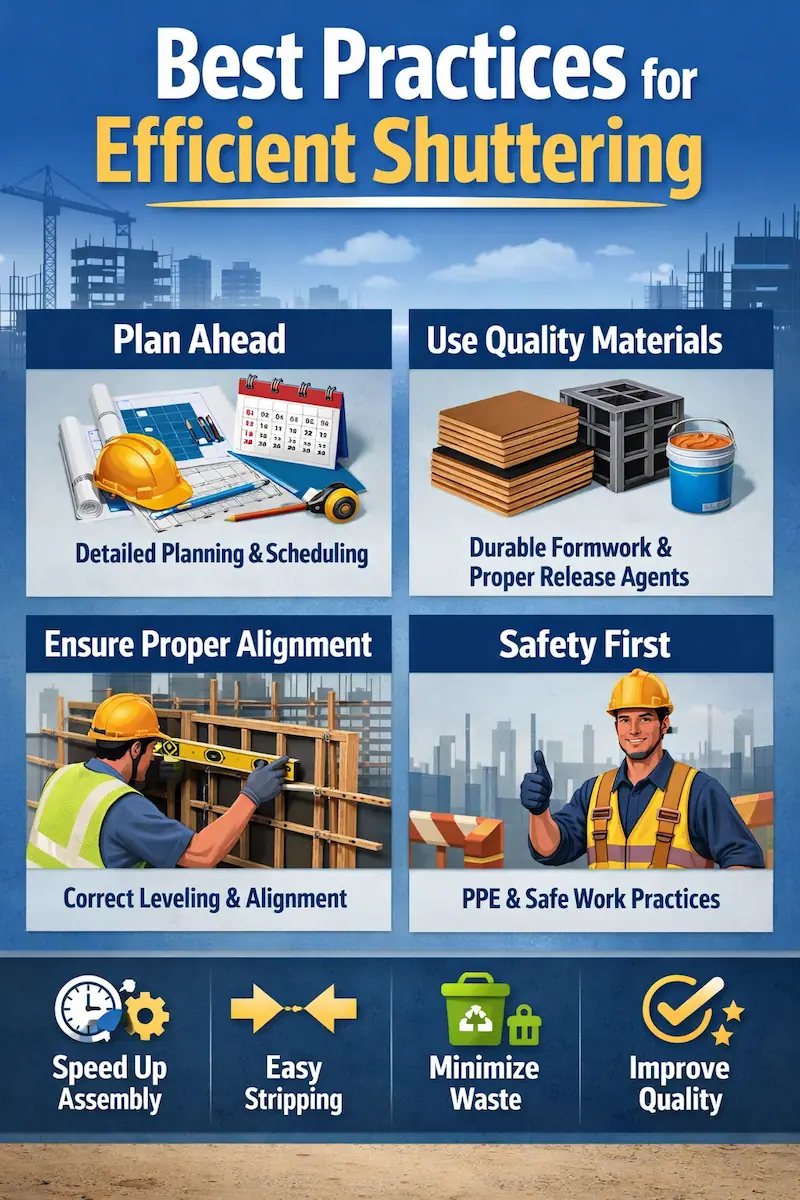
Best Practices for Efficient Shuttering
Reusability Optimization
Using durable materials like steel and aluminum increases reusability, reducing long-term costs.
Minimizing Leakage
Proper sealing of joints prevents leakage of cement slurry, ensuring better concrete strength.
Proper Alignment Techniques
Accurate alignment ensures structural integrity and reduces the need for rework.
Use of Modern Systems
Modern systems improve efficiency and reduce labor dependency. Advanced techniques are widely adopted in large-scale projects.
Key Takeaway
- Material choice directly impacts cost and performance
- Accurate alignment and timely removal are critical
- Modern systems enhance productivity and reduce errors
Modern Innovations in Shuttering
Modular Formwork Systems
Modern construction has shifted toward modular systems that allow faster assembly, higher precision, and improved efficiency. These systems consist of pre-engineered panels and components that can be reused multiple times with minimal adjustments.
Key features:
- Standardized panel sizes
- Quick locking mechanisms
- Reduced labor dependency
- High dimensional accuracy
Modular shuttering systems are widely used in large infrastructure and commercial projects due to their ability to speed up construction cycles while maintaining consistent quality. According to engineering practices aligned with the American Concrete Institute, modular systems significantly reduce on-site errors and material wastage.
Aluminum Formwork Systems (Mivan Technology)
Aluminum shuttering, commonly associated with Mivan technology, is one of the most advanced systems used in modern construction. It is particularly effective in high-rise buildings and mass housing projects.
Key advantages:
- Lightweight yet strong
- High reusability (100+ cycles)
- Fast construction speed
- Smooth surface finish (reduces plastering work)
This system allows entire structural units such as walls and slabs to be cast in a single operation, improving efficiency and reducing construction time significantly.
Organizations like the Institution of Civil Engineers recognize aluminum systems as a major advancement in improving construction productivity and structural consistency.
Prefabricated Shuttering Systems
Prefabricated shuttering involves manufacturing components off-site and assembling them on-site. This approach enhances quality control and reduces construction time.
Benefits include:
- Reduced on-site labor
- Improved precision and quality
- Faster project completion
- Lower material wastage
Prefabrication is increasingly adopted in urban construction projects where speed and efficiency are critical.
Conclusion
This is remains one of the most fundamental components in modern construction, directly influencing the strength, safety, and durability of concrete structures. From traditional timber systems to advanced aluminum and modular solutions, the evolution of shuttering reflects the industry’s focus on efficiency, precision, and sustainability.
- Accurate structural dimensions
- High-quality surface finishes
- Enhanced safety during construction
- Long-term structural reliability
As construction technologies continue to advance, its modern adaptation systems is becoming essential for meeting industry standards and improving project outcomes. Following established guidelines from recognized organizations ensures that shuttering practices remain safe, efficient, and cost-effective.
Frequently Asked Questions (FAQs)
What is shuttering in construction?
It is a temporary mold or framework used to hold wet concrete in place until it gains sufficient strength. It ensures that concrete structures such as slabs, beams, and columns achieve the desired shape, alignment, and surface finish during curing.
What is the difference between shuttering and formwork?
It refers specifically to the vertical mold used to contain concrete, while formwork is a broader term that includes all temporary molds and supporting systems used in concrete construction. Shuttering is a component of the overall formwork system.
What materials are commonly used in shuttering?
Common materials include:
- Timber and plywood
- Steel
- Aluminum
- Plastic
Each material varies in terms of cost, durability, and reusability, and is selected based on project requirements.
How long should shuttering remain before removal?
The removal time depends on the type of structural element and environmental conditions. Generally:
- Columns and walls: 24–48 hours
- Slabs: 3–7 days (with props)
- Beams: up to 14 days
These timelines are based on standard construction practices.
What is the cost of shuttering per square foot?
The cost varies depending on material, labor, and project complexity. Timber shuttering is relatively low-cost, while steel and aluminum systems have higher initial costs but offer better long-term value due to reusability.
Which type of shuttering is best?
There is no single “best” type. The choice depends on:
- Project size
- Budget
- Required surface finish
- Reusability needs
Aluminum and steel systems are preferred for large projects, while timber is suitable for smaller works.
Why is shuttering important in construction?
It is essential because it:
- Maintains structural shape and alignment
- Supports wet concrete
- Ensures safety during construction
- Improves final surface quality
Without proper shuttering, concrete structures cannot achieve the required strength and stability.