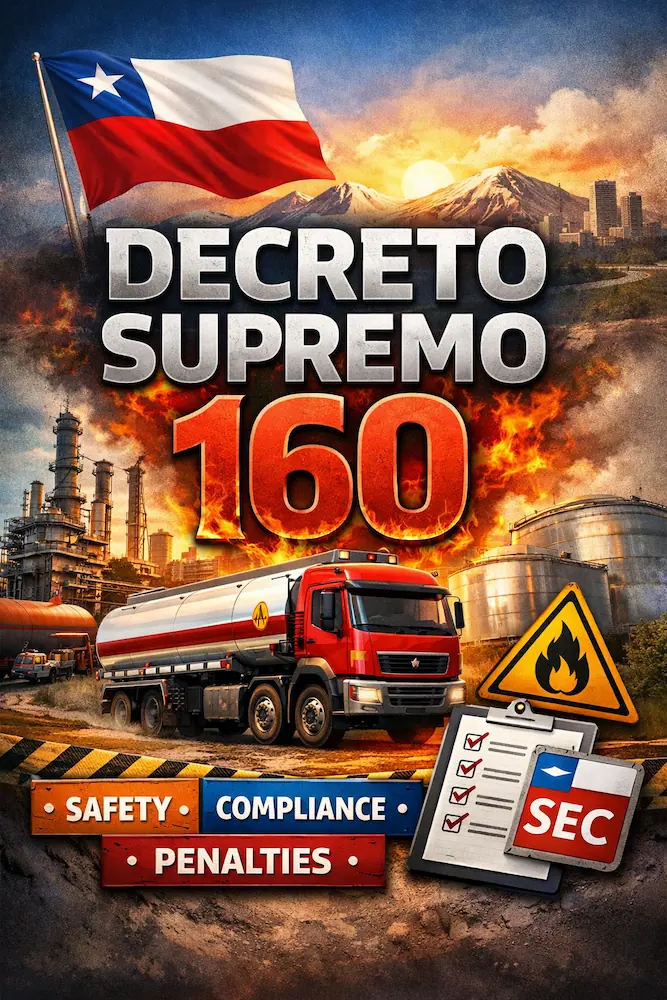
Decreto Supremo 160 is a key regulation issued by the Gobierno de Chile that establishes strict rules for the storage, handling, transportation, and safety of liquid fuels. It is primarily enforced by the Superintendencia de Electricidad y Combustibles to ensure safe fuel operations across Chile.
In simple terms, Decreto Supremo 160 is the legal framework that ensures fuel-related activities are conducted safely, efficiently, and in compliance with national standards.
Purpose and Legal Scope
The main purpose of Decreto Supremo 160 is to regulate all aspects of fuel management to reduce risks and protect both people and the environment. This includes:
- Preventing accidents such as fires and explosions
- Ensuring proper installation of fuel systems
- Regulating fuel transport and storage facilities
- Establishing safety protocols for workers
The regulation applies to:
- Fuel companies
- Industrial facilities
- Transportation operators
- Storage and distribution centers
It operates under the authority of the Ministerio de Energía, which defines national energy policies and safety standards.
Why Decreto Supremo 160 Matters
Decreto Supremo 160 plays a critical role in maintaining public safety and industrial reliability. Without such regulation, fuel-related operations could pose serious risks.
Key reasons why it matters:
- Safety Assurance: Reduces risks of hazardous incidents
- Legal Compliance: Businesses must follow it to operate legally
- Environmental Protection: Minimizes fuel leaks and contamination
- Operational Standards: Ensures uniform procedures across industries
Summary
Decreto Supremo 160 is a Chilean legal regulation that governs fuel safety, covering storage, transport, and handling, enforced by national authorities to ensure compliance and risk prevention.
Key Takeaways
- Decreto Supremo 160 regulates fuel-related activities in Chile
- It focuses on safety, compliance, and environmental protection
- Enforced by the Superintendencia de Electricidad y Combustibles
- Applies to multiple industries dealing with fuels
Pros / Cons
Pros
- Enhances safety standards
- Reduces environmental risks
- Creates clear legal structure
Cons
- Requires strict compliance efforts
- Can increase operational costs for businesses
Common Misconceptions
- It only applies to large fuel companies
It applies to any entity handling fuels - It is optional
It is legally mandatory in Chile
Background of Decreto Supremo 160 in Chile
Regulatory History
Decreto Supremo 160 was introduced as part of Chile’s effort to modernize and strengthen its fuel safety and energy regulations. As fuel consumption and industrial activities expanded, the need for a structured legal framework became essential to prevent accidents and ensure consistent operational standards.
Historically, Chile relied on fragmented safety rules. However, with increasing risks in fuel storage and transportation, Decreto Supremo 160 was established to unify regulations under one comprehensive system. This allowed authorities to standardize safety practices across all sectors dealing with liquid fuels.
Role of Ministerio de Energía
The Ministerio de Energía plays a central role in shaping and updating Decreto Supremo 160. It is responsible for:
- Developing national energy policies
- Setting safety and operational standards
- Coordinating with regulatory bodies
- Ensuring alignment with international best practices
Through this ministry, the Chilean government ensures that Decreto Supremo 160 remains relevant and effective in addressing modern energy challenges.
Evolution of Fuel Safety Laws
Over time, Decreto Supremo 160 has evolved to reflect:
- Advances in fuel technology
- Increased environmental awareness
- Stricter industrial safety expectations
Regulatory enforcement is primarily handled by the Superintendencia de Electricidad y Combustibles, which conducts inspections and ensures compliance.
This evolution has helped Chile:
- Reduce fuel-related accidents
- Improve workplace safety
- Strengthen environmental protections
Today, Decreto Supremo 160 is considered a foundational regulation in Chile’s energy and safety landscape, forming the basis for how fuel-related operations are managed nationwide.
Summary
The background of Decreto Supremo 160 reflects Chile’s shift toward unified and modern fuel safety regulations, driven by government authorities and evolving industry needs.
Key Takeaways
- Decreto Supremo 160 was created to unify fuel regulations
- Developed under the Ministerio de Energía
- Enforced by the Superintendencia de Electricidad y Combustibles
- Continuously updated to match modern safety standards
Common Misconceptions
- It has remained unchanged since creation
It has evolved over time with new safety requirements - It only addresses technical issues
It also covers legal, environmental, and operational aspects
Key Objectives of Decreto Supremo 160
Safety Standards
One of the primary objectives of Decreto Supremo 160 is to establish strict safety standards for all fuel-related activities. These standards are designed to minimize risks such as fires, explosions, and hazardous leaks.
The regulation ensures that:
- Fuel storage tanks meet technical safety requirements
- Equipment is regularly inspected and maintained
- Workers follow defined safety protocols
- Emergency systems are always in place
By enforcing these measures, Decreto Supremo 160 helps create a safer working environment across all fuel-handling industries in Chile.
Environmental Protection
Another key objective of Decreto Supremo 160 is to protect the environment from fuel-related hazards. Improper handling of fuels can lead to soil contamination, water pollution, and air quality issues.
To address this, the regulation focuses on:
- Preventing fuel spills and leaks
- Ensuring proper waste management
- Promoting environmentally safe storage systems
- Reducing emissions from fuel operations
These environmental safeguards align with national policies set by the Ministerio de Energía and other regulatory authorities.
Industry Regulation
Decreto Supremo 160 also plays a critical role in regulating industries that deal with fuels. It provides a clear legal framework that businesses must follow to operate legally and efficiently.
This includes:
- Defining operational standards
- Requiring licenses and permits
- Establishing inspection procedures
- Ensuring accountability through enforcement
The Superintendencia de Electricidad y Combustibles oversees compliance and ensures that all entities adhere to the regulation.
Summary
Decreto Supremo 160 aims to ensure safety, protect the environment, and regulate fuel-related industries through clear and enforceable standards.
Key Takeaways
- Decreto Supremo 160 prioritizes safety in fuel operations
- It includes strong environmental protection measures
- It provides a structured regulatory framework for industries
- Enforcement is handled by national authorities
Pros / Cons
Pros
- Reduces accident risks
- Protects natural resources
- Creates clear industry standards
Cons
- Requires strict compliance
- Can increase operational responsibilities
Common Mistakes
- Ignoring environmental requirements
- Failing to maintain safety equipment
- Not updating compliance procedures regularly
Main Regulations Under Decreto Supremo 160
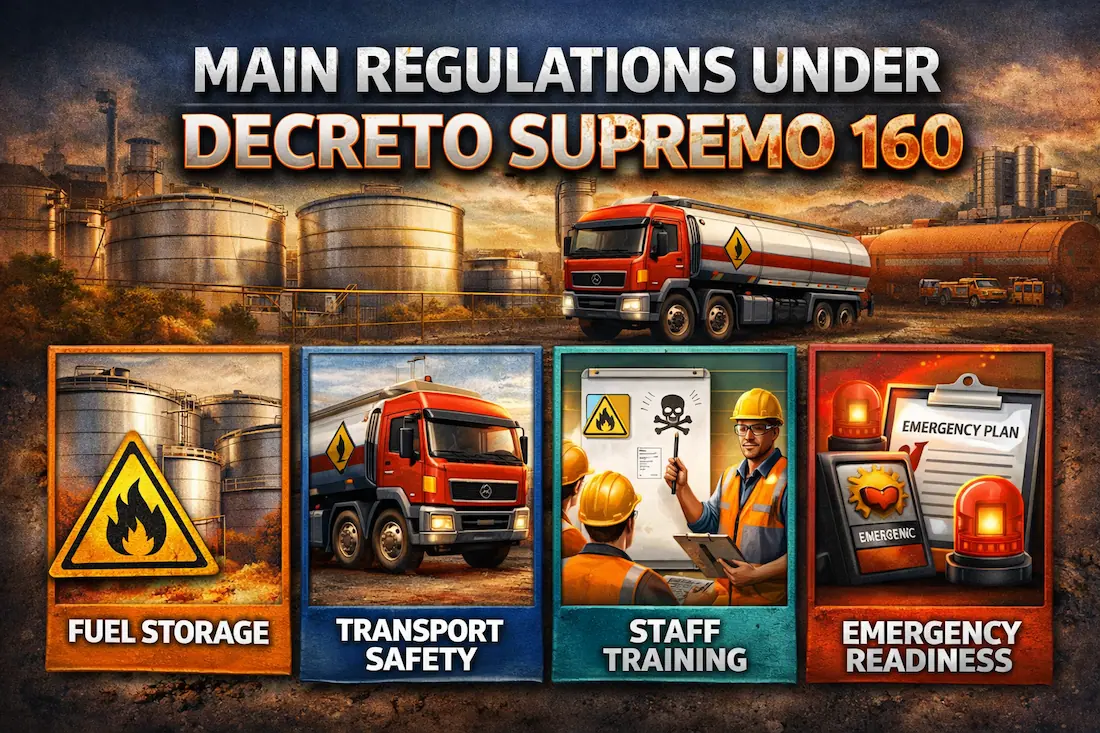
Fuel Storage Requirements
Decreto Supremo 160 establishes strict rules for the safe storage of liquid fuels to prevent accidents and environmental damage. These requirements apply to all facilities handling fuels, from small storage units to large industrial tanks.
Key storage regulations include:
- Use of approved and certified storage tanks
- Installation of leak detection systems
- Proper ventilation to avoid vapor buildup
- Safe distance between tanks and populated areas
- Regular inspection and maintenance schedules
These measures ensure that fuel storage systems operate safely and reduce the risk of hazardous incidents.
Transportation Rules
Transportation of fuels is a high-risk activity, and Decreto Supremo 160 provides clear guidelines to ensure safety during transit.
The regulation requires:
- Use of authorized and properly labeled transport vehicles
- Compliance with safety standards for fuel containers
- Driver training for handling hazardous materials
- Emergency response plans in case of accidents
These rules help minimize risks associated with fuel movement across Chile.
Installation Standards
Proper installation of fuel systems is critical under Decreto Supremo 160. The regulation ensures that all infrastructure is designed and built according to strict technical standards.
Equipment Requirements
All equipment used in fuel systems must:
- Meet certified quality standards
- Be resistant to corrosion and pressure
- Include safety valves and control systems
- Be compatible with the type of fuel handled
Technical Specifications
The regulation also defines detailed technical specifications, including:
- Tank design and capacity limits
- Pipeline construction standards
- Pressure control mechanisms
- Fire prevention systems
These specifications ensure that installations are safe, reliable, and compliant with national regulations enforced by the Superintendencia de Electricidad y Combustibles.
| Regulation Area | Key Requirement | Purpose |
|---|---|---|
| Storage | Certified tanks & inspections | Prevent leaks and accidents |
| Transport | Authorized vehicles & trained staff | Ensure safe fuel movement |
| Installation | Technical standards & safety systems | Maintain operational safety |
Summary
Decreto Supremo 160 defines detailed regulations for fuel storage, transportation, and installation to ensure safety, compliance, and risk prevention.
Key Takeaways
- Decreto Supremo 160 covers storage, transport, and installation rules
- Requires certified equipment and trained personnel
- Includes strict technical and safety specifications
- Enforced by national regulatory authorities
Common Mistakes
- Using non-certified storage equipment
- Ignoring transport safety protocols
- Improper installation of fuel systems
Compliance Requirements in Decreto Supremo 160
Who Must Comply
Decreto Supremo 160 applies to all individuals and organizations involved in the storage, handling, transportation, and distribution of liquid fuels in Chile.
Entities required to comply include:
- Fuel distribution companies
- Industrial facilities using fuels
- Transport operators handling fuel logistics
- Storage terminal operators
- Service stations and fuel retailers
In simple terms, if an entity deals with fuels in any capacity, compliance with Decreto Supremo 160 is mandatory.
Licensing and Permits
To legally operate under Decreto Supremo 160, businesses must obtain proper licenses and approvals from regulatory authorities. These permits ensure that operations meet safety and technical standards before they begin.
Key licensing requirements include:
- Authorization for fuel storage facilities
- Approval of installation designs and infrastructure
- Certification of equipment and systems
- Operational permits for transport and distribution
These approvals are overseen by the Superintendencia de Electricidad y Combustibles, which ensures that all conditions are met before granting permission.
Inspection Procedures
Regular inspections are a core part of Decreto Supremo 160 compliance. These inspections are designed to verify that facilities and operations continue to meet safety standards.
Inspection processes typically include:
- Evaluation of storage systems and tanks
- Verification of safety equipment functionality
- Review of maintenance records
- Assessment of staff training and procedures
Inspections can be scheduled or unannounced, depending on risk levels and regulatory priorities.
Role of Superintendencia de Electricidad y Combustibles
The Superintendencia de Electricidad y Combustibles (SEC) is the main authority responsible for enforcing Decreto Supremo 160.
Its responsibilities include:
- Granting licenses and permits
- Conducting inspections and audits
- Investigating violations
- Imposing penalties for non-compliance
The SEC ensures that all fuel-related operations align with national safety and regulatory standards.
| Requirement | Description | Authority |
|---|---|---|
| Licensing | Approval to operate fuel-related activities | SEC |
| Permits | Authorization for installations and transport | SEC |
| Inspections | Regular safety and compliance checks | SEC |
| Certification | Equipment and system validation | SEC |
Summary
Decreto Supremo 160 requires all fuel-related entities to obtain licenses, follow strict safety standards, and undergo regular inspections enforced by the SEC.
Key Takeaways
- Compliance with Decreto Supremo 160 is legally mandatory
- Applies to all fuel-related businesses and operations
- Requires licensing, permits, and certifications
- Regular inspections ensure ongoing compliance
Common Mistakes
- Operating without proper permits
- Failing inspections due to poor maintenance
- عدم updating safety documentation regularly
- Ignoring regulatory changes
Safety Standards Defined by Decreto Supremo 160
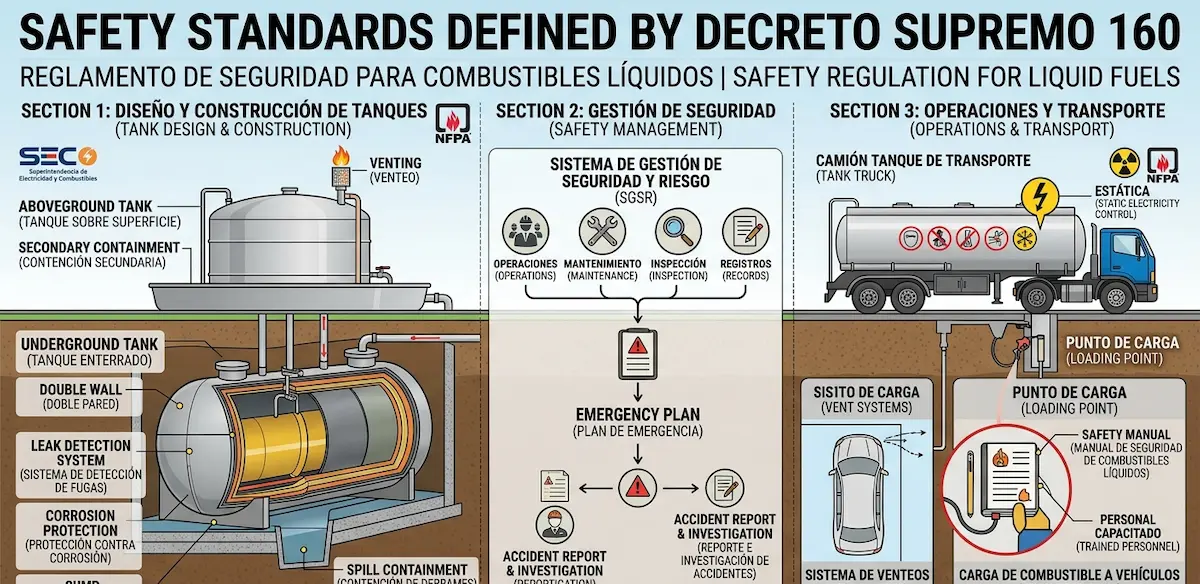
Risk Prevention Measures
A core focus of Decreto Supremo 160 is to minimize risks associated with fuel handling and storage. Since fuels are highly flammable and hazardous, strict preventive measures are required across all operations.
Key risk prevention measures include:
- Installation of fire detection and suppression systems
- Use of leak detection technologies
- Proper labeling of hazardous materials
- Maintaining safe distances between fuel facilities and populated areas
- Routine safety audits and equipment checks
These measures significantly reduce the likelihood of accidents and ensure safer operational environments across Chile.
Emergency Protocols
Decreto Supremo 160 requires all fuel-related facilities to have well-defined emergency response plans. These protocols are critical in minimizing damage in case of incidents such as fires, spills, or explosions.
Essential emergency requirements include:
- Clearly documented emergency procedures
- Availability of firefighting equipment
- Staff training for emergency response
- Immediate reporting of incidents to authorities
- Evacuation plans for workers and nearby areas
These protocols are monitored and enforced by the Superintendencia de Electricidad y Combustibles to ensure readiness at all times.
Workplace Safety
Ensuring worker safety is another major objective of Decreto Supremo 160. Employees working with fuels are exposed to significant risks, making safety training and protective measures essential.
Workplace safety requirements include:
- Use of personal protective equipment (PPE)
- Regular safety training programs
- Clear operational guidelines and procedures
- Monitoring exposure to hazardous substances
- Maintaining safe working conditions
These standards align with national policies set by the Ministerio de Energía and broader industrial safety practices.
| Safety Area | Requirement | Purpose |
|---|---|---|
| Risk Prevention | Leak detection & fire systems | Prevent accidents |
| Emergency Plans | Response procedures & training | Reduce damage |
| Workplace Safety | PPE & staff training | Protect workers |
Summary
Decreto Supremo 160 defines strict safety standards focused on risk prevention, emergency preparedness, and worker protection in all fuel-related operations.
Key Takeaways
- Decreto Supremo 160 emphasizes strong safety measures
- Requires emergency response planning
- Protects workers through training and equipment
- Enforced through inspections and compliance checks
Common Mistakes
- عدم maintaining emergency equipment
- Lack of employee training
- Ignoring regular safety inspections
- Poor implementation of risk prevention systems
Penalties and Violations Under Decreto Supremo 160
Common Violations
Under Decreto Supremo 160, violations occur when companies or individuals fail to follow required fuel safety, storage, transport, or operational standards. These violations are taken seriously due to the high risk of fire, explosions, and environmental damage.
Common violations include:
- Operating fuel facilities without proper authorization
- Using non-certified storage tanks or equipment
- Ignoring mandatory safety inspections
- Improper handling or transport of fuels
- Lack of emergency response systems
- Failure to train staff in safety procedures
Such violations directly increase risks to public safety and the environment in Chile.
Also Read: Punjab Kings vs Chennai Super Kings Timeline: Ultimate Dominant & Explosive IPL Rivalry Guide
Fines and Legal Actions
When violations of Decreto Supremo 160 are detected, the Superintendencia de Electricidad y Combustibles has the authority to apply penalties.
Possible consequences include:
- Monetary fines (vary depending on severity)
- Temporary suspension of operations
- Closure of non-compliant facilities
- Revocation of licenses and permits
- Mandatory corrective actions
In serious cases, legal action may also be taken if negligence leads to accidents or environmental damage.
Business Consequences
Non-compliance with Decreto Supremo 160 can have significant long-term effects on businesses beyond immediate penalties.
Key impacts include:
- Loss of operational reputation
- Increased insurance costs
- Delays in business expansion or approvals
- Financial losses due to shutdowns
- Reduced trust from clients and partners
For industries dealing with fuels, compliance is not optional—it is essential for survival and long-term stability.
Penalties Table
| Violation Type | Possible Penalty | Authority |
|---|---|---|
| No license | Fines + shutdown | SEC |
| Safety breach | Suspension | SEC |
| Equipment failure | Corrective orders | SEC |
| Severe negligence | Legal action | SEC / Courts |
Summary
Decreto Supremo 160 enforces strict penalties for violations, including fines, suspensions, and shutdowns to ensure safety and regulatory compliance.
Key Takeaways
- Violations include unsafe fuel handling and lack of permits
- SEC enforces penalties under Decreto Supremo 160
- Consequences range from fines to facility shutdowns
- Non-compliance can severely impact business operations
Common Mistakes
- Ignoring inspection requirements
- Using uncertified equipment
- Delaying corrective actions after warnings
- Underestimating regulatory enforcement
Industries Affected by Decreto Supremo 160
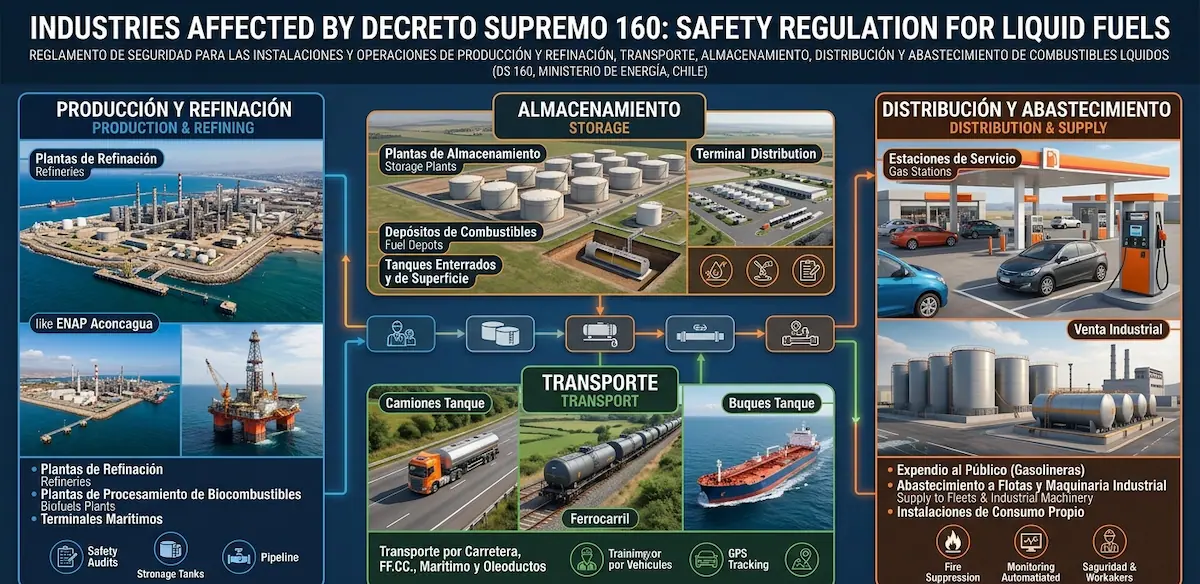
Fuel Companies
One of the main sectors impacted by Decreto Supremo 160 is the fuel industry itself. Companies involved in importing, storing, refining, and distributing fuels must follow strict safety and operational rules.
These companies must ensure:
- Safe storage of large fuel volumes
- Certified infrastructure and equipment
- Continuous safety monitoring systems
- Compliance with inspection schedules
Because of the high-risk nature of their operations, fuel companies are closely monitored by the Superintendencia de Electricidad y Combustibles.
Transport Sector
The transport sector plays a critical role in moving fuels across regions in Chile. Under Decreto Supremo 160, transport operators must meet strict safety requirements to prevent leaks, spills, and accidents.
Key requirements include:
- Use of approved fuel transport vehicles
- Proper labeling and hazard identification
- Driver training for hazardous materials handling
- Emergency response readiness during transit
Even small mistakes in transport can lead to serious environmental and safety risks.
Industrial Facilities
Industries that use fuel for production, energy generation, or machinery operations are also regulated under Decreto Supremo 160. These include manufacturing plants, mining operations, and energy facilities.
They are required to:
- Maintain safe fuel storage systems on-site
- Conduct regular safety inspections
- Train workers in fuel handling procedures
- Implement emergency shutdown systems
These measures ensure safe and continuous industrial operations under national safety laws.
Industry Impact Table
| Industry | Main Responsibility | Compliance Focus |
|---|---|---|
| Fuel Companies | Storage & distribution | Safety & infrastructure |
| Transport Sector | Fuel movement | Vehicle safety & training |
| Industrial Facilities | Fuel usage | Workplace safety |
Summary
Decreto Supremo 160 affects multiple industries including fuel companies, transport operators, and industrial facilities, ensuring safe and regulated fuel handling across all sectors.
Key Takeaways
- Affects all sectors dealing with fuel
- Fuel companies face the strictest monitoring
- Transport safety is highly regulated
- Industrial users must follow strict on-site safety rules
Common Mistakes
- Assuming only fuel companies are regulated
- Ignoring transport safety requirements
- Lack of internal safety audits in industries
Step-by-Step Guide to Comply With Decreto Supremo 160
Step 1: Initial Assessment
The first step in complying with Decreto Supremo 160 is to evaluate your current fuel-related operations. This helps identify gaps between existing practices and legal requirements.
You should:
- Review fuel storage systems
- Check safety equipment condition
- Identify operational risks
- Compare current practices with regulatory standards
This step is essential for understanding your compliance level under Decreto Supremo 160 in Chile.
Step 2: Documentation
Proper documentation is a legal requirement under Decreto Supremo 160. All fuel-related activities must be recorded and available for inspection.
Key documents include:
- Facility design and installation plans
- Safety inspection reports
- Equipment certification records
- Employee training logs
- Emergency response procedures
These documents are often reviewed by the Superintendencia de Electricidad y Combustibles during audits.
Step 3: Safety Implementation
After documentation, businesses must implement required safety measures as defined by Decreto Supremo 160.
This includes:
- Installing fire prevention systems
- Adding leak detection mechanisms
- Ensuring proper ventilation systems
- Using certified fuel storage equipment
At this stage, compliance becomes practical and operational, not just theoretical.
Step 4: Inspection Readiness
The final step is preparing for inspections conducted by regulatory authorities. Under Decreto Supremo 160, inspections can occur at any time.
To stay ready, organizations must:
- Maintain updated safety records
- Ensure equipment is fully functional
- Train staff for inspection procedures
- Correct previous violations promptly
Regular readiness ensures smooth approval and avoids penalties.
Compliance Process Table
| Step | Action | Outcome |
|---|---|---|
| Assessment | Identify gaps | Understand compliance needs |
| Documentation | Prepare records | Legal readiness |
| Implementation | Apply safety systems | Operational compliance |
| Inspection | Maintain readiness | Regulatory approval |
Summary
Compliance with Decreto Supremo 160 requires a structured process: assessment, documentation, safety implementation, and continuous inspection readiness.
Key Takeaways
- Compliance is a step-by-step process
- Documentation is legally required
- Safety systems must be properly implemented
- Inspections can happen anytime
Common Mistakes
- Skipping initial risk assessment
- Missing or incomplete documentation
- Delayed safety upgrades
- Poor preparation for inspections
Common Mistakes to Avoid in Decreto Supremo 160 Compliance
Ignoring Safety Protocols
One of the most serious mistakes under Decreto Supremo 160 is neglecting established safety procedures. Many operational failures happen simply because basic safety rules are not followed.
Common issues include:
- Skipping routine safety checks
- Not using required protective equipment
- Overlooking leak detection systems
- Bypassing emergency procedures
These failures significantly increase the risk of accidents and non-compliance in Chile.
Poor Documentation
Proper documentation is a legal requirement under Decreto Supremo 160, yet many organizations fail in this area.
Typical documentation mistakes:
- Missing inspection reports
- Incomplete equipment records
- Lack of employee training logs
- Outdated safety certificates
The Superintendencia de Electricidad y Combustibles often identifies documentation gaps during audits, which can lead to penalties.
Lack of Training
Another major mistake is not providing adequate training to workers handling fuels. Without proper knowledge, employees may unintentionally create dangerous situations.
Training failures include:
- No emergency response training
- Lack of equipment handling instruction
- Infrequent safety refreshers
- Unclear operational guidelines
Under Decreto Supremo 160, training is essential for maintaining workplace safety and compliance.
Delayed Maintenance
Failing to maintain equipment on time is another critical violation. Fuel systems must always be in optimal condition.
Common maintenance issues:
- Ignoring tank inspections
- Delaying repairs on damaged systems
- Not replacing outdated equipment
- Poor monitoring of safety systems
| Mistake | Risk | Outcome |
|---|---|---|
| Ignoring safety protocols | High accident risk | Legal violations |
| Poor documentation | Audit failure | Fines & penalties |
| Lack of training | Human error | Workplace hazards |
| Delayed maintenance | Equipment failure | Safety breaches |
Summary
Most violations of Decreto Supremo 160 come from avoidable mistakes such as poor safety practices, weak documentation, lack of training, and delayed maintenance.
Key Takeaways
- Safety protocols must always be followed
- Documentation is legally mandatory
- Worker training is essential
- Maintenance delays increase risk significantly
Common Misconceptions
- Small errors don’t matter
Even minor violations can lead to penalties - Training is optional
Training is a core compliance requirement
Benefits of Following Decreto Supremo 160
Legal Protection
One of the most important benefits of complying with Decreto Supremo 160 is strong legal protection. Businesses that follow the regulation properly reduce the risk of fines, shutdowns, and legal disputes.
By staying compliant, organizations ensure:
- Full authorization to operate fuel-related activities
- Reduced risk of penalties from regulatory inspections
- Protection from legal action in case of audits
- Clear alignment with national laws in Chile
This legal security is especially important for industries handling hazardous fuels.
Also Read: Slylar Box : Powerful Guide to Unlock Its Amazing Features and Benefits
Improved Safety
Compliance with Decreto Supremo 160 significantly improves overall safety in workplaces and industrial environments. The regulation is designed to prevent accidents before they happen.
Key safety improvements include:
- Reduced risk of fires and explosions
- Better control of fuel leaks and spills
- Safer working conditions for employees
- Reliable emergency response systems
These improvements are continuously monitored by the Superintendencia de Electricidad y Combustibles to ensure proper enforcement.
Business Credibility
Following Decreto Supremo 160 also enhances a company’s reputation and trust in the market. Compliance shows that a business operates responsibly and follows strict safety standards.
Benefits for business credibility include:
- Stronger trust from clients and partners
- Easier approval for new projects and expansions
- Better relationships with regulatory authorities
- Competitive advantage in industrial sectors
In regulated industries, compliance is often a key factor for long-term success and stability.
Benefits Table
| Benefit Area | Advantage | Impact |
|---|---|---|
| Legal Protection | Avoid fines & shutdowns | Business stability |
| Safety | Fewer accidents | Worker protection |
| Credibility | Strong reputation | Growth opportunities |
Summary
Complying with Decreto Supremo 160 provides legal security, improves safety standards, and strengthens business credibility across fuel-related industries.
Key Takeaways
- Compliance prevents legal and financial risks
- Safety standards significantly reduce accidents
- Businesses gain trust and market credibility
- Enforcement ensures consistent industry behavior
Common Misconceptions
- Compliance is only about avoiding fines
It also improves safety and business growth - Only large companies benefit
All fuel-related businesses benefit equally
Decreto Supremo 160 vs Other Safety Regulations
Comparison With International Standards
Decreto Supremo 160 is a national regulation in Chile focused specifically on fuel storage, transport, and handling safety. When compared with international safety frameworks, it shares many similarities but also has unique national requirements.
For example, international standards such as those used in industrial safety systems often emphasize:
- Risk-based safety management
- Environmental protection controls
- Equipment certification standards
- Emergency preparedness systems
Decreto Supremo 160 aligns with these principles but is more operationally detailed for Chile’s fuel industry, making it highly practical for local enforcement.
It is closely monitored by the Superintendencia de Electricidad y Combustibles to ensure alignment with both national and global safety expectations.
Key Differences
While international regulations are often broad and principle-based, Decreto Supremo 160 is more specific and technical.
Main differences include:
- Scope
- International: General industrial safety frameworks
- Decreto Supremo 160: Focused only on fuel-related operations
- Enforcement
- International: Varies by country
- Chile: Strict enforcement by national authority
- Detail Level
- International: Guidelines and principles
- Decreto Supremo 160: Specific technical and operational rules
- Application
- International: Adaptable across industries
- Decreto Supremo 160: Designed specifically for Chile’s fuel sector
Regulatory Alignment
Despite differences, Decreto Supremo 160 is designed to remain compatible with global best practices. It incorporates key elements such as:
- Workplace safety requirements
- Environmental protection measures
- Risk prevention systems
- Inspection and compliance mechanisms
This ensures that industries in Chile operate at a level consistent with international safety expectations while still following national law.
Comparison Table
| Feature | Decreto Supremo 160 | International Standards |
|---|---|---|
| Scope | Fuel-specific | Broad industrial safety |
| Enforcement | National (Chile) | Global/local variation |
| Detail Level | Highly technical | Principle-based |
| Focus | Operational safety | General risk management |
Summary
Decreto Supremo 160 is a Chile-specific fuel safety regulation that aligns with international safety principles but provides more detailed and enforceable operational rules.
Key Takeaways
- Focused specifically on fuel safety in Chile
- More detailed than general international frameworks
- Enforced strictly by national authorities
- Aligns with global safety principles
Common Misconceptions
- It is the same as international safety laws
It is more specific and locally enforced - It only focuses on technical rules
It also includes environmental and operational safety
Frequently Asked Questions
What is Decreto Supremo 160?
Decreto Supremo 160 is a fuel safety regulation in Chile that defines rules for storage, transport, handling, and safety of liquid fuels. It is enforced by the Superintendencia de Electricidad y Combustibles.
Who enforces Decreto Supremo 160?
The regulation is mainly enforced by the Superintendencia de Electricidad y Combustibles (SEC), which is responsible for inspections, permits, and penalties in fuel-related operations.
Who must comply with Decreto Supremo 160?
All organizations involved in fuel-related activities must comply, including:
- Fuel storage companies
- Transport operators
- Industrial facilities
- Service stations
- Distribution centers
What happens if someone violates Decreto Supremo 160?
Violations can lead to:
- Fines
- Suspension of operations
- Facility closure
- License cancellation
- Legal action in severe cases
Why is Decreto Supremo 160 important?
It is important because it:
- Prevents fuel-related accidents
- Protects workers and the environment
- Ensures legal and safe fuel operations
- Standardizes industrial safety practices
Does Decreto Supremo 160 apply outside Chile?
No. Decreto Supremo 160 is specific to Chile, but it is aligned with international safety principles used in similar regulatory systems worldwide.
Is compliance with Decreto Supremo 160 mandatory?
Yes. Compliance is legally mandatory for all fuel-related operations in Chile. Non-compliance can result in serious penalties enforced by the SEC.