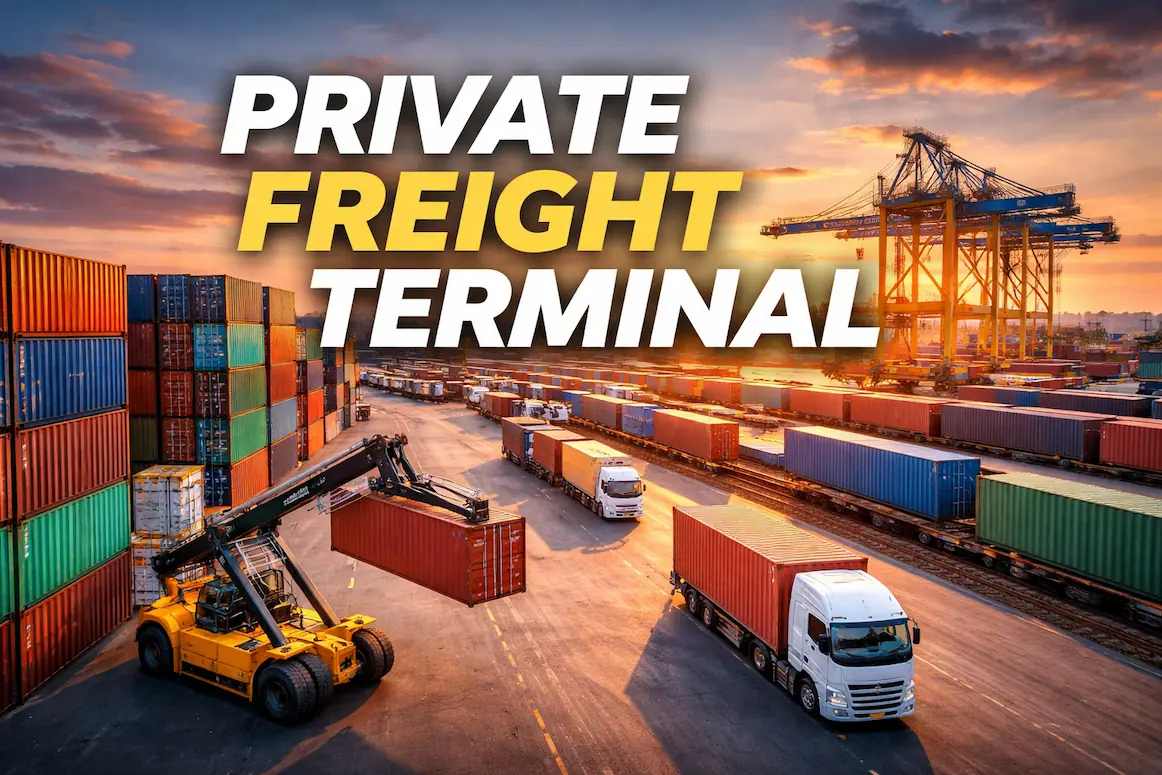
A private freight terminal is a specialized logistics facility owned, operated, or controlled by a private company for the handling, storage, and transfer of goods. It is designed to streamline cargo movement across different transport modes such as rail, road, sea, or air, without relying on publicly managed infrastructure.
Unlike shared logistics hubs, a private freight terminal operates exclusively or primarily for a specific organization or a group of contracted users. This allows greater control over operations, scheduling, and cost efficiency.
According to global logistics standards and practices, a private freight terminal plays a critical role in improving supply chain performance by reducing delays, enhancing cargo security, and optimizing throughput.
Summary
A private freight terminal is a privately owned cargo-handling facility that improves logistics efficiency, control, and operational speed across transportation networks.
Key Takeaways
- A private freight terminal is owned by a private entity
- It handles cargo storage, transfer, and distribution
- It supports multiple transport modes
- It offers greater operational control than public terminals
Key Characteristics
A private freight terminal has several defining features that distinguish it from public logistics infrastructure:
- Exclusive or Controlled Access
Access is limited to the owning company or authorized partners. - Customized Infrastructure
Facilities are tailored to specific cargo types such as containers, bulk goods, or industrial materials. - Integrated Logistics Systems
Advanced tracking, automation, and management systems are often used. - High Efficiency and Speed
Reduced congestion leads to faster cargo handling and turnaround times. - Strategic Location
Typically located near industrial zones, ports, or major transport corridors.
These characteristics make a private freight terminal highly valuable for industries that depend on reliable and fast logistics operations.
Summary
Key characteristics of a private freight terminal include exclusivity, customization, efficiency, and advanced logistics integration.
Key Takeaways
- Offers controlled and secure operations
- Designed for specific business needs
- Improves cargo handling speed
- Uses advanced logistics technologies
How It Differs from Public Freight Terminals
A private freight terminal differs significantly from publicly operated freight terminals in ownership, access, and operational flexibility.
| Feature | Private Freight Terminal | Public Freight Terminal |
|---|---|---|
| Ownership | Private companies | Government or public authorities |
| Access | Restricted | Open to multiple users |
| Efficiency | High (less congestion) | Variable (often crowded) |
| Control | Full operational control | Limited control |
| Customization | Highly customizable | Standardized |
Private freight terminals are commonly used by large logistics firms such as DHL and Maersk, which require dedicated infrastructure to manage global supply chains efficiently.
In contrast, public terminals are managed under regulations set by organizations like the International Maritime Organization and serve a wide range of users.
Summary
A private freight terminal offers exclusive access, higher efficiency, and full control, while public terminals serve multiple users under shared infrastructure.
Key Takeaways
- Private terminals are controlled and efficient
- Public terminals are shared and regulated
- Businesses choose private terminals for better performance
Pros and Cons
Pros
- Faster operations
- Better security
- Customized infrastructure
- Reduced delays
Cons
- High setup cost
- Requires regulatory compliance
- Limited accessibility for third parties
Types of Private Freight Terminals
A private freight terminal can be designed in different forms depending on the mode of transportation, type of cargo, and industry requirements. Each type of private freight terminal serves a specific logistics function and is optimized for efficiency within its operational environment.
Rail-Based Private Freight Terminal
A rail-based private freight terminal is connected directly to railway networks and is primarily used for transporting bulk goods and containerized cargo over long distances
These terminals are commonly operated by major rail logistics providers such as Union Pacific Railroad and private industrial companies that require direct rail access.
Key Features
- Direct rail connectivity
- High-capacity cargo handling
- Ideal for bulk commodities (coal, steel, grain)
- Efficient long-distance transport
Use Case
Manufacturing and heavy industries rely on this type of private freight terminal to move raw materials and finished goods efficiently.
Summary
Rail-based private freight terminals are designed for large-scale, long-distance cargo transport using railway infrastructure.
Key Takeaways
- Best for bulk and heavy cargo
- Reduces road transport costs
- Improves long-distance logistics efficiency
Port-Based Private Freight Terminal
A port-based private freight terminal is located within or near seaports and is used for handling international cargo transported by ships.
Global shipping companies such as Maersk operate private terminals to manage container flows efficiently and reduce dependency on public port congestion.
Key Features
- Located at seaports
- Handles import and export cargo
- Uses container cranes and automation
- Supports global trade operations
Use Case
International trade companies and exporters use this type of private freight terminal for faster customs clearance and cargo handling.
Summary
Port-based private freight terminals handle international cargo and improve efficiency in global shipping operations.
Key Takeaways
- Essential for global trade
- Reduces port congestion delays
- Enhances cargo handling speed
Inland Container Depots (ICDs)
An inland container depot is a type of private freight terminal located away from seaports, often referred to as a “dry port.” It acts as an extension of a seaport by handling container storage, customs clearance, and cargo consolidation.
These terminals are often regulated under international trade frameworks guided by organizations like the World Trade Organization.
Key Features
- Located inland (away from ports)
- Provides customs clearance services
- Reduces congestion at seaports
- Connects rail and road transport
Use Case
Businesses located far from ports use this private freight terminal type to streamline import/export operations.
Summary
Inland container depots function as inland extensions of ports, enabling efficient cargo handling and customs processing.
Key Takeaways
- Supports inland logistics
- Reduces pressure on seaports
- Improves supply chain flexibility
Air Cargo Private Terminals
An air cargo private freight terminal is located at or near airports and is used for handling time-sensitive and high-value goods transported by air.
These terminals often operate under standards set by organizations like the International Air Transport Association.
Key Features
- Located at airports
- Handles high-value and perishable goods
- Fast processing and turnaround
- Advanced security systems
Use Case
E-commerce, pharmaceuticals, and electronics industries depend on this type of private freight terminal for rapid delivery.
Summary
Air cargo private freight terminals enable fast and secure handling of time-sensitive shipments.
Key Takeaways
- Best for urgent shipments
- High security and speed
- Supports global air logistics
| Type | Transport Mode | Best For | Key Advantage |
|---|---|---|---|
| Rail-Based | Rail | Bulk goods | Cost-efficient long-distance transport |
| Port-Based | Sea | International trade | High cargo volume handling |
| Inland Depot | Rail/Road | Inland logistics | Reduces port congestion |
| Air Cargo | Air | Urgent shipments | Fast delivery speed |
Summary
Each type of private freight terminal is designed for a specific logistics function, ensuring optimized cargo handling across different transport modes.
Key Takeaways
- Different types serve different industries
- Selection depends on cargo type and location
- All types improve logistics efficiency
How a Private Freight Terminal Works
A private freight terminal operates as a controlled logistics hub where cargo is received, processed, stored, and dispatched using a structured workflow. The entire system is designed to ensure fast movement of goods, reduced congestion, and optimized supply chain performance.
Unlike public facilities, a private freight terminal follows customized operational procedures defined by the owning organization, allowing greater efficiency and coordination across transport modes such as rail, road, sea, and air.
Cargo Arrival Process
At the entry point of a private freight terminal, cargo arrives through trucks, trains, or containers depending on the terminal type.
Process Overview
- Goods are transported to the terminal gate
- Security and documentation checks are completed
- Cargo is registered into the terminal management system
- Containers or goods are assigned to designated zones
Key Systems Used
- Automated gate entry systems
- RFID and barcode tracking
- Digital freight management platforms
Large logistics operators such as DHL use advanced tracking systems to ensure accurate cargo identification and real-time monitoring.
Also Read: Decreto Supremo 160 : Powerful Essential Guide to Chile’s Critical Fuel Safety Law
Summary
The arrival process in a private freight terminal focuses on secure entry, digital tracking, and structured cargo registration.
Key Takeaways
- Cargo is digitally registered on arrival
- Security checks are mandatory
- Tracking systems ensure visibility
Handling and Storage
Once cargo enters a private freight terminal, it is moved to handling and storage areas depending on its category, urgency, and destination.
Handling Process
- Unloading using cranes, forklifts, or automated systems
- Sorting based on destination or cargo type
- Quality inspection (if required)
Storage Process
- Containers stored in yards or warehouses
- Temperature-controlled storage for sensitive goods
- Segregation based on cargo classification
Companies like Maersk operate advanced container handling systems in their terminals to improve speed and reduce turnaround time.
Summary
Handling and storage in a private freight terminal ensure efficient sorting, safe storage, and organized cargo management.
Key Takeaways
- Automated equipment improves efficiency
- Cargo is categorized before storage
- Specialized storage for sensitive goods
Dispatch and Distribution
The final stage of a private freight terminal operation is dispatching cargo to its destination.
Dispatch Process
- Cargo is assigned to outbound transport (truck, rail, ship, or aircraft)
- Final documentation and clearance are completed
- Loading onto transport vehicles using automated systems
- Real-time tracking activated for delivery
Distribution Channels
- Domestic transport networks
- International shipping routes
- Intermodal logistics systems
Summary Box
Dispatch and distribution ensure cargo leaves the private freight terminal efficiently and reaches its destination through optimized transport routes.
Key Takeaways
- Cargo is assigned to outbound transport
- Documentation is finalized before departure
- Tracking continues until delivery
Step-by-Step Workflow of a Private Freight Terminal
| Step | Stage | Description |
|---|---|---|
| 1 | Arrival | Cargo enters terminal via transport mode |
| 2 | Verification | Security and documentation checks |
| 3 | Registration | Cargo logged into system |
| 4 | Unloading | Physical handling of goods |
| 5 | Sorting | Classification based on destination/type |
| 6 | Storage | Temporary warehousing or yard storage |
| 7 | Dispatch | Cargo loaded for outbound transport |
| 8 | Tracking | Real-time monitoring until delivery |
Summary
The workflow of a private freight terminal is a structured process designed to ensure efficient cargo movement from arrival to final dispatch.
Key Takeaways
- Operations follow a fixed sequence
- Digital systems manage tracking
- Efficiency depends on coordination between stages
Role of Technology in Operations
Modern private freight terminals heavily rely on technology to improve speed, accuracy, and transparency.
Technologies Used
- AI-based logistics planning
- IoT-enabled cargo tracking
- Automated cranes and robotics
- Warehouse management systems (WMS)
These technologies help reduce human error and improve operational efficiency across the entire supply chain.
Summary
Technology plays a central role in optimizing the efficiency of a private freight terminal through automation and real-time tracking.
Key Takeaways
- Automation reduces delays
- Real-time tracking improves visibility
- AI enhances logistics planning
Key Components of a Private Freight Terminal
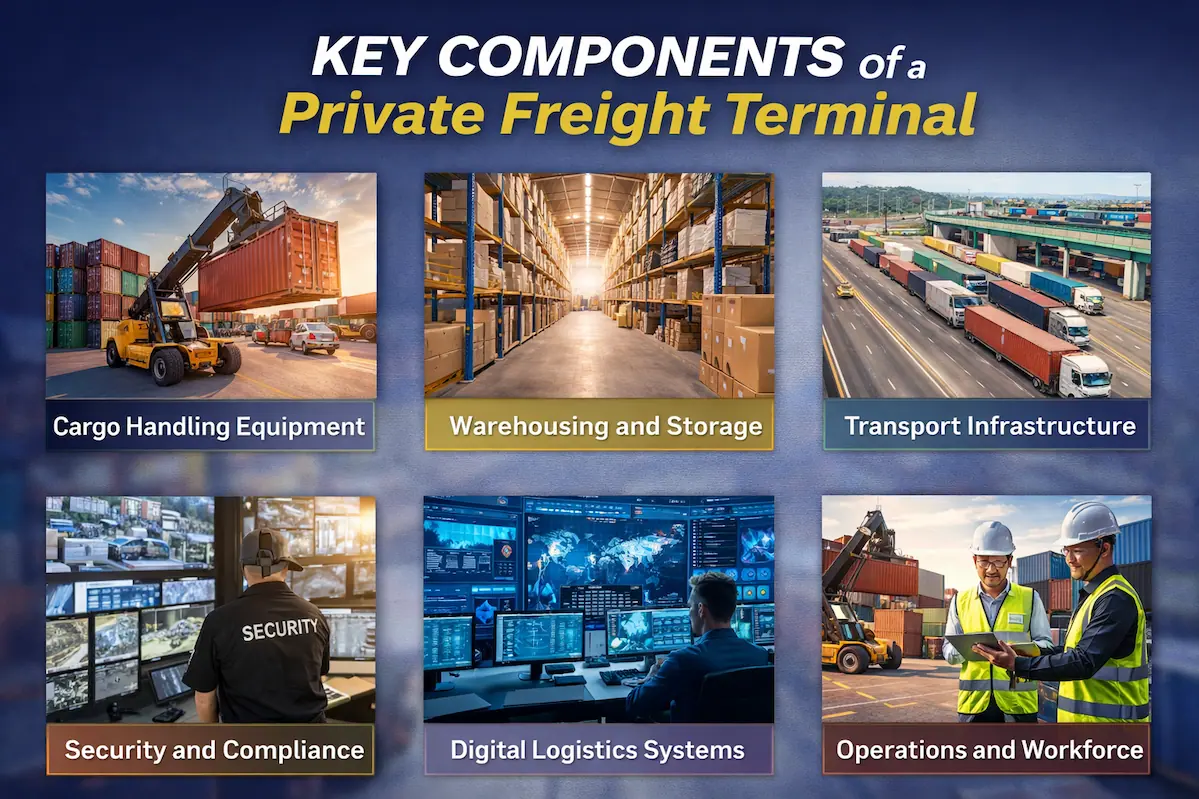
A private freight terminal is a complex logistics infrastructure system made up of multiple physical, operational, and technological components. Each component plays a critical role in ensuring smooth cargo movement, efficient storage, and fast distribution across supply chains.
Understanding these components is essential to evaluate how a private freight terminal achieves high efficiency and operational control compared to public logistics facilities.
Infrastructure Elements
The physical infrastructure of a private freight terminal forms the backbone of its operations. It is designed to handle large volumes of cargo with minimal delays.
Core Infrastructure Includes:
- Container yards for stacking and organizing cargo
- Warehouses for short-term and long-term storage
- Rail sidings for direct train connectivity
- Truck docking bays for road transport integration
- Weighbridges for cargo weight verification
- Security checkpoints for controlled access
These infrastructure elements are strategically designed to reduce bottlenecks and improve cargo flow efficiency within the terminal.
Summary Box
Infrastructure in a private freight terminal ensures structured cargo movement, secure handling, and multimodal transport connectivity.
Key Takeaways
- Designed for high-volume cargo handling
- Supports rail, road, and sometimes sea connectivity
- Focuses on efficiency and congestion reduction
Cargo Handling Equipment
A private freight terminal relies heavily on advanced mechanical and automated equipment to move and manage goods efficiently.
Common Equipment Includes:
- Gantry cranes for container lifting
- Forklifts for pallet movement
- Reach stackers for container stacking
- Conveyor systems for automated movement
- Automated guided vehicles (AGVs) in advanced terminals
Companies like Maersk and other global logistics operators use advanced cargo handling systems to reduce turnaround time and improve operational precision.
Summary
Cargo handling equipment in a private freight terminal ensures fast, safe, and efficient movement of goods within the facility.
Key Takeaways
- Automation reduces manual labor
- Improves speed of cargo operations
- Enhances safety and accuracy
Digital and IT Systems
Modern private freight terminal operations depend on digital technologies for coordination, tracking, and optimization.
Key Systems Include:
- Terminal Operating Systems (TOS)
- Warehouse Management Systems (WMS)
- GPS and RFID tracking systems
- AI-based logistics optimization tools
- Electronic Data Interchange (EDI) platforms
These systems ensure real-time visibility of cargo and seamless communication between different stakeholders in the supply chain.
Organizations such as International Air Transport Association promote standardized digital systems to improve global freight interoperability.
Summary
Digital systems in a private freight terminal enable real-time tracking, automation, and efficient logistics coordination.
Key Takeaways
- Improves supply chain visibility
- Reduces operational errors
- Enhances decision-making speed
Workforce and Operational Staff
Even with automation, a private freight terminal requires skilled human resources to manage operations, safety, and logistics coordination.
Key Roles Include:
- Terminal managers overseeing operations
- Logistics coordinators managing cargo flow
- Equipment operators handling machinery
- Security personnel ensuring safety compliance
- IT specialists maintaining digital systems
A well-trained workforce ensures that all systems in a private freight terminal function smoothly and efficiently.
Summary
Human expertise remains essential in a private freight terminal to manage operations, safety, and coordination.
Key Takeaways
- Skilled labor supports automation
- Ensures operational accuracy
- Maintains safety and compliance
Safety and Security Systems
Security is a critical component of every private freight terminal, especially due to high-value cargo movement.
Security Features Include:
- CCTV surveillance systems
- Access control gates
- Cargo scanning and inspection units
- Perimeter fencing and monitoring
- Cybersecurity for digital systems
These measures help prevent theft, unauthorized access, and data breaches within the terminal ecosystem.
Summary
Safety systems in a private freight terminal protect cargo, infrastructure, and digital operations from physical and cyber threats.
Key Takeaways
- Strong physical security is essential
- Digital systems require cybersecurity protection
- Continuous monitoring improves safety
Integrated Component Structure of a Private Freight Terminal
| Component | Function | Importance |
|---|---|---|
| Infrastructure | Physical cargo movement | Core operational base |
| Handling Equipment | Cargo lifting and transport | Efficiency and speed |
| Digital Systems | Tracking and optimization | Real-time visibility |
| Workforce | Operational management | Human control and oversight |
| Security Systems | Protection and compliance | Risk reduction |
Summary
A private freight terminal operates through a combination of infrastructure, advanced equipment, digital systems, skilled workforce, and security frameworks, all working together to ensure efficient logistics operations.
Key Takeaways
- All components are interconnected
- Technology and infrastructure work together
- Efficiency depends on system integration
- Security and workforce remain essential
Benefits of Using a Private Freight Terminal
A private freight terminal provides significant operational, financial, and strategic advantages for companies involved in logistics, manufacturing, and global trade. These benefits primarily come from greater control over cargo handling, reduced dependency on public infrastructure, and optimized supply chain performance.
Efficiency Improvements
A major advantage of a private freight terminal is the improvement in operational efficiency across the entire logistics chain.
How Efficiency Is Improved:
- Reduced waiting times for cargo handling
- Faster loading and unloading operations
- Streamlined customs and documentation processes (in regulated setups)
- Direct coordination between transport modes
Because operations are controlled by a single organization, a private freight terminal eliminates many delays commonly found in shared public facilities.
Summary
A private freight terminal significantly improves logistics efficiency by reducing congestion and accelerating cargo processing.
Key Takeaways
- Faster cargo movement
- Reduced operational delays
- Better coordination across transport modes
Cost Optimization
A private freight terminal helps organizations reduce long-term logistics costs through better resource management and operational control.
Cost-Saving Factors:
- Reduced demurrage and storage charges
- Lower dependency on third-party logistics hubs
- Optimized labor and equipment usage
- Efficient fuel and transport routing
Large logistics operators such as DHL often invest in dedicated logistics infrastructure to reduce per-unit shipping costs and improve overall profitability.
Summary
Private freight terminals reduce logistics costs by minimizing delays, inefficiencies, and third-party dependency.
Key Takeaways
- Lower handling and storage fees
- Reduced third-party costs
- Better resource utilization
Supply Chain Control
One of the strongest advantages of a private freight terminal is complete control over supply chain operations.
Control Advantages:
- Full visibility over cargo movement
- Ability to customize logistics workflows
- Better demand forecasting and planning
- Reduced reliance on external operators
Companies like Maersk use integrated terminal systems to maintain control over global shipping routes and container logistics.
Summary
A private freight terminal gives organizations full control over their supply chain operations, improving reliability and planning.
Key Takeaways
- End-to-end supply chain visibility
- Customizable operations
- Improved forecasting accuracy
Reduced Congestion and Delays
Public freight terminals often face congestion due to shared usage. A private freight terminal solves this problem by limiting access and optimizing scheduling.
Benefits Include:
- Dedicated cargo handling capacity
- No competition for terminal space
- Predictable scheduling and operations
- Faster turnaround times
This makes private freight terminals highly suitable for industries that depend on time-sensitive deliveries.
Summary
Private freight terminals reduce congestion and ensure faster, more predictable logistics operations.
Key Takeaways
- Less congestion compared to public terminals
- Faster cargo turnaround
- Improved scheduling reliability
Enhanced Security and Risk Management
Security is a critical advantage of a private freight terminal, especially for high-value or sensitive cargo.
Security Benefits:
- Restricted access to authorized personnel only
- Continuous surveillance systems
- Reduced risk of theft or damage
- Controlled cargo handling environment
These systems help ensure compliance with international safety standards and reduce operational risks.
Summary
Private freight terminals offer stronger security and better risk management compared to shared logistics facilities.
Key Takeaways
- Controlled access improves safety
- Reduced cargo theft risk
- Better compliance with regulations
Strategic Business Advantage
A private freight terminal provides companies with long-term strategic advantages in competitive markets.
Strategic Benefits:
- Faster response to market demand
- Improved customer service delivery times
- Competitive advantage in logistics performance
- Greater scalability for business expansion
Industries such as manufacturing, retail, and energy rely heavily on dedicated logistics infrastructure to maintain competitiveness.
Summary
It provides businesses with strong strategic advantages in speed, reliability, and scalability.
Key Takeaways
- Improves business competitiveness
- Supports rapid scaling
- Enhances customer satisfaction
| Benefit Area | Impact |
|---|---|
| Efficiency | Faster cargo handling |
| Cost | Reduced logistics expenses |
| Control | Full supply chain visibility |
| Congestion | Minimal delays |
| Security | High-level protection |
| Strategy | Competitive advantage |
Summary
A private freight terminal delivers major benefits including efficiency, cost reduction, supply chain control, and enhanced security, making it a critical asset for modern logistics-driven industries.
Key Takeaways
- Improves overall logistics performance
- Reduces operational costs and delays
- Strengthens supply chain control
- Enhances security and reliability
Private Freight Terminal vs Public Freight Terminal
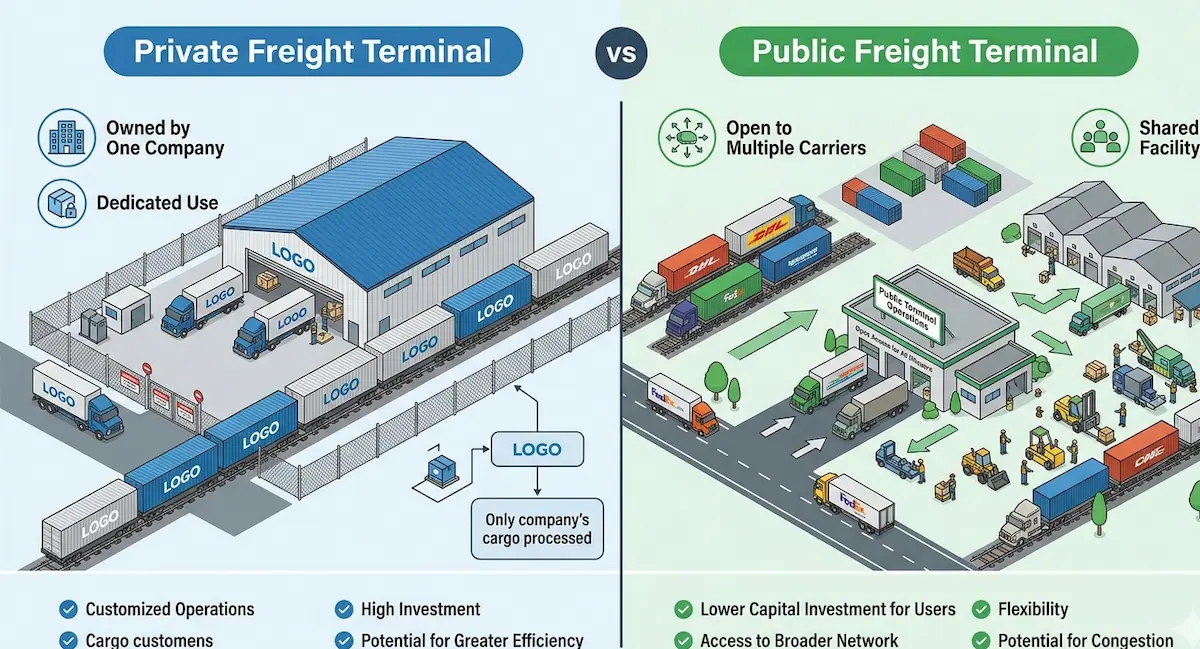
A private freight terminal and a public freight terminal both serve the same core purpose—handling, storing, and transferring cargo—but they differ significantly in ownership, operational control, efficiency, and accessibility. Understanding these differences is essential for businesses deciding which logistics model best suits their supply chain needs.
Key Differences Between Private Freight Terminal and Public Freight Terminal
A private freight terminal is operated by a private company for dedicated or restricted use, while a public freight terminal is managed by government authorities or public port/rail agencies and is open to multiple users.
Comparison Table
| Feature | Private Freight Terminal | Public Freight Terminal |
|---|---|---|
| Ownership | Private companies | Government or public authorities |
| Access | Restricted to selected users | Open to multiple users |
| Efficiency | High due to dedicated operations | Moderate due to shared usage |
| Congestion | Low | Often high |
| Cost Structure | Optimized for large-scale users | Pay-per-use model |
| Customization | Highly customizable systems | Standardized infrastructure |
| Control | Full operational control | Limited control for users |
| Turnaround Time | Faster | Slower due to traffic load |
Summary
It offers dedicated, high-efficiency logistics operations, while public terminals provide shared access and standardized services for multiple users.
Key Takeaways
- Private terminals prioritize speed and control
- Public terminals prioritize accessibility and shared usage
- Efficiency is generally higher in private freight terminals
Operational Differences
A private freight terminal is designed for optimized workflows tailored to a specific company’s logistics needs. In contrast, public terminals handle a wide variety of cargo types from multiple businesses, which can lead to operational delays.
Private Freight Terminal Operations:
- Dedicated cargo handling systems
- Customized scheduling
- Integrated digital logistics platforms
- Reduced waiting times
Public Freight Terminal Operations:
- Shared infrastructure among users
- Standardized handling procedures
- Higher dependency on queue systems
- Variable processing times
Summary
It operate with customized, controlled workflows, while public terminals rely on shared systems and standardized processes.
Also Read: Punjab Kings vs Chennai Super Kings Timeline: Ultimate Dominant & Explosive IPL Rivalry Guide
Key Takeaways
- Private systems are flexible and optimized
- Public systems are standardized and shared
- Workflow control is stronger in private terminals
Cost and Investment Differences
The financial structure of a private freight terminal differs significantly from public freight terminals.
Private Freight Terminal Costs:
- High initial infrastructure investment
- Long-term cost savings for large operators
- Reduced per-unit handling cost at scale
Public Freight Terminal Costs:
- Lower entry cost for users
- Pay-per-service model
- Additional charges during peak congestion periods
Large logistics companies such as DHL and Maersk often prefer private terminals to reduce long-term operational expenses and improve supply chain efficiency.
Summary
It require higher upfront investment but offer long-term cost efficiency, while public terminals have lower entry costs but variable expenses.
Key Takeaways
- Private terminals are cost-efficient at scale
- Public terminals are cheaper for occasional use
- Investment strategy depends on cargo volume
Performance and Efficiency Comparison
A private freight terminal generally delivers higher performance due to dedicated infrastructure and streamlined operations.
Performance Factors:
- Faster cargo processing in private terminals
- Higher congestion risk in public terminals
- Better tracking and automation in private systems
- More predictable delivery timelines in private setups
Organizations like World Trade Organization recognize the importance of efficient logistics infrastructure in supporting global trade performance and reducing supply chain disruptions.
Summary
It outperform public terminals in speed, predictability, and operational efficiency.
Key Takeaways
- Private terminals ensure faster throughput
- Public terminals face higher delays
- Efficiency is a key differentiator
When to Choose Private vs Public Freight Terminal
Choosing between a private freight terminal and a public freight terminal depends on business size, cargo volume, and operational needs.
Choose Private Freight Terminal When:
- High cargo volume is required
- Speed and efficiency are critical
- Long-term logistics control is needed
- Custom workflows are necessary
Choose Public Freight Terminal When:
- Cargo volume is low or occasional
- Budget constraints exist
- Flexibility and shared access are preferred
Summary
Private freight terminals are best for large-scale, efficiency-driven operations, while public terminals suit flexible, low-volume logistics needs.
Key Takeaways
- Private terminals suit large enterprises
- Public terminals suit general users
- Choice depends on logistics strategy
Major Organizations Involved in Private Freight Terminals
A private freight terminal operates within a complex global logistics ecosystem involving shipping companies, rail operators, port authorities, and international regulatory organizations. These entities play a key role in designing, operating, regulating, and optimizing freight terminal infrastructure worldwide.
Global Logistics and Shipping Companies
Large logistics and shipping companies are the primary operators and investors in many private freight terminal systems. They build or manage terminals to improve cargo control, reduce delays, and optimize end-to-end supply chains.
Key Companies
- DHL
- Maersk
- FedEx
- DP World
Their Role in Private Freight Terminal Systems
- Operate dedicated cargo terminals
- Manage container logistics and warehousing
- Provide end-to-end supply chain solutions
- Invest in automation and smart logistics infrastructure
These companies use private freight terminals to maintain control over global shipping routes and ensure faster delivery times.
Summary
Global logistics companies are the primary drivers behind private freight terminal development and operation.
Key Takeaways
- They invest heavily in terminal infrastructure
- They improve global supply chain efficiency
- They use private terminals for operational control
Rail Freight Operators
Rail companies play a critical role in inland private freight terminal systems, especially in regions where rail is a major cargo transport mode.
Key Organizations
- Union Pacific Railroad
- BNSF Railway
- Deutsche Bahn Cargo
Their Role
- Operate rail-connected private freight terminals
- Transport bulk goods and containers over long distances
- Integrate rail networks with road and port logistics
- Improve inland freight connectivity
Rail operators often collaborate with manufacturers and logistics companies to build dedicated terminal infrastructure for high-volume cargo movement.
Summary
Rail freight operators enable efficient inland transportation through rail-connected private freight terminals.
Key Takeaways
- Essential for inland cargo movement
- Support large-scale freight distribution
- Connect industrial zones with ports
Port Operators and Terminal Management Companies
Port operators are among the most influential stakeholders in private freight terminal development, especially for international trade and container shipping.
Key Organizations
- APM Terminals
- PSA International
- Hutchison Ports
- DP World
Their Role
- Operate private port terminals
- Manage container loading and unloading
- Improve port efficiency and reduce congestion
- Implement automation and smart port systems
These organizations are central to global maritime logistics and play a major role in international trade efficiency.
Summary
Port operators manage large-scale private freight terminals that support global import and export operations.
Key Takeaways
- Handle international cargo flows
- Reduce port congestion
- Invest in automation and infrastructure
Regulatory and Trade Organizations
Regulatory bodies ensure that private freight terminal operations comply with international trade laws, safety standards, and environmental regulations.
Key Organizations
- World Trade Organization
- International Maritime Organization
- International Air Transport Association
Their Role
- Establish global trade regulations
- Set safety and environmental standards
- Promote standardized logistics practices
- Facilitate international freight coordination
These organizations do not operate terminals directly but heavily influence how private freight terminals are designed and managed.
Summary
Regulatory organizations ensure private freight terminals operate safely, legally, and in compliance with global standards.
Key Takeaways
- Set international logistics standards
- Ensure safety and compliance
- Support global trade coordination
Industrial and Manufacturing Companies
Large industrial firms also develop their own private freight terminal infrastructure to support high-volume production and distribution needs.
Examples of Industry Users
- Automotive manufacturers
- Steel and mining companies
- Energy and oil & gas corporations
- Large-scale agricultural exporters
Their Role
- Build dedicated terminals near production sites
- Control inbound raw materials and outbound distribution
- Reduce dependency on public logistics hubs
- Improve supply chain reliability
Summary
Industrial companies use private freight terminals to gain direct control over their production and distribution logistics.
Key Takeaways
- Supports manufacturing efficiency
- Reduces logistics dependency
- Enhances supply chain reliability
Regulations and Compliance for Private Freight Terminals
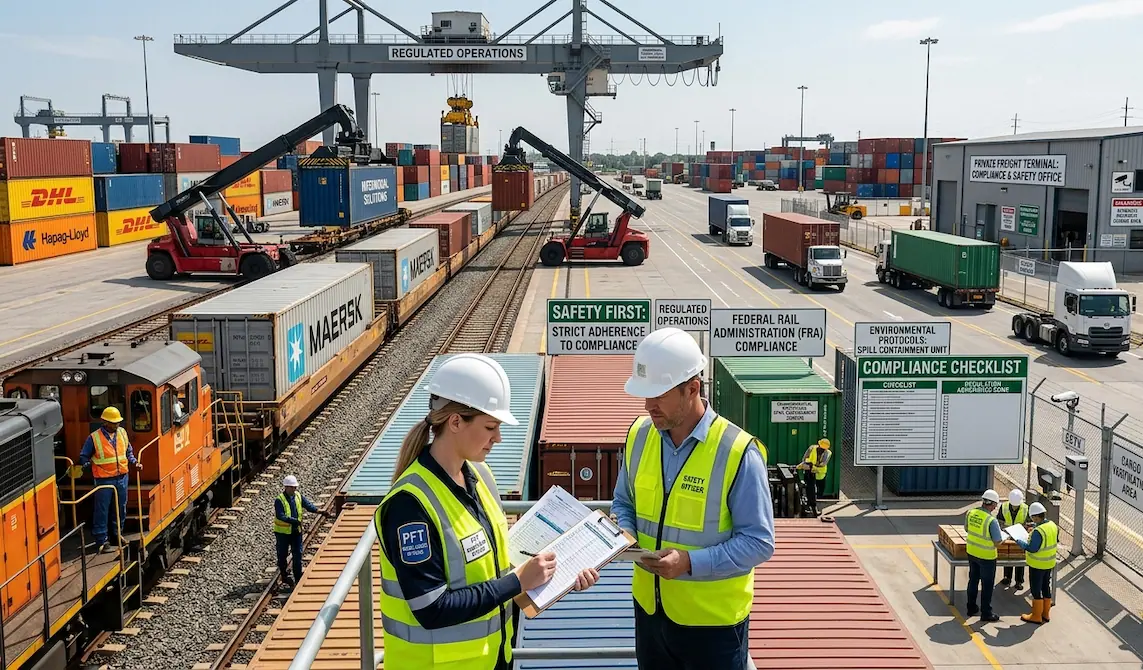
A private freight terminal operates under strict regulatory frameworks that ensure safety, efficiency, environmental protection, and compliance with national and international trade laws. These regulations are essential because private freight terminals handle high volumes of cargo, hazardous materials in some cases, and cross-border shipments that require standardized control systems.
Compliance in a private freight terminal is not optional; it is a core operational requirement that directly affects licensing, operational approval, and long-term sustainability.
Safety Standards and Operational Compliance
Safety is one of the most critical regulatory areas for a private freight terminal, as these facilities involve heavy machinery, large cargo volumes, and continuous movement of vehicles and containers.
Key Safety Requirements
- Safe handling of cargo using certified equipment
- Regular inspection of cranes, forklifts, and lifting systems
- Worker safety training and certification programs
- Emergency response and fire safety systems
- Hazardous material handling protocols
Safety frameworks are often aligned with international best practices developed by organizations such as the International Maritime Organization.
Summary
Safety regulations ensure that a private freight terminal operates without risks to workers, cargo, or infrastructure through strict operational standards.
Key Takeaways
- Safety compliance is mandatory
- Equipment must be regularly inspected
- Workers require formal safety training
Environmental Regulations
A private freight terminal must comply with environmental laws aimed at reducing pollution, emissions, and ecological damage caused by logistics operations.
Key Environmental Requirements
- Emission control for trucks, trains, and terminal equipment
- Proper waste management systems
- Noise reduction measures in operational zones
- Energy-efficient infrastructure and green logistics practices
- Water runoff and contamination control
Global trade and environmental sustainability standards are influenced by regulatory frameworks supported by organizations like the World Trade Organization, especially in relation to sustainable trade practices.
Summary
Environmental regulations ensure that private freight terminals minimize pollution and adopt sustainable logistics practices.
Key Takeaways
- Focus on emission reduction
- Promote sustainable infrastructure
- Control industrial waste and noise
Customs and Trade Compliance
For international logistics, a private freight terminal must follow customs regulations and trade compliance procedures to ensure legal movement of goods across borders.
Key Compliance Areas
- Accurate cargo documentation
- Customs clearance procedures
- Import/export licensing requirements
- Tariff classification and duties
- Security checks for international shipments
Air cargo-related compliance standards are strongly influenced by organizations such as the International Air Transport Association, which sets guidelines for safe and standardized air freight operations.
Summary
Customs compliance ensures that private freight terminals facilitate legal and efficient international trade without delays or penalties.
Key Takeaways
- Proper documentation is essential
- Customs laws vary by country
- Compliance reduces shipment delays
Infrastructure and Construction Regulations
A private freight terminal must also comply with construction, zoning, and infrastructure regulations before and during its operation.
Key Requirements
- Land-use approval from local authorities
- Structural safety certifications
- Zoning compliance for industrial activity
- Transportation connectivity approvals (road, rail, port access)
- Building code compliance for warehouses and terminals
These regulations ensure that terminal infrastructure is safe, legally approved, and suitable for heavy industrial use.
Summary
Infrastructure regulations ensure that private freight terminals are safely constructed and legally approved for industrial operations.
Key Takeaways
- Requires government approvals
- Must follow zoning laws
- Ensures structural safety
Digital and Data Compliance
Modern private freight terminal systems rely heavily on digital technologies, which introduces the need for cybersecurity and data compliance regulations.
Key Requirements
- Protection of cargo tracking data
- Cybersecurity protocols for terminal operating systems
- Secure electronic documentation systems
- Compliance with data protection laws (where applicable)
- System audits and vulnerability testing
Digital logistics systems used in a private freight terminal must ensure data integrity and protection against cyber threats.
Summary
Digital compliance ensures that private freight terminals protect operational data and maintain cybersecurity standards.
Key Takeaways
- Cybersecurity is increasingly important
- Digital systems require regular audits
- Data protection ensures operational trust
Use Cases of Private Freight Terminals
A private freight terminal is widely used across multiple industries where efficient, high-volume, and controlled cargo movement is essential. These facilities are designed to support specialized logistics requirements, reduce dependency on public infrastructure, and improve overall supply chain performance.
Each private freight terminal use case is closely linked to industry demand, cargo type, and transportation efficiency requirements.
Manufacturing Industry
A private freight terminal plays a crucial role in manufacturing supply chains by ensuring uninterrupted movement of raw materials and finished goods.
Key Applications
- Import of raw materials such as steel, chemicals, and machinery
- Export of finished industrial products
- Just-in-time (JIT) inventory management
- Continuous supply chain operations
Large-scale manufacturers often integrate logistics systems with terminals to avoid delays in production cycles.
Summary
In manufacturing, a private freight terminal ensures continuous material flow and reduces production downtime.
Key Takeaways
- Supports large-scale production systems
- Enables just-in-time logistics
- Reduces dependency on public terminals
E-commerce and Retail Industry
The rapid growth of global e-commerce has increased demand for fast and reliable logistics, making the private freight terminal essential for retail distribution networks.
Key Applications
- High-speed parcel sorting and distribution
- Cross-docking operations for faster delivery
- Integration with last-mile delivery networks
- Handling peak-season order surges
Companies like DHL use advanced terminal systems to manage large-scale e-commerce shipments efficiently and maintain fast delivery timelines.
Summary
Private freight terminals support e-commerce by enabling fast, scalable, and efficient distribution of goods.
Key Takeaways
- Essential for fast delivery systems
- Supports high-volume parcel handling
- Improves customer delivery speed
Energy and Bulk Commodity Sector
A private freight terminal is heavily used in industries dealing with bulk commodities such as coal, oil, gas, and minerals.
Key Applications
- Transport of raw energy materials
- Handling of bulk cargo (coal, ore, petroleum products)
- Connection between extraction sites and processing plants
- Export of natural resources
Rail-connected terminals are especially important in this sector, with operators like Union Pacific Railroad playing a major role in bulk freight transportation.
Summary
Energy and commodity industries rely on private freight terminals for large-scale, efficient bulk cargo movement.
Key Takeaways
- Ideal for heavy bulk materials
- Supports resource export industries
- Reduces transportation costs
Agriculture and Commodity Export
Agricultural supply chains depend on private freight terminal systems to move perishable and bulk food products efficiently.
Key Applications
- Storage and shipment of grains, fruits, and vegetables
- Temperature-controlled logistics for perishable goods
- Export of agricultural commodities
- Seasonal supply chain management
These terminals help reduce spoilage and ensure timely delivery to international markets.
Summary
Private freight terminals improve agricultural logistics by enabling efficient handling and export of perishable goods.
Key Takeaways
- Reduces food spoilage
- Supports global agricultural trade
- Improves cold-chain logistics
Automotive Industry
The automotive sector relies heavily on a private freight terminal for the movement of vehicles, parts, and raw materials.
Key Applications
- Transport of car components and assemblies
- Finished vehicle distribution
- Import/export of automotive materials
- Supply chain synchronization with production plants
Manufacturers integrate logistics terminals directly with factories to maintain production efficiency and reduce delays.
Summary
Private freight terminals support automotive manufacturing through efficient transport of parts and finished vehicles.
Key Takeaways
- Supports global automotive supply chains
- Reduces production delays
- Enables large-scale vehicle logistics
Construction and Heavy Equipment Industry
A private freight terminal is also essential for industries dealing with heavy machinery and construction materials.
Key Applications
- Transport of construction equipment
- Handling of oversized cargo
- Movement of cement, steel, and building materials
- Coordination of large infrastructure projects
These terminals provide the infrastructure needed to handle non-standard, heavy, or oversized shipments.
Summary
Construction industries rely on private freight terminals for handling heavy and oversized cargo efficiently.
Key Takeaways
- Handles oversized shipments
- Supports infrastructure projects
- Improves heavy logistics efficiency
Challenges and Limitations of Private Freight Terminals
A private freight terminal offers major advantages in efficiency and control, but it also comes with several operational, financial, and regulatory challenges. These limitations can affect feasibility, scalability, and long-term performance depending on the industry, location, and investment capacity.
Understanding these challenges is essential for businesses planning to develop or operate a private freight terminal.
High Initial Investment Cost
One of the most significant limitations of a private freight terminal is the extremely high upfront capital requirement.
Key Cost Factors
- Land acquisition in strategic logistics locations
- Construction of warehouses, yards, and rail/road infrastructure
- Purchase of heavy cargo handling equipment
- Installation of digital logistics systems
- Security and compliance infrastructure
Developing a fully functional terminal requires long-term financial commitment, which can be a barrier for small and medium enterprises.
Summary
A private freight terminal requires substantial initial investment in infrastructure, equipment, and technology before operations can begin.
Key Takeaways
- High capital expenditure is required
- Long payback period for investment
- Economically viable mainly for large operators
Regulatory and Approval Complexity
A private freight terminal must comply with multiple layers of regulation, which can delay development and increase operational complexity.
Key Regulatory Challenges
- Land-use and zoning approvals
- Environmental impact assessments
- Transport and safety certifications
- Customs and trade compliance requirements
- Local and national government permissions
Regulatory oversight is often influenced by global trade and safety frameworks established by organizations such as the International Maritime Organization.
Summary
Regulatory approvals for private freight terminals are complex and time-consuming, requiring compliance with multiple authorities.
Key Takeaways
- Multiple permits are required
- Environmental and safety compliance is mandatory
- Approval delays can affect project timelines
Operational and Maintenance Costs
Even after setup, a private freight terminal requires continuous investment in operations and maintenance.
Key Ongoing Costs
- Equipment maintenance and replacement
- Workforce salaries and training
- Technology system upgrades
- Energy consumption and utilities
- Security and monitoring systems
High operational complexity means costs remain significant throughout the terminal’s lifecycle.
Summary
Operational costs of a private freight terminal remain high due to continuous maintenance and workforce requirements.
Key Takeaways
- Ongoing expenses are substantial
- Maintenance is essential for efficiency
- Skilled workforce increases operational cost
Space and Location Constraints
The effectiveness of a private freight terminal heavily depends on its geographical location and available space.
Key Limitations
- Limited availability of land near ports or industrial hubs
- High land prices in strategic logistics zones
- Difficulty expanding existing infrastructure
- Urban restrictions and zoning limitations
Poor location selection can significantly reduce terminal efficiency and increase transportation costs.
Summary
Location and space limitations can restrict the scalability and efficiency of private freight terminals.
Key Takeaways
- Strategic location is critical
- Expansion is often difficult
- Land cost impacts feasibility
Operational Risks and Disruptions
A private freight terminal is exposed to various operational risks that can disrupt logistics flow.
Key Risks
- Equipment breakdowns and mechanical failures
- Supply chain disruptions
- Labor shortages or strikes
- Cybersecurity threats to digital systems
- Weather-related operational delays
Because operations are centralized, any disruption can have a significant impact on the entire supply chain.
Summary
Private freight terminals face operational risks that can disrupt cargo flow and reduce efficiency.
Key Takeaways
- System failures can halt operations
- Cybersecurity is increasingly important
- External disruptions affect performance
Limited Accessibility for External Users
A defining feature of a private freight terminal is restricted access, which can also be a limitation.
Key Issues
- Not available for general public use
- Limited third-party participation
- Dependence on internal logistics networks
- Reduced flexibility for smaller businesses
While this exclusivity improves efficiency, it also reduces shared infrastructure benefits.
Summary
Private freight terminals prioritize exclusivity, which limits accessibility for external users and smaller operators.
Key Takeaways
- Restricted access model
- Less flexible for small users
- Designed for dedicated operations
Future Trends in Private Freight Terminals
A private freight terminal is evolving rapidly due to advancements in technology, globalization of supply chains, and increasing demand for faster and more sustainable logistics systems. Future developments are focused on automation, digital integration, environmental sustainability, and smarter infrastructure design.
These trends are shaping how a private freight terminal will operate in the coming years, making it more efficient, data-driven, and globally connected.
Automation and Robotics
Automation is one of the most transformative trends in a private freight terminal, reducing human dependency and improving operational speed.
Key Developments
- Automated cranes for container handling
- Robotics for warehouse sorting and packaging
- Autonomous trucks for internal cargo movement
- AI-based scheduling systems
These technologies reduce delays, improve safety, and increase throughput capacity in modern terminals.
Summary
Automation is making private freight terminals faster, safer, and more efficient by reducing manual processes and increasing precision.
Key Takeaways
- Reduces human error
- Increases operational speed
- Improves cargo handling accuracy
Artificial Intelligence and Predictive Logistics
AI is becoming a core component of the private freight terminal ecosystem, especially in planning and optimization.
Key Applications
- Predicting cargo demand and flow
- Optimizing storage space usage
- Real-time route and dispatch planning
- Risk detection in supply chains
AI-driven systems help terminals operate with higher efficiency and fewer disruptions.
Summary
AI enables private freight terminals to make data-driven decisions that improve efficiency and reduce operational risks.
Key Takeaways
- Improves forecasting accuracy
- Optimizes logistics planning
- Reduces operational inefficiencies
Smart and Connected Terminals
A modern private freight terminal is increasingly becoming part of a fully connected digital ecosystem.
Key Features
- IoT-enabled cargo tracking systems
- Real-time data exchange between stakeholders
- Cloud-based terminal management systems
- Integrated supply chain visibility platforms
Organizations like International Air Transport Association are promoting standardized digital frameworks to improve global freight connectivity.
Summary
Smart private freight terminals use IoT and cloud systems to provide real-time visibility and seamless logistics coordination.
Key Takeaways
- Full supply chain visibility
- Real-time cargo tracking
- Improved communication between systems
Sustainability and Green Logistics
Environmental sustainability is becoming a major priority for every private freight terminal.
Key Trends
- Electrification of cargo handling equipment
- Use of renewable energy sources (solar, wind)
- Low-emission transport integration
- Green warehouse design and insulation systems
Global sustainability expectations are influenced by international trade and environmental frameworks supported by organizations like the World Trade Organization.
Summary
Private freight terminals are shifting toward sustainable operations to reduce environmental impact and comply with global standards.
Key Takeaways
- Focus on reducing carbon emissions
- Adoption of clean energy systems
- Environmentally friendly infrastructure
Digital Twin Technology
Digital twin technology is an emerging innovation in private freight terminal management.
Key Applications
- Virtual simulation of terminal operations
- Real-time monitoring of cargo flow
- Predictive maintenance of equipment
- Scenario planning for logistics optimization
This technology allows operators to test and optimize operations without physical disruptions.
Summary
Digital twins help private freight terminals simulate and optimize operations using virtual models.
Key Takeaways
- Enables predictive maintenance
- Improves operational planning
- Reduces downtime and inefficiencies
Expansion of Intermodal Logistics
Future private freight terminal systems will increasingly rely on intermodal transport integration.
Key Trends
- Seamless integration of rail, road, sea, and air transport
- Faster cargo transfer between modes
- Unified logistics platforms
- Expansion of inland logistics hubs
Companies like DP World are investing heavily in intermodal infrastructure to improve global trade efficiency.
Summary
Intermodal integration will make private freight terminals more flexible and globally connected.
Key Takeaways
- Improves transport flexibility
- Reduces transfer delays
- Enhances global logistics efficiency
Common Mistakes to Avoid in Private Freight Terminals
Operating a private freight terminal requires precise planning, strong infrastructure, and efficient management. However, many projects fail or underperform due to avoidable mistakes in planning, design, and operations. Understanding these errors helps improve performance and long-term sustainability.
Poor Location Selection
One of the most critical mistakes in a private freight terminal is choosing an unsuitable location.
Common Issues
- Far from major trade routes or ports
- Poor road or rail connectivity
- High congestion areas without expansion space
- Ignoring future industrial growth zones
A weak location increases transport costs and reduces overall efficiency.
Summary
Location mistakes can permanently reduce a terminal’s competitiveness and efficiency.
Key Takeaways
- Location determines logistics success
- Connectivity is more important than land cost
- Future expansion potential must be considered
Underestimating Infrastructure Requirements
Many projects fail because they underestimate what a fully functional private freight terminal actually needs.
Key Oversights
- Insufficient cargo handling equipment
- Inadequate storage and warehousing space
- Weak power and utility planning
- Lack of digital systems for tracking and management
Without proper infrastructure, operations become slow and inefficient.
Summary
Underbuilding infrastructure leads to long-term operational bottlenecks and higher costs.
Key Takeaways
- Infrastructure must match cargo volume
- Technology integration is essential
- Scalability should be planned early
Ignoring Technology Integration
A modern private freight terminal depends heavily on digital systems, yet many operators delay or ignore this.
Common Mistakes
- No real-time tracking systems
- Lack of automation in cargo handling
- Manual documentation processes
- Poor data management systems
This results in delays, errors, and reduced competitiveness.
Summary
Ignoring technology reduces efficiency and makes terminals outdated quickly.
Key Takeaways
- Digital systems improve accuracy
- Automation increases speed
- Data-driven decisions are essential
Weak Regulatory Compliance Planning
Regulatory mistakes are a major risk for any private freight terminal project.
Common Issues
- Late environmental approvals
- Missing safety certifications
- Poor customs compliance planning
- Ignoring zoning regulations
Such mistakes can delay projects or even stop operations entirely.
Summary
Non-compliance with regulations can lead to legal delays, penalties, or shutdowns.
Key Takeaways
- Compliance must be planned early
- Regulations vary by region
- Legal approvals take time
Poor Financial Planning
Financial mismanagement is another common failure point in a private freight terminal project.
Key Mistakes
- Underestimating setup costs
- Ignoring maintenance expenses
- Overestimating revenue in early years
- Lack of contingency budgeting
This can lead to cash flow problems and operational instability.
Summary
Strong financial planning is essential to sustain long-term terminal operations.
Key Takeaways
- Costs are often higher than expected
- Revenue takes time to stabilize
- Budget buffers are necessary
Lack of Skilled Workforce
A private freight terminal cannot operate efficiently without trained personnel.
Common Issues
- Hiring untrained labor
- Lack of technical training programs
- Poor management structure
- High employee turnover
This leads to inefficiency and increased operational errors.
Summary
Skilled workforce is essential for smooth and efficient terminal operations.
Key Takeaways
- Training improves performance
- Skilled staff reduces errors
- Retention strategies are important
Ignoring Future Expansion Planning
Many terminals are designed only for current needs, which limits future growth.
Common Mistakes
- No space reserved for expansion
- Fixed infrastructure design
- Lack of modular development planning
- Ignoring future trade growth
This reduces long-term profitability and scalability.
Summary
Failure to plan for expansion limits long-term growth potential.
Key Takeaways
- Scalability is essential
- Demand can grow rapidly
- Flexible design is better
Frequently Asked Questions
What is a private freight terminal?
A private freight terminal is a logistics facility owned and operated by a private company to handle cargo transportation, storage, loading, and unloading of goods. It is not publicly operated and is designed to serve specific businesses or supply chains.
How does a private freight terminal work?
A private freight terminal works by receiving goods through rail, road, sea, or air transport, then storing, sorting, and redistributing them using specialized equipment and digital logistics systems. It streamlines cargo movement within a controlled environment.
What are the main benefits of a private freight terminal?
Key benefits include:
- Faster cargo handling and reduced delays
- Better control over logistics operations
- Improved security for goods
- Lower long-term transportation costs
- Integration with digital supply chain systems
Who uses private freight terminals?
A private freight terminal is mainly used by:
- Large manufacturing companies
- Logistics and shipping companies
- Export-import businesses
- Industrial supply chain operators
- Distribution and warehousing firms
What is the difference between a private and public freight terminal?
A private freight terminal is owned and operated by a private entity for its own logistics needs, while a public terminal is managed by government or port authorities and is available for multiple users.
Are private freight terminals expensive to build?
Yes, building a private freight terminal is expensive due to:
- Land acquisition costs
- Infrastructure development
- Heavy cargo handling equipment
- Technology and automation systems
- Regulatory and compliance requirements
What challenges do private freight terminals face?
Common challenges include:
- High initial investment
- Regulatory approvals and compliance
- Maintenance and operational costs
- Skilled workforce requirements
- Location and space limitations
Are private freight terminals environmentally friendly?
Modern private freight terminals are increasingly adopting green practices such as:
- Electric cargo equipment
- Renewable energy systems
- Reduced emissions transport
- Sustainable warehouse design
However, environmental impact depends on how well sustainability measures are implemented.
What technologies are used in private freight terminals?
A private freight terminal may use:
- Automation and robotics
- Artificial intelligence (AI) systems
- Internet of Things (IoT) tracking
- Digital twin simulation
- Cloud-based logistics platforms
What is the future of private freight terminals?
The future of a private freight terminal includes:
- Full automation and AI integration
- Smarter, connected logistics systems
- Expansion of intermodal transport networks
- Strong focus on sustainability and green logistics