Side hustle income refers to money earned outside a primary job through flexible, independent, or part-time activities. These earnings typically come from online work, freelance services, digital assets, or gig-based opportunities designed to supplement regular income.
Modern side hustle income ideas are no longer limited to temporary extra work. They now form structured income systems supported by digital platforms, remote technology, and global marketplaces.
A side hustle can operate alongside full-time employment while offering scalability toward long-term financial independence.
Side Hustle vs Traditional Second Job
| Factor | Side Hustle | Traditional Second Job |
|---|---|---|
| Work Flexibility | High | Fixed schedule |
| Income Growth | Scalable | Limited hourly pay |
| Skill Ownership | Personal asset | Employer-controlled |
| Remote Options | Common | Rare |
| Automation Potential | Possible | None |
A traditional second job exchanges time directly for wages. In contrast, many modern side hustle income ideas allow income expansion without proportional increases in working hours.
Growth of the Gig Economy Income Model
Digital labor markets have reshaped how individuals earn money. Platforms connecting freelancers with global clients enable workers to monetize skills without geographic restrictions.
According to labor market studies, independent and gig-based workers continue increasing annually due to:
- Remote work adoption
- Digital payment systems
- Platform-based hiring
- Demand for specialized micro-services
This shift explains why online side jobs now represent one of the fastest-growing supplemental income categories worldwide.
Why Multiple Income Streams Matter in 2026
Economic volatility, automation, and evolving job markets have increased reliance on diversified earnings.
Financial planning models increasingly recommend:
- Multiple income channels
- Skill-based earning capacity
- Digital asset ownership
- Flexible earning systems
Income diversification reduces dependency on a single employer while improving long-term financial stability.
Quick Takeaway
- A side hustle builds independent earning power.
- Digital platforms reduce startup barriers.
- Scalable income opportunities outperform hourly work over time.
Best Side Hustle Income Ideas in 2026
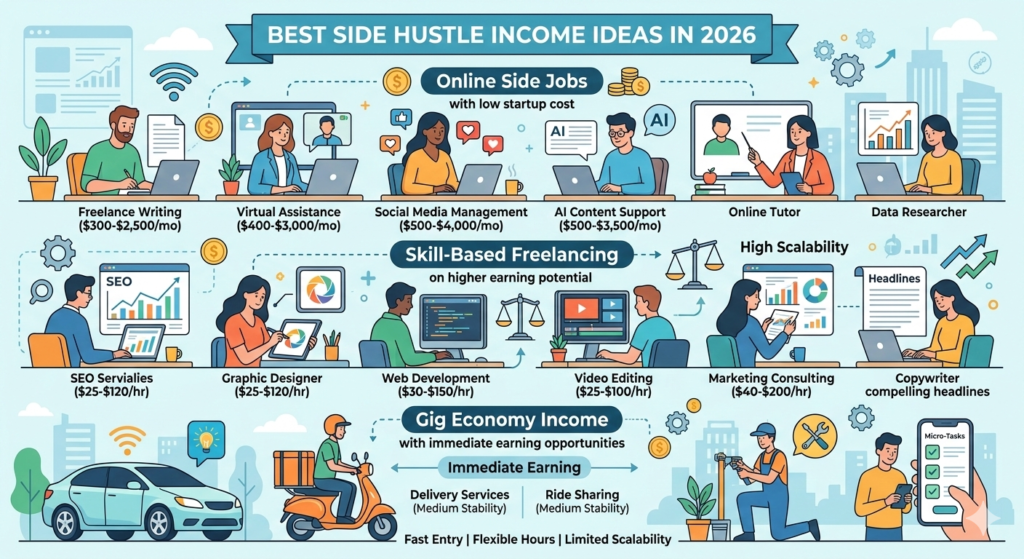
The most effective side hustle income ideas combine low startup cost with scalable demand. Opportunities fall into three primary categories: online services, skill-based freelancing, and gig economy work.
Online Side Jobs With Low Startup Cost
Online work remains the easiest entry point for beginners.
Common options include:
- Freelance writing
- Virtual assistance
- Social media management
- AI-assisted content support
- Online tutoring
- Data research services
Most online side jobs require only internet access and transferable skills.
| Online Side Hustle | Startup Cost | Monthly Income Potential | Experience Needed |
|---|---|---|---|
| Freelance Writing | Very Low | $300–$2,500 | Beginner–Intermediate |
| Virtual Assistant | Low | $400–$3,000 | Beginner |
| Social Media Management | Low | $500–$4,000 | Intermediate |
| Online Tutoring | Low | $300–$2,000 | Subject Knowledge |
| AI Content Support | Very Low | $500–$3,500 | Beginner |
Income ranges vary depending on specialization and consistency.
Skill-Based Freelance Side Hustles
Skill monetization produces higher earning ceilings compared to general online work.
High-demand freelance services include:
- Search engine optimization services
- Graphic design
- Website development
- Video editing
- Marketing analytics
- Copywriting
Professionals offering measurable business outcomes typically command premium rates.
| Skill-Based Hustle | Average Hourly Rate | Scalability |
|---|---|---|
| SEO Services | $25–$120 | High |
| Web Development | $30–$150 | High |
| Graphic Design | $20–$90 | Medium |
| Video Editing | $25–$100 | High |
| Marketing Consulting | $40–$200 | Very High |
Skill ownership converts time into intellectual capital rather than hourly labor.
Gig Economy Income Opportunities
Gig economy income focuses on task-based earnings rather than long-term contracts.
Examples include:
- Ride-sharing services
- Food delivery platforms
- Local service marketplaces
- Micro-task applications
These side hustle income ideas provide immediate earning opportunities but limited scalability.
| Gig Work Type | Entry Speed | Income Stability | Automation |
|---|---|---|---|
| Delivery Services | Fast | Medium | None |
| Ride Sharing | Fast | Medium | None |
| Task Services | Fast | Variable | Low |
Gig work often serves as a starting point before transitioning into scalable digital income streams.
Pros and Limitations of Gig Income
Advantages
- Immediate cash flow
- Minimal skill requirement
- Flexible scheduling
Limitations
- Income tied to hours worked
- Operating costs
- Limited long-term growth
Passive Income Streams That Scale Over Time
Passive income refers to earnings generated after initial setup with reduced ongoing effort. While most passive income streams require early work, they can produce recurring revenue.
Digital Asset-Based Income
Digital ownership represents one of the strongest long-term side hustle income ideas.
Examples include:
- Blogging websites
- Affiliate marketing systems
- Online courses
- Digital downloads
- Print-on-demand products
- Educational resources
Once established, these assets can generate continuous traffic and sales.
| Passive Income Asset | Setup Time | Income Timeline | Maintenance Level |
|---|---|---|---|
| Blog Website | Medium | 6–12 Months | Low |
| Affiliate Marketing | Medium | 4–10 Months | Low |
| Digital Products | High | 3–8 Months | Very Low |
| Online Courses | High | 6–12 Months | Low |
Long-term profitability depends on audience growth and consistent optimization.
Investment-Based Passive Income
Financial assets also contribute to supplemental income generation. Some investors also explore digital assets using structured cryptocurrency investment strategies as part of diversified side hustle income ideas.
Common approaches include:
- Dividend-paying stocks
- Real estate investment trusts (REITs)
- Index fund investing
- Crypto staking mechanisms
Investment income typically requires capital rather than labor.
| Investment Type | Risk Level | Income Frequency | Capital Required |
|---|---|---|---|
| Dividend Stocks | Medium | Quarterly | Medium |
| REITs | Medium | Monthly/Quarterly | Medium |
| Index Funds | Low–Medium | Long-Term | Medium |
| Crypto Staking | High | Variable | Variable |
Diversification remains a standard risk management practice.
Active vs Passive Income Comparison
| Feature | Active Income | Passive Income |
|---|---|---|
| Time Requirement | Continuous | Front-loaded |
| Income Growth | Linear | Scalable |
| Automation | Low | High |
| Stability | Immediate | Long-term |
Many successful earners combine both models for balanced cash flow.
Key Insight
Passive income rarely begins passively. Initial effort builds systems that later reduce active workload.
Online Side Jobs You Can Start From Home
Remote work accessibility has expanded earning opportunities globally. Many side hustle income ideas now operate entirely from home environments.
Beginner-Friendly Remote Hustles
Low-barrier online work includes:
- Customer support outsourcing
- Content moderation
- Transcription services
- Data entry verification
- Online research assistance
These roles help beginners develop professional digital skills.
AI-Assisted Income Opportunities
Automation tools increasingly support productivity-based income models.
Emerging opportunities include:
- Content optimization assistance
- Workflow automation setup
- Prompt-based research services
- Digital marketing support
Workers leveraging productivity tools often complete tasks faster, improving hourly profitability.
Platforms Enabling Online Earnings
Digital marketplaces connect individuals with global demand.
Common earning platforms include:
- Upwork
- Fiverr
- Etsy
- Shopify
- Amazon marketplaces
- YouTube monetization systems
Platform ecosystems reduce client acquisition barriers while enabling scalable exposure.
Home-Based Income Summary
- Internet access replaces physical workspace.
- Skills determine earning potential.
- Consistency drives income growth.
- Platform diversification reduces risk.
How Much Can You Earn From Side Hustles?
Income from side hustle income ideas varies widely depending on effort, specialization, and scalability.
Income Ranges by Effort Level
| Weekly Hours | Hustle Type | Estimated Monthly Income |
|---|---|---|
| 5–8 Hours | Beginner Online Work | $150–$600 |
| 10–15 Hours | Freelancing | $500–$2,000 |
| 20+ Hours | Specialized Services | $2,000–$6,000+ |
Income growth typically follows skill development rather than time investment alone.
Time Investment vs Earnings
Early-stage side hustles prioritize learning and client acquisition. Later stages benefit from:
- Repeat customers
- Pricing optimization
- Workflow automation
- Productization of services
This transition converts small supplemental earnings into meaningful secondary income streams.
Scaling From Side Hustle to Primary Income
Many individuals eventually transition when side income becomes stable.
Indicators include:
- Consistent monthly revenue
- Client retention
- Predictable workflow
- Financial reserve coverage
Scaling requires operational planning rather than sudden job replacement.
Summary
- Side hustle income ideas now form structured earning systems.
- Online and skill-based work offers the highest scalability.
- Passive income develops through digital or investment assets.
- Remote platforms enable global earning access.
- Income potential increases with specialization and consistency.
Freelance Tax Tips and How to Report Side Income Correctly
As more individuals adopt side hustle income ideas, understanding taxation becomes essential. Earnings generated outside traditional employment are typically classified as self-employment or independent income in most financial systems.
Failure to report additional earnings can lead to penalties, inaccurate financial records, or compliance issues.
When Side Hustle Income Becomes Taxable
Income earned through freelance work, digital platforms, consulting services, or gig economy participation generally becomes taxable once payments exceed minimum reporting thresholds established by national tax authorities.
Common taxable income sources include:
- Freelance service payments
- Online marketplace earnings
- Affiliate commissions
- Digital product sales
- Consulting or coaching income
- Platform-based gig payments
Even small online side jobs contribute to total annual taxable income.
How to Track Side Hustle Earnings
Accurate income tracking simplifies reporting and financial planning.
Recommended record-keeping practices include:
- Maintaining digital invoices
- Recording payment dates
- Tracking platform transaction reports
- Separating personal and business accounts
- Monitoring recurring subscriptions or expenses
| Record Type | Purpose | Recommended Frequency |
|---|---|---|
| Income Ledger | Track payments received | Weekly |
| Expense Log | Deduction verification | Monthly |
| Platform Reports | Revenue confirmation | Monthly |
| Invoice Archive | Audit protection | Continuous |
Consistent documentation aligns with standard accounting practices used by independent professionals.
Expense Deductions for Freelancers
Many side hustle income ideas allow legitimate expense deductions when costs directly support income generation.
Typical deductible expenses include:
- Internet usage related to work
- Software subscriptions
- Marketing costs
- Equipment purchases
- Educational courses
- Workspace expenses
| Expense Category | Deductible Purpose |
|---|---|
| Laptop & Equipment | Work productivity |
| Internet Services | Online operations |
| Advertising | Client acquisition |
| Professional Tools | Service delivery |
| Training Programs | Skill improvement |
Proper expense classification reduces taxable income while maintaining compliance.
Common Reporting Mistakes
Individuals managing multiple side hustle income ideas frequently encounter reporting errors such as:
- Mixing personal and business expenses
- Ignoring small payments
- Missing digital wallet transactions
- Failing to maintain receipts
- Underestimating quarterly tax obligations
Financial experts recommend periodic income reviews to avoid year-end complications.
Compliance Summary
- All earned income should be recorded.
- Expenses must relate directly to work activity.
- Organized tracking prevents reporting issues.
Choosing the Right Side Hustle Income Idea
Not all earning opportunities produce equal results. Selecting effective side hustle income ideas requires alignment between skills, time availability, and financial goals.
Skill-Based Selection Framework
Individuals typically succeed faster when monetizing existing abilities rather than learning entirely new fields.
| Skill Level | Recommended Hustle Type |
|---|---|
| Beginner | Online assistance, data services |
| Intermediate | Freelancing, digital marketing |
| Advanced | Consulting, development services |
| Expert | Agency or product systems |
Skill leverage shortens income generation timelines.
Time vs Profit Decision Matrix
Side hustles differ significantly in time requirements and earning capacity.
| Time Available | Suitable Side Hustle |
|---|---|
| 5 Hours Weekly | Online micro-services |
| 10 Hours Weekly | Freelance projects |
| 15–20 Hours | Digital assets |
| 20+ Hours | Scalable businesses |
Higher earnings usually depend on systems rather than effort alone.
Risk vs Stability Analysis
| Hustle Category | Income Stability | Growth Potential |
|---|---|---|
| Gig Work | Medium | Low |
| Freelancing | Medium–High | High |
| Digital Products | Low Initially | Very High |
| Investments | Variable | Long-Term |
Balanced income portfolios often combine stable freelance work with scalable passive income streams.
Decision Insight
Successful earners rarely depend on a single method. Combining multiple side hustle income ideas improves resilience and long-term growth.
Scaling Side Hustle Income Into Sustainable Earnings
Many individuals begin with supplemental income but later expand into structured revenue systems.
Stage 1: Income Validation
Early validation focuses on confirming demand.
Indicators include:
- Repeat customers
- Consistent project requests
- Positive client feedback
- Increasing referrals
Validation confirms market demand before scaling.
Stage 2: Process Optimization
Efficiency improvements increase earnings without increasing workload.
Optimization methods include:
- Workflow templates
- Automated billing
- Service packaging
- Time management systems
Automation reduces operational friction.
Stage 3: Income Expansion
Growth strategies involve transforming services into scalable models:
- Selling digital products
- Creating subscription services
- Building online audiences
- Delegating repetitive tasks
Many high-performing side hustle income ideas evolve into small digital businesses.
Future Trends Shaping Side Hustle Income Ideas Beyond 2026
Economic and technological changes continue influencing income opportunities.
Expansion of Remote Global Work
Businesses increasingly hire international freelancers due to:
- Cost efficiency
- Remote collaboration tools
- Access to specialized talent
Global marketplaces broaden earning potential regardless of location.
Automation and Productivity Technology
Automation tools now assist with:
- Content creation workflows
- Customer communication
- Scheduling systems
- Data analysis
Individuals leveraging technology often outperform traditional hourly workers.
Growth of the Creator Economy
Content-driven income models continue expanding through:
- Educational platforms
- Subscription communities
- Digital memberships
- Advertising monetization
Ownership-based income systems represent a growing portion of modern side hustle income ideas.
Digital Asset Ownership
Future earning models emphasize ownership instead of labor.
Examples include:
- Websites generating advertising revenue
- Online learning platforms
- Intellectual property licensing
- Digital marketplaces
Ownership-based income typically scales faster than service-based work.
Trend Summary
- Remote earning is becoming standard.
- Automation improves productivity.
- Digital ownership increases income scalability.
Practical Framework for Building Reliable Side Income
A structured approach improves long-term success.
Step-by-Step Model
- Identify monetizable skills
- Select one primary income channel
- Validate earning potential
- Track income and expenses
- Reinvent processes for efficiency
- Add passive income streams
- Diversify income sources
Following systematic steps reduces financial uncertainty.
Practical Blueprint for Starting Side Hustle Income Ideas Successfully
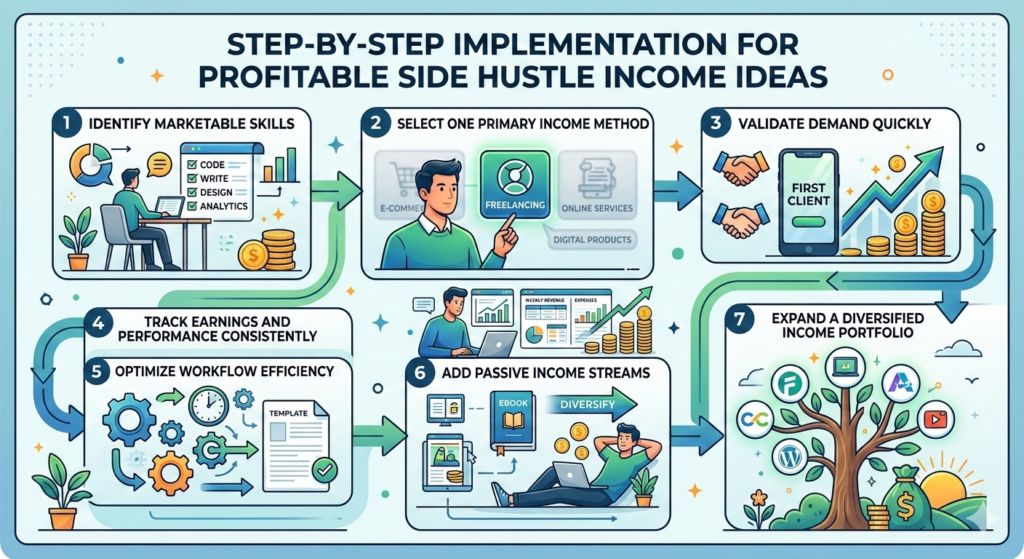
Building sustainable earnings requires more than choosing random opportunities. The most successful side hustle income ideas follow a structured execution framework that transforms small efforts into reliable income streams over time.
A clear system helps individuals evaluate, launch, and grow profitable side hustle income ideas while minimizing financial risk and wasted effort.
Step-by-Step Implementation for Profitable Side Hustle Income Ideas
1. Identify Marketable Skills
Start by assessing skills that can immediately support realistic side hustle income ideas. Existing professional abilities, digital skills, or subject expertise often provide the fastest path toward earning supplemental income.
Skill alignment significantly improves early success rates when testing new side hustle income ideas.
2. Select One Primary Income Method
Avoid managing multiple opportunities at the beginning. Focus on one proven category of side hustle income ideas such as freelancing, online services, or scalable digital work.
Concentrating effort allows faster learning and income validation.
3. Validate Demand Quickly
Before investing significant time, confirm whether your chosen side hustle income ideas solve real market problems. Demand validation may include securing first clients, testing online listings, or offering small pilot services.
Market validation ensures that selected side hustle income ideas have earning potential.
4. Track Earnings and Performance Consistently
Financial tracking transforms casual work into structured income growth. Successful earners monitor revenue generated from their side hustle income ideas through weekly income reviews and performance analysis.
Consistent tracking highlights which side hustle income ideas deliver the highest return on effort.
5. Optimize Workflow Efficiency
Once income begins, improve productivity by standardizing processes. Templates, automation tools, and repeatable systems help scale side hustle income ideas without increasing working hours.
Efficiency optimization allows income expansion while maintaining flexibility.
6. Add Passive Income Streams
After stabilizing active earnings, introduce passive models that complement existing side hustle income ideas. Digital products, affiliate systems, or content-based assets gradually reduce reliance on hourly work.
Combining active and passive side hustle income ideas strengthens long-term income stability.
7. Expand a Diversified Income Portfolio
Long-term financial resilience comes from diversification. Expanding into multiple compatible side hustle income ideas protects income against platform changes, market fluctuations, or client loss.
Diversified income systems create sustainable earning ecosystems rather than temporary extra income.
Key Implementation Insight
Execution consistency matters more than chasing new opportunities. Individuals who steadily refine proven side hustle income ideas typically achieve stronger and more predictable financial growth than those frequently switching strategies.
Conclusion
Side hustle income ideas have evolved from temporary extra work into structured financial strategies supported by digital platforms and global demand. Online services, freelance expertise, passive assets, and gig economy participation collectively provide flexible earning opportunities.
Long-term success depends on skill development, consistent execution, and proper financial management. Individuals combining scalable income systems with disciplined reporting practices position themselves for sustainable earnings growth in modern digital economies.
Frequently Asked Questions
1. What are the most profitable side hustle income ideas in 2026?
High-income opportunities typically include freelance consulting, digital product creation, online education services, and specialized technical freelancing due to scalability and global demand.
2. Can online side jobs replace a full-time income?
Yes. Many individuals transition successfully once earnings become consistent and diversified across multiple income streams.
3. Do passive income streams require work?
Most passive income systems require significant setup effort before generating recurring revenue.
4. How should beginners start earning side income?
Beginners should begin with low-cost online services using existing skills before expanding into scalable digital assets.
5. Is side hustle income taxable?
Income earned outside primary employment is generally taxable and must be reported according to financial regulations.
6. How many side hustles should someone manage?
Financial planners typically recommend starting with one reliable income stream before adding additional opportunities.
7. What is the safest way to grow side income?
Combining stable freelance earnings with long-term passive income assets provides balanced risk management.
Disclaimer
The information provided in this article is for educational and informational purposes only and should not be considered financial, investment, tax, or legal advice. The author is not a licensed financial advisor. Readers should conduct their own research and consult a qualified financial professional before making any financial or investment decisions.