The AI loan approval process is a digital system that uses artificial intelligence and machine learning to evaluate loan applications automatically. Instead of manual review by loan officers, the system analyzes borrower data, predicts risk, and makes approval decisions within minutes.
In simple terms, the AI loan approval process replaces slow paperwork and manual checks with automated decision models. It studies large amounts of financial and behavioral data to decide whether a borrower qualifies for a loan.
According to industry standards, the AI loan approval process improves speed, accuracy, and risk prediction compared to traditional underwriting methods.
How AI Approves Loans Using Data
The AI loan approval process works by collecting and analyzing different types of data. These include:
- Credit history
- Income and employment details
- Debt-to-income ratio
- Banking transaction data
- Education and work background
- Digital financial behavior
This is how AI approves loans step by step:
- The borrower submits an online application.
- The system collects financial and non-traditional data.
- Machine learning models compare the data with past borrower patterns.
- The system calculates a risk score.
- The AI loan approval process generates an approval or rejection decision.
Because the system processes data instantly, many lenders can offer instant loan approval online without manual review.
Difference Between Traditional and AI Loan Approval Process
| Feature | Traditional Loan Approval | AI Loan Approval Process |
|---|---|---|
| Review Method | Manual review by officer | Automated underwriting system |
| Processing Time | Several days | Minutes |
| Data Used | Credit score + income | Traditional + alternative credit scoring models |
| Risk Assessment | Rule-based | Predictive machine learning models |
| Scalability | Limited | Highly scalable |
Traditional banks rely heavily on fixed rules and manual verification. In contrast, the AI loan approval process uses automated underwriting systems and predictive analytics to assess borrower risk more precisely.
Machine learning in banking allows lenders to evaluate more applicants fairly, including those with limited credit history.
Summary
The AI loan approval process is an automated system that evaluates borrower data using machine learning. It replaces manual underwriting with predictive risk models, reduces approval time, and enables instant loan approval online using traditional and alternative credit scoring models.
Key Takeaways
- The AI loan approval process uses machine learning to assess risk.
- It analyzes both traditional and non-traditional credit data.
- It enables faster decisions than manual underwriting.
- It powers instant loan approval online platforms.
Pros and Cons of the AI Loan Approval Process
Pros
- Faster approvals
- More data-driven decisions
- Scalable automated underwriting system
- Expanded access through alternative credit scoring models
Cons
- Model bias risks if data is flawed
- Dependence on data quality
- Regulatory and compliance challenges
How AI Approves Loans Faster Than Banks

Role of Machine Learning in Banking
Machine learning in banking is the powerful core technology behind the AI loan approval process. It allows systems to study past loan data, identify meaningful patterns, and accurately predict future borrower behavior with greater precision.
Instead of using fixed rules, machine learning models learn from:
- Repayment history
- Default patterns
- Income stability trends
- Spending behavior
The Artificial Intelligence loan approval process uses these patterns to calculate risk scores automatically. This reduces human error and speeds up decisions.
According to observed fintech practices, machine learning models can analyze thousands of variables at once. Traditional underwriting cannot process this level of data manually.
Automated Underwriting System
An automated underwriting system is software that evaluates loan applications using predefined algorithms and predictive models.
In the AI loan approval process, the automated underwriting system:
- Collects applicant data.
- Verifies financial details digitally.
- Applies risk prediction models.
- Assigns a credit risk score.
- Generates an approval or denial decision.
Unlike traditional banks, which may take days to review applications, an automated underwriting system completes this process in minutes.
This is how AI approves loans faster — by removing manual document checks and replacing them with automated data validation.
How Instant Loan Approval Online Works
Instant loan approval online is possible because of the AI loan approval process. The system connects directly to:
- Credit bureaus
- Banking databases
- Income verification tools
- Digital identity systems
Once the borrower submits the form, the AI loan approval process evaluates data in real time.
Typical timeline:
| Step | Time Required |
|---|---|
| Online application submission | 5–10 minutes |
| Data verification | Seconds |
| Risk analysis by machine learning | Seconds |
| Decision generation | Instant |
This real-time evaluation explains how AI approves loans much faster than traditional banking systems.
Fintech lenders use automated underwriting systems to provide instant loan approval online while maintaining structured risk control.
Summary
The AI loan approval process uses machine learning in banking and automated underwriting systems to approve loans in minutes. It replaces manual review with predictive models, enabling instant loan approval online through real-time data analysis.
Key Takeaways
- Machine learning in banking improves risk prediction.
- Automated underwriting systems remove manual delays.
- The AI loan approval process evaluates data instantly.
- Instant loan approval online is powered by real-time analysis.
Pros and Cons
Pros
- Faster loan decisions
- Reduced operational cost
- More consistent risk evaluation
- Scalable automated underwriting system
Cons
- Heavy reliance on digital data
- Requires strong cybersecurity systems
- Model errors can affect decisions
Alternative Credit Scoring Models in the AI Loan Approval Process
What Are Alternative Credit Scoring Models?
Alternative credit scoring models are risk assessment systems that use non-traditional data instead of only relying on credit bureau scores.
In the AI loan approval process, alternative credit scoring models help evaluate borrowers who may not have a long credit history.
These models may include:
- Utility payment history
- Rental payment records
- Bank transaction patterns
- Education background
- Employment stability
- Digital financial behavior
The AI loan approval process uses these expanded datasets to improve risk prediction accuracy.
Also Read: Buy Now, Pay later
Non-Traditional Data Used in the AI Loan Approval Process
Traditional loan approvals mainly depend on credit scores and income verification. However, the AI loan approval process collects broader financial signals.
Common non-traditional data sources include:
| Traditional Data | Alternative Data in AI Loan Approval Process |
|---|---|
| Credit score | Utility payments |
| Income statements | Rental history |
| Debt ratio | Bank cash-flow trends |
| Employment proof | Education and job stability |
By analyzing this wider dataset, the AI loan approval process can assess borrowers more comprehensively.
This is one reason how AI approves loans for individuals who may be rejected by traditional systems.
Risk Prediction and Default Modeling
Risk prediction is a central function of the AI loan approval process. Machine learning in banking enables predictive models that estimate the probability of default.
The process includes:
- Collecting structured and alternative credit scoring data.
- Comparing borrower behavior with historical repayment patterns.
- Assigning a predictive risk score.
- Adjusting loan terms based on risk level.
Automated underwriting systems continuously update models as new data becomes available. This improves forecasting accuracy over time.
According to fintech industry documentation, predictive analytics enhances default detection compared to static rule-based underwriting.
Summary
Alternative credit scoring models expand the AI loan approval process beyond traditional credit scores. By analyzing non-traditional financial data, machine learning models improve risk prediction and support fairer lending decisions.
Key Takeaways
- The AI loan approval process uses alternative credit scoring models.
- Non-traditional data improves borrower evaluation.
- Machine learning in banking strengthens default prediction.
- Automated underwriting systems update risk models continuously.
Pros and Cons
Pros
- Broader borrower inclusion
- More accurate risk assessment
- Data-driven predictive modeling
- Improved fintech lending efficiency
Cons
- Data privacy concerns
- Regulatory scrutiny
- Model bias risk if data is incomplete
How Platforms Use the AI Loan Approval Process

Upstart Loan Review and AI Loan Approval Process
The AI loan approval process used by Upstart is designed to evaluate more than traditional credit scores. The platform applies machine learning in banking to analyze education, employment history, income patterns, and repayment behavior.
In an Upstart loan review, the AI loan approval process:
- Collects applicant financial and background data.
- Applies alternative credit scoring models.
- Uses predictive risk algorithms.
- Assigns a borrower risk grade.
- Generates an automated approval or denial decision.
This automated underwriting system allows faster decisions compared to manual bank reviews. According to fintech industry documentation, AI-driven models can evaluate significantly more data variables than traditional systems.
LendingClub and Automated Underwriting System in the Artificial Intelligence Loan Approval Process
LendingClub uses an automated underwriting system supported by artificial intelligence. The AI loan approval process evaluates borrower credit history, income stability, and digital financial behavior.
The platform integrates:
- Credit bureau data
- Cash-flow analysis
- Risk-based pricing models
- Default probability scoring
Through machine learning in banking, the AI loan approval process continuously improves its prediction accuracy. This enables instant loan approval online for qualified applicants while maintaining structured risk control.
Fintech Lending Trends 2026 and the AI Loan Approval Process
Fintech lending trends 2026 show increased adoption of the AI loan approval process across digital lenders.
Key trends include:
- Expansion of alternative credit scoring models
- Greater use of automated underwriting systems
- Increased demand for instant loan approval online
- Broader integration of machine learning in banking
- Real-time risk monitoring systems
Industry data indicates that AI-powered platforms reduce processing time from days to minutes. The AI loan approval process is becoming a standard feature in digital lending ecosystems.
Summary
Leading fintech platforms like Upstart and LendingClub use the AI loan approval process to automate underwriting, apply alternative credit scoring models, and deliver instant loan approval online. Fintech lending trends 2026 show growing reliance on machine learning in banking.
Key Takeaways
- The AI loan approval process powers modern fintech platforms.
- Upstart loan review uses predictive risk modeling.
- LendingClub relies on automated underwriting systems.
- Fintech lending trends 2026 highlight AI expansion.
- Instant loan approval online is driven by machine learning models.
Pros and Cons
Pros
- Faster loan decisions
- Data-driven automated underwriting system
- Broader borrower evaluation
- Scalable AI loan approval process
Cons
- Model transparency challenges
- Regulatory compliance requirements
- Dependence on accurate data inputs
Benefits and Limitations of the AI Loan Approval Process
Advantages of the AI Loan Approval Process
The advanced AI loan approval process significantly improves speed, accuracy, and overall efficiency in lending decisions. By using powerful machine learning in banking, lenders can analyze large datasets almost instantly and more intelligently.
Key advantages include:
- Much faster approvals compared to slow manual review
- Strong support for instant loan approval online
- Smarter use of alternative credit scoring models
- Reduced human error and fewer subjective decisions
- Highly scalable automated underwriting system
The innovative AI loan approval process also positively increases financial inclusion. Borrowers with limited credit history can be fairly evaluated using reliable non-traditional data.
According to established fintech industry standards, automated underwriting systems deliver more consistent and dependable risk assessment.
Risks and Challenges in the AI Loan Approval Process
Despite its advantages, the AI loan approval process has limitations.
Common risks include:
- Model bias if training data is incomplete
- Data privacy concerns
- Cybersecurity risks
- Over-reliance on automated underwriting systems
Machine learning in banking depends heavily on accurate and diverse datasets. If historical data contains bias, the AI loan approval process may reflect similar patterns.
Regulators closely monitor AI-based lending to ensure fairness and compliance.
Compliance and Regulation in AI Loan Approval Process
Financial institutions using the AI loan approval process must follow lending regulations and consumer protection laws.
Compliance requirements typically include:
- Transparent decision-making criteria
- Fair lending practices
- Data protection standards
- Explainable automated underwriting system outputs
Regulators require lenders to provide clear reasons for loan denials, even when decisions are generated by AI.
As fintech lending trends 2026 continue evolving, regulatory frameworks are adapting to ensure responsible use of artificial intelligence in lending.
Summary
The AI loan approval process offers faster decisions, improved risk analysis, and expanded borrower access. However, it requires strong compliance systems, data protection measures, and monitoring to reduce bias and maintain regulatory standards.
Key Takeaways
- The AI loan approval process improves speed and scalability.
- Alternative credit scoring models increase inclusion.
- Machine learning in banking enhances predictive accuracy.
- Compliance and fairness remain critical challenges.
- Automated underwriting systems require regulatory oversight.
Pros and Cons
Pros
- Faster processing
- Instant loan approval online capability
- Data-driven decision accuracy
- Scalable automated underwriting system
Cons
- Potential algorithmic bias
- Data privacy risks
- Regulatory complexity
- Limited transparency in complex models
Step-by-Step Breakdown of the AI Loan Approval Process
Application Submission in the AI Loan Approval Process
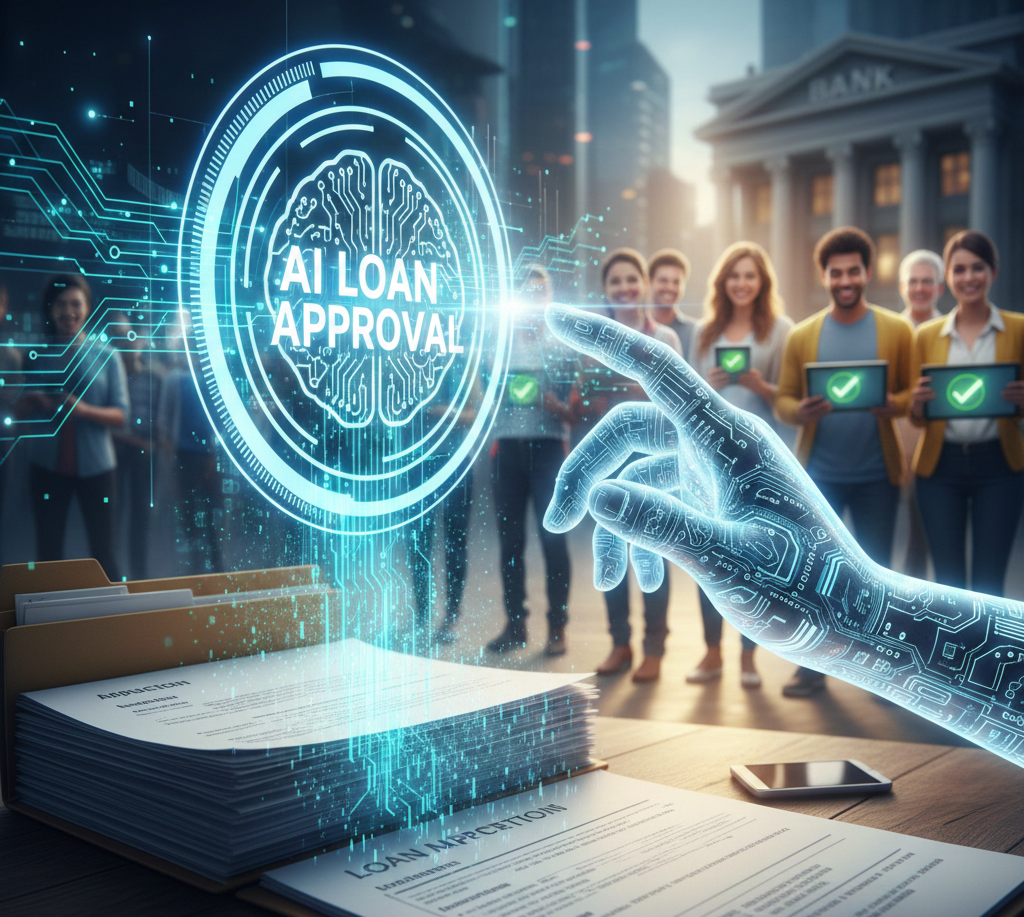
The AI loan approval process begins when a borrower submits an online application. This step collects:
- Personal identification details
- Income and employment information
- Loan amount requested
- Consent for data verification
Most fintech platforms offering instant loan approval online use digital forms that connect directly to verification systems.
The AI loan approval process immediately transfers the application data to an automated underwriting system.
Data Collection and Analysis in the AI Loan Approval Process
After submission, the AI loan approval process gathers both traditional and alternative credit scoring data.
Data sources may include:
| Data Type | Purpose in AI Loan Approval Process |
|---|---|
| Credit bureau data | Credit history review |
| Bank transaction records | Cash-flow analysis |
| Employment data | Income stability check |
| Rental/utility payments | Alternative credit scoring models |
Machine learning in banking analyzes this information in seconds. The automated underwriting system compares the applicant’s profile with historical repayment patterns.
Risk Scoring in the AI Loan Approval Process
Risk scoring is a core stage of the AI loan approval process.
The system:
- Processes collected data.
- Applies predictive risk models.
- Estimates probability of default.
- Assigns a borrower risk grade.
Unlike traditional underwriting, the AI loan approval process evaluates thousands of data points simultaneously.
This predictive approach improves accuracy in automated underwriting systems.
Instant Loan Approval Online Decision
Once risk scoring is complete, the AI loan approval process generates a decision.
Possible outcomes:
- Approved
- Conditionally approved
- Rejected
For qualified applicants, instant loan approval online may occur within minutes. The automated underwriting system determines loan terms such as:
- Interest rate
- Repayment period
- Approved loan amount
This explains how AI approves loans faster than traditional banks.
Loan Offer and Disbursement
In the final stage of the Artificial Intelligence loan approval process:
- The borrower receives a digital loan offer.
- Terms are presented clearly.
- Upon acceptance, funds are disbursed electronically.
Fintech lending trends 2026 show increasing use of fully digital disbursement systems integrated with automated underwriting systems.
Summary
The Artificial Intelligence loan approval process follows five structured steps: application submission, data collection, risk scoring, instant loan approval online decision, and digital disbursement. Machine learning in banking powers each stage through automated underwriting systems and alternative credit scoring models.
Key Takeaways
- The Artificial Intelligence loan approval process is fully digital.
- Automated underwriting systems manage evaluation and scoring.
- Machine learning in banking predicts default risk.
- Alternative credit scoring models expand borrower assessment.
- Instant loan approval online is achieved through real-time analysis.
Pros and Cons
Pros
- Clear step-by-step digital workflow
- Faster decision-making
- Scalable automated underwriting system
- Supports instant loan approval online
Cons
- Requires accurate digital data
- May face compliance challenges
- Dependent on predictive model accuracy
Conclusion
The Artificial Intelligence loan approval process is transforming modern lending by replacing manual underwriting with automated decision systems. Through machine learning in banking, lenders analyze traditional and alternative credit scoring models to predict borrower risk more accurately.
This digital approach enables instant loan approval online, improves efficiency, and supports broader financial inclusion. As fintech lending trends 2026 continue evolving, the AI loan approval process is becoming a core component of automated underwriting systems across the financial industry.
FAQs
1. What is the AI loan approval process?
The AI loan approval process is a digital underwriting system that uses machine learning to evaluate borrower data, predict default risk, and generate automated loan decisions within minutes.
2. How AI approves loans instantly?
AI approves loans by using automated underwriting systems that analyze credit data, income, and alternative credit scoring models in real time. This allows instant loan approval online without manual review.
3. Is instant loan approval online safe?
Instant loan approval online is generally safe when lenders use secure automated underwriting systems and follow regulatory standards. Data encryption and compliance policies help protect borrower information.
4. What is the Upstart loan review process?
The Upstart loan review uses the AI loan approval process to assess education, employment, income, and credit history. Machine learning models generate a risk score and determine approval decisions automatically.
5. What are alternative credit scoring models?
Alternative credit scoring models use non-traditional data such as rental payments, utility bills, and banking activity. In the AI loan approval process, these models expand borrower evaluation beyond standard credit scores.
6. How does an automated underwriting system work?
An automated underwriting system collects applicant data, applies predictive risk algorithms, assigns a risk score, and produces a loan decision. It forms the technical foundation of the AI loan approval process.
7. Will AI replace traditional loan officers?
AI systems automate much of the loan evaluation process. However, human oversight remains important for compliance, complex cases, and regulatory review within the AI loan approval process.
Disclaimer:
All content, including details about the AI loan approval process and lending systems, is provided for awareness purposes only. Always seek guidance from a certified financial expert before applying for loans.