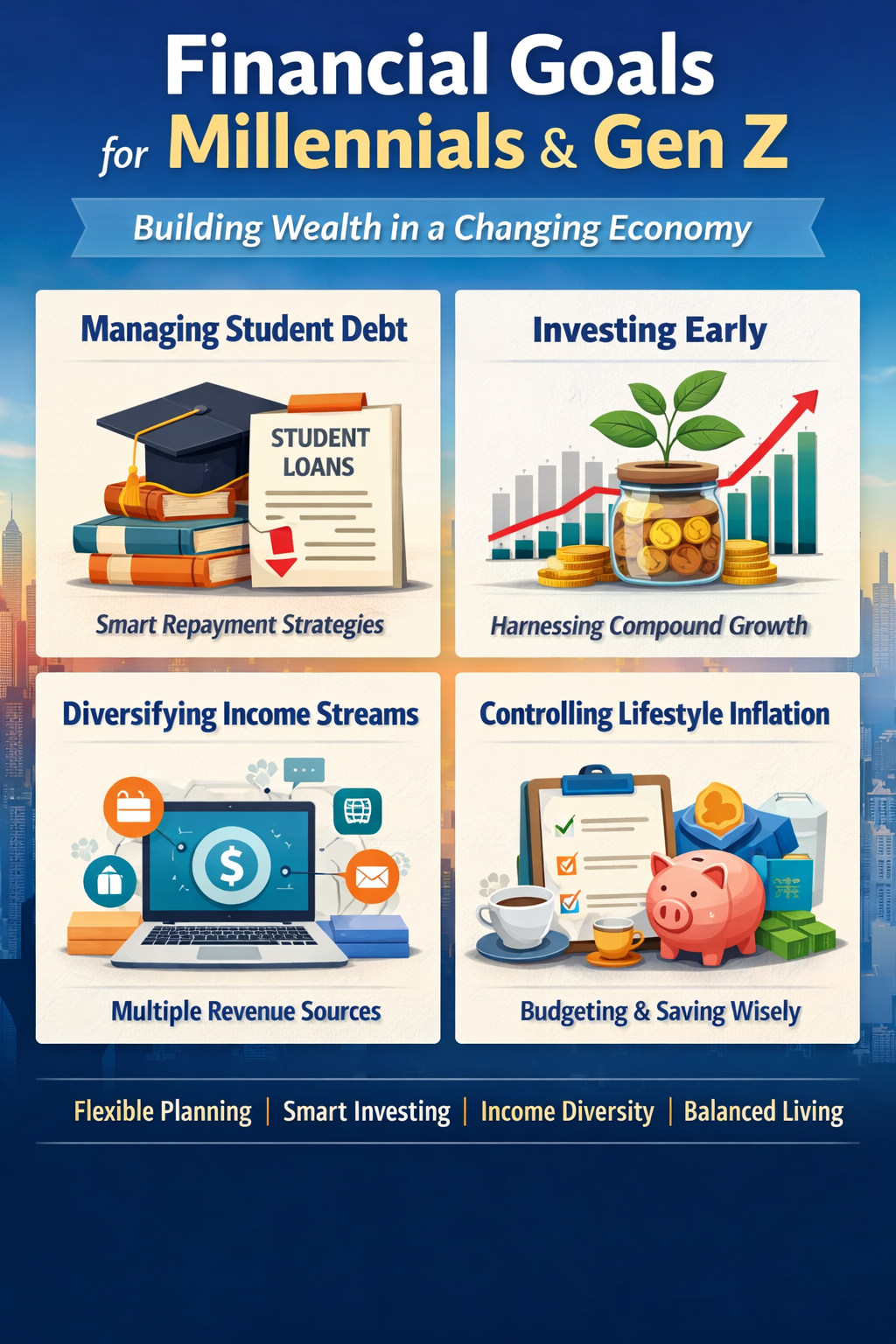
Shifts in Saving, Investing, and Spending Habits Across Generations
Over the past decade, financial planning priorities have shifted significantly among younger generations. Economic volatility, rising housing costs, expanding student debt, and rapid digital innovation have reshaped how wealth is defined and pursued. As a result, financial goals for millennials are no longer centered solely on traditional milestones like early homeownership or lifetime corporate employment.
Millennials entered adulthood during or shortly after the 2008 global financial crisis, a period marked by job instability and declining asset values. According to the Federal Reserve, younger households have carried higher student loan burdens and experienced slower net worth growth compared to previous generations at the same age. These structural pressures significantly influenced financial goals for millennials, pushing many toward liquidity, diversified income streams, and delayed asset purchases.
At the same time, Generation Z has grown up in a fully digital financial ecosystem. Platforms such as Robinhood and Acorns have lowered the barrier to investing, making market participation accessible in early adulthood. This accessibility influences both Gen Z money habits and evolving financial goals for millennials, especially as peer-to-peer financial education spreads through online communities.
Housing affordability remains one of the most defining factors reshaping wealth-building strategies. Data from the U.S. Bureau of Labor Statistics shows wage growth has not consistently kept pace with housing price increases in major metropolitan areas. Consequently, financial goals for millennials increasingly prioritize mobility and investment diversification over immediate property ownership.
Another emerging shift involves values-based investing. Younger investors show stronger interest in ESG-aligned portfolios, supported by asset managers like Vanguard and Fidelity Investments. These preferences demonstrate that financial goals for millennials are not defined solely by accumulation, but also by alignment with social and environmental principles.
In summary, generational financial transformation is driven by three major forces:
- Macroeconomic disruption
- Technological democratization of investing
- Cultural redefinition of success
Together, these forces continue to reshape financial goals for millennials and influence how Gen Z approaches saving, investing, and long-term planning.
Why Financial Goals for Millennials Look Different Today
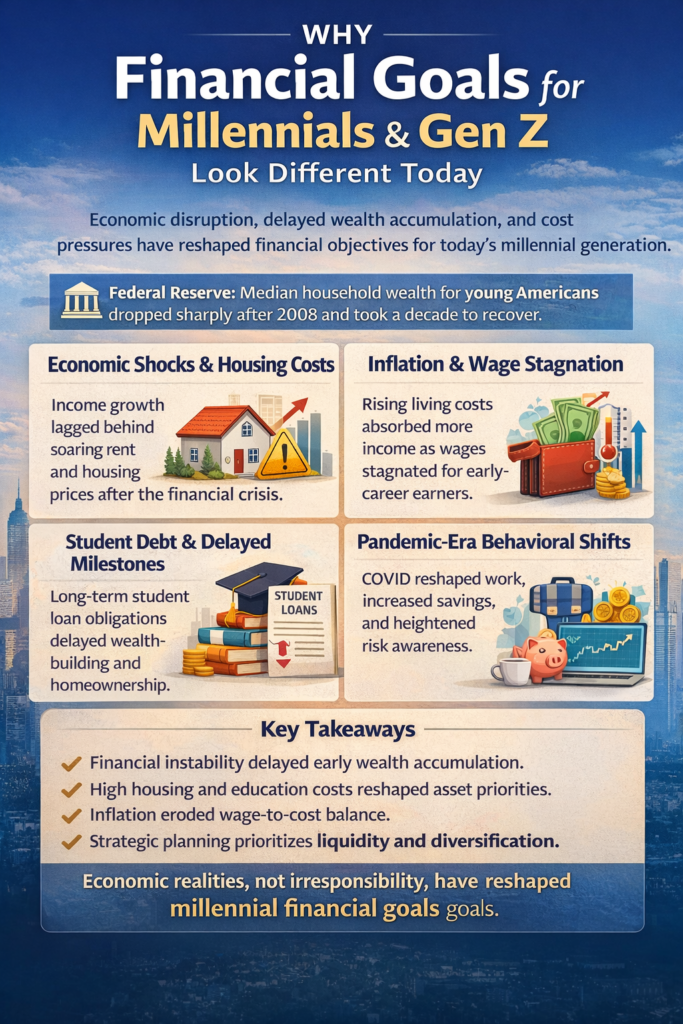
Financial goals for millennials look different today because this generation entered adulthood during economic instability, rising education costs, and rapidly increasing housing prices. Compared to previous generations, millennials faced weaker wage growth, higher debt burdens, and delayed wealth accumulation at similar life stages.
According to the Federal Reserve, median wealth among younger households declined sharply after the 2008 financial crisis and took more than a decade to recover. That prolonged recovery period reshaped long-term planning behavior and permanently influenced financial goals for millennials.
Economic Shocks and Housing Costs
The 2008 global financial crisis disrupted early career trajectories. Many millennials entered the workforce during hiring freezes, reduced compensation growth, and limited advancement opportunities. Lower starting salaries compounded over time, affecting retirement contributions and investment capacity.
At the same time, housing affordability deteriorated. Data from the U.S. Bureau of Labor Statistics shows that rent and home prices in many metropolitan areas have grown faster than median wages over the past decade. This imbalance altered traditional milestones.
As a result, financial goals for millennials increasingly prioritize:
- Liquidity over long-term lock-in
- Geographic mobility over early homeownership
- Diversified investments over single-asset concentration
Delayed homeownership is therefore largely structural rather than behavioral. When fixed costs consume a larger share of income, flexibility becomes a rational financial strategy.
Inflation and Wage Stagnation
Persistent inflation has reduced purchasing power, particularly for early-career professionals. Essential categories—housing, healthcare, and education—consume a greater percentage of income than they did for previous generations at comparable ages.
In response, financial goals for millennials often emphasize:
- Building a 3–6 month emergency fund
- Investing in inflation-resistant assets
- Creating multiple income streams
- Reducing fixed monthly obligations
This recalibration reflects economic adaptation. Rather than abandoning long-term wealth building, millennials are adjusting timelines and risk exposure to match current conditions.
Student Debt and Delayed Milestones
Student loan balances remain a defining variable in generational wealth trends. Education debt affects credit scores, borrowing power, and the ability to accumulate savings early.
Income-driven repayment programs can extend loan terms to 20–25 years, altering capital allocation decisions during prime earning years. In practical terms, student debt delays wealth accumulation by reducing disposable income available for investing, retirement contributions, and homeownership.
Consequently, financial goals for millennials frequently begin with debt stabilization before asset expansion.
Pandemic-Era Behavioral Shifts
The COVID-19 pandemic accelerated structural changes in work and financial behavior. Remote employment expanded geographic flexibility, allowing some households to reduce housing costs or relocate strategically.
Temporary stimulus measures increased short-term savings rates, while market volatility heightened awareness of portfolio risk. Many younger investors diversified earlier and prioritized emergency reserves.
Gen Z Money Habits in a Digital-First Economy
Gen Z money habits are shaped by full immersion in digital finance, mobile-first banking, and instant access to investment platforms. While millennials adapted to technological change, Gen Z entered adulthood expecting seamless financial tools. This environment directly influences how younger adults approach saving, investing, and long-term planning.
A defining feature of Gen Z money habits is early exposure to investing. Platforms such as Robinhood, Acorns, and Betterment allow fractional investing, automated portfolio allocation, and low minimum deposits. This accessibility reduces entry barriers that previously limited participation to higher-income households.
As a result, investing in your 20s has become more normalized. Market participation often begins with exchange-traded funds (ETFs), index funds, and increasingly, digital assets. Platforms like Coinbase have accelerated interest in cryptocurrency, though volatility remains a key risk factor.
How Are Gen Z Money Habits Different?
Gen Z approaches money with three distinct characteristics:
- Digital-first financial management
- Higher comfort with alternative assets
- Greater emphasis on values-based investing
Unlike previous generations who relied heavily on traditional banking institutions, Gen Z frequently uses app-based ecosystems that combine spending, saving, and investing in one interface.
Investing Early Through Automation
Automation is central to Gen Z money habits. Auto-deposits into brokerage accounts, round-up investing tools, and algorithm-driven portfolio management reduce behavioral friction.
According to research from the Federal Reserve, younger investors show increased participation in equities compared to previous generations at the same age. This trend supports the broader shift in financial goals for millennials, as both generations prioritize earlier market entry to leverage compound growth.
Why investing in your 20s matters:
- Compounding multiplies long-term returns
- Risk tolerance is typically higher
- Time horizon allows volatility recovery
Even modest monthly investments can significantly increase net worth over multiple decades.
The Rise of Alternative Assets
Gen Z demonstrates stronger interest in cryptocurrencies, thematic ETFs, and decentralized finance tools. While traditional firms like Vanguard continue to dominate index investing, younger investors diversify across digital-native assets more frequently.
However, higher risk tolerance does not eliminate volatility exposure. Financial planners consistently emphasize asset allocation discipline and portfolio diversification to avoid concentration risk.
Key risk factors include:
- Market speculation driven by social media
- Short-term trading behavior
- Emotional reaction to price swings
These behaviors contrast with long-term compounding strategies historically promoted by institutional investors.
Financial Education via Social Platforms
Another defining feature of Gen Z money habits is peer-driven financial literacy. Educational content circulates rapidly through short-form video platforms, discussion forums, and creator-led finance communities.
This democratization improves awareness but also increases exposure to unverified strategies. As documented by the OECD, financial literacy levels vary widely among younger adults despite higher engagement.
Structured budgeting frameworks—such as the 50/30/20 rule—remain foundational despite digital innovation. These systems allocate:
- 50% to needs
- 30% to discretionary spending
- 20% to savings and investment
Automation often supports these allocations, reinforcing disciplined saving strategies for young adults.
ESG and Values-Based Investing
Gen Z shows stronger preference for environmental, social, and governance (ESG) aligned portfolios. Asset managers including Fidelity Investments have expanded ESG offerings in response to growing demand.
Values-based allocation reflects a broader shift in financial goals for millennials as well, where wealth accumulation increasingly aligns with social impact priorities.
Key Insights
Values-based investing continues to expand among younger cohorts.International organizations such as the OECD and the World Economic Forum have documented widening intergenerational wealth disparities, reinforcing the need for disciplined financial planning.
Digital platforms accelerate early investing participation.
Automation reduces behavioral barriers to saving.
Alternative assets increase diversification but also volatility.
Social media influences both education and speculation.
Summary
- Early career instability reshaped long-term planning behavior
- Housing affordability pressures altered traditional milestones
- Student debt redirected early capital toward repayment
- Inflation reduced purchasing power
- Risk awareness increased after pandemic volatility
Key Takeaways
- Structural economic conditions largely explain evolving financial goals for millennials.
- Delayed milestones reflect cost realities rather than reduced financial discipline.
- Liquidity, diversification, and debt management are now foundational priorities.
Generational Wealth Trends and Financial Data Comparison
Generational wealth trends provide measurable context for understanding how financial priorities have shifted over time. Comparing savings rates, asset ownership, and net worth across age groups reveals structural differences rather than purely behavioral ones.
According to the Federal Reserve, median net worth for younger households remains lower than that of previous generations at comparable ages, largely due to delayed asset acquisition and higher debt burdens. These structural realities continue to influence financial goals for millennials, particularly in the areas of homeownership timing and retirement contributions.
Net Worth by Age Group
Wealth accumulation typically accelerates through home equity growth, retirement account contributions, and business ownership. However, millennials experienced delayed entry into these wealth-building channels following the 2008 financial crisis.
| Generation (at similar age) | Median Net Worth | Primary Asset Driver | Debt Burden Level |
|---|---|---|---|
| Baby Boomers | Higher | Home equity | Moderate |
| Generation X | Moderate | Real estate + equities | Moderate |
| Millennials | Lower (at same age benchmark) | Retirement accounts + diversified investments | Higher (student loans) |
Lower early-stage net worth does not necessarily indicate reduced lifetime potential. Instead, it reflects delayed compounding due to economic timing.
Savings Rate Differences
Savings behavior among younger generations shows both constraint and adaptation. While student debt reduces disposable income, automatic enrollment in employer-sponsored retirement plans has increased participation rates.
Data indicates:
- Millennials contribute to retirement accounts earlier than Gen X did at comparable ages.
- Emergency savings rates fluctuate more frequently due to income variability.
- Gig and freelance income structures influence irregular saving patterns.
These shifts demonstrate that financial goals for millennials increasingly emphasize flexibility over rigid accumulation targets.
Retirement Account Participation
Employer-sponsored plans such as 401(k)s and individual retirement accounts (IRAs) play a central role in long-term wealth building. Automatic enrollment policies have improved participation among younger workers.
Investment firms like Vanguard report higher equity allocation among younger investors, reflecting longer time horizons and greater risk tolerance. This aligns with evolving financial goals for millennials that prioritize growth-oriented portfolios in early career stages.
Risk Tolerance and Asset Allocation Patterns
Younger generations generally allocate a larger portion of portfolios to equities and alternative assets. Exposure to digital platforms has increased comfort with diversified instruments, including ETFs and thematic funds.
However, volatility awareness has also increased following major market disruptions. Many investors balance growth assets with cash reserves to protect against income instability.
Key patterns shaping current generational wealth trends include:
- Delayed homeownership but increased market participation
- Higher education debt but earlier retirement investing
- Greater diversification across asset classes
- Emphasis on liquidity during uncertain economic cycles
These data-driven shifts illustrate that financial goals for millennials are not abandoned—they are restructured around economic realities and technological access.
Summary
- Net worth accumulation for millennials was delayed by macroeconomic shocks.
- Retirement participation has increased due to automatic enrollment policies.
- Equity exposure remains high among younger investors.
- Liquidity and diversification play larger roles in portfolio construction.
Key Takeaways
- Generational wealth differences reflect economic timing rather than financial disengagement.
- Earlier market participation may offset delayed real estate ownership over time.
- Portfolio diversification and retirement contributions remain central to long-term growth strategies.
Saving Strategies for Young Adults in a High-Cost Economy
Rising living expenses and income variability have made structured saving essential for long-term stability. In this environment, financial goals for millennials increasingly begin with liquidity, risk management, and disciplined automation rather than aggressive early asset concentration.
Younger households face higher rent-to-income ratios, elevated healthcare costs, and education-related debt obligations. According to data from the U.S. Bureau of Labor Statistics, essential spending categories have grown faster than discretionary income in many metropolitan areas. As a result, saving strategies must account for cost volatility and income uncertainty.
Building an Emergency Fund
An emergency fund serves as the foundation of financial stability. Most financial planners recommend saving three to six months of essential expenses in a liquid, low-risk account.
Core principles include:
- Prioritizing essential expense coverage (housing, utilities, food, insurance)
- Keeping funds in high-yield savings accounts
- Separating emergency funds from daily spending accounts
Liquidity protects against job disruptions, medical expenses, and unexpected repairs. For many households, financial goals for millennials prioritize emergency stability before investment expansion.
Automation and Budgeting Systems
Automation reduces behavioral friction and increases consistency. Automatic transfers into savings or investment accounts ensure progress regardless of income variability.
Two widely used budgeting frameworks include:
| Method | Allocation Structure | Best For |
|---|---|---|
| 50/30/20 Rule | 50% needs, 30% wants, 20% savings | Stable income earners |
| Zero-Based Budget | Every dollar assigned a role | Variable or gig income |
Automation tools offered by financial platforms such as Betterment support recurring contributions and asset rebalancing. This approach reinforces disciplined savings behavior aligned with evolving financial goals for millennials.
Avoiding Lifestyle Inflation
Lifestyle inflation occurs when spending increases proportionally with income growth. Salary increases can unintentionally expand fixed expenses, reducing long-term wealth accumulation.
Common triggers include:
- Upgrading housing immediately after income growth
- Increasing recurring subscription or financing commitments
- Expanding discretionary spending without increasing savings rate
Preventative strategies:
- Increase savings rate before increasing lifestyle costs
- Cap fixed expense growth below income growth
- Allocate raises toward debt reduction or investments
Controlling lifestyle inflation preserves surplus income for compounding. In practice, many financial goals for millennials now include intentional resistance to unnecessary spending expansion.
Building Multiple Income Streams
Income diversification reduces reliance on a single employer. Gig work, freelance contracts, digital products, and remote consulting have become more accessible through online platforms.
Diversified income supports:
- Faster debt repayment
- Increased retirement contributions
- Greater financial flexibility
This strategy reflects structural adaptation to wage stagnation and economic unpredictability. Rather than relying solely on employer-driven raises, younger adults often build supplementary income channels to accelerate savings.
Summary
- Emergency funds provide financial resilience.
- Automation increases saving consistency.
- Budgeting frameworks create allocation discipline.
- Limiting lifestyle inflation preserves long-term growth capacity.
- Income diversification reduces financial vulnerability.
Key Takeaways
- Liquidity is foundational in high-cost environments.
- Structured systems outperform ad hoc saving.
- Preventing lifestyle inflation significantly improves long-term wealth outcomes.
- Multiple income streams enhance financial security and flexibility.
Investing in Your 20s for Long-Term Wealth Acceleration
Early investing provides a structural advantage because time amplifies returns through compound growth. Even modest contributions can generate significant long-term value when invested consistently over multiple decades. For younger adults, this dynamic plays a central role in shaping financial goals for millennials, particularly as traditional wealth milestones shift later in life.
According to long-term market data analyzed by institutions such as Vanguard, equities have historically outperformed most asset classes over extended time horizons despite short-term volatility. A longer investment runway allows younger investors to absorb market fluctuations while benefiting from compounding.
The Power of Compound Growth
Compound growth occurs when investment earnings generate additional earnings over time. The earlier investing begins, the greater the cumulative effect.
For example:
- Investing consistently from age 25 rather than 35 can result in significantly higher retirement balances.
- Smaller monthly investments over longer periods often outperform larger late-stage contributions.
Time in the market generally has a greater impact than attempting to time market cycles. This principle reinforces why investing in your 20s remains one of the most effective long-term wealth strategies.
Index Funds vs. Individual Stocks
Investment selection significantly affects risk exposure and volatility.
| Investment Type | Risk Level | Diversification | Management Required | Suitable For |
|---|---|---|---|---|
| Index Funds | Moderate | Broad | Low | Long-term passive investors |
| Individual Stocks | Higher | Limited (unless diversified manually) | High | Active investors |
| ETFs | Moderate | Broad | Low to Moderate | Diversified growth strategies |
Index funds and ETFs provide built-in diversification, reducing exposure to single-company risk. Individual stock investing may offer higher upside potential but also carries greater volatility.
Younger investors often allocate larger equity percentages due to longer time horizons. This allocation approach aligns with evolving financial goals for millennials that prioritize growth early and stability later.
Retirement Accounts: 401(k) and IRA
Employer-sponsored retirement plans such as 401(k)s and Individual Retirement Accounts (IRAs) provide tax advantages that enhance long-term returns.
Key benefits include:
- Tax-deferred or tax-free growth
- Employer matching contributions (where available)
- Automatic payroll deductions
Automatic enrollment policies have increased participation among younger workers. Data from the Federal Reserve shows rising equity participation rates among early-career earners compared to previous generations at similar ages.
Maximizing employer match contributions is often considered a foundational investment step due to the immediate return on contribution.
Diversification and Risk Management
Diversification spreads capital across multiple asset classes to reduce concentrated risk. Balanced portfolios often include:
- Domestic equities
- International equities
- Fixed income securities
- Cash or cash equivalents
Market volatility events, including those documented by global policy organizations such as the OECD, reinforce the importance of asset allocation discipline.
While higher risk tolerance is common in early adulthood, unmanaged concentration in speculative assets increases downside exposure. As a result, financial goals for millennials increasingly integrate diversification principles alongside growth objectives.
Core Principles
- Start investing as early as possible to maximize compounding.
- Prioritize diversified funds over concentrated positions.
- Use tax-advantaged accounts before taxable brokerage accounts.
- Align risk exposure with time horizon.
Key Takeaways
- Time horizon is a powerful wealth-building advantage.
- Diversification reduces portfolio volatility.
- Tax-efficient retirement accounts accelerate growth.
- Consistent investing outperforms sporadic contributions over the long term.
Student Loan Repayment Tips and Debt Management Strategy
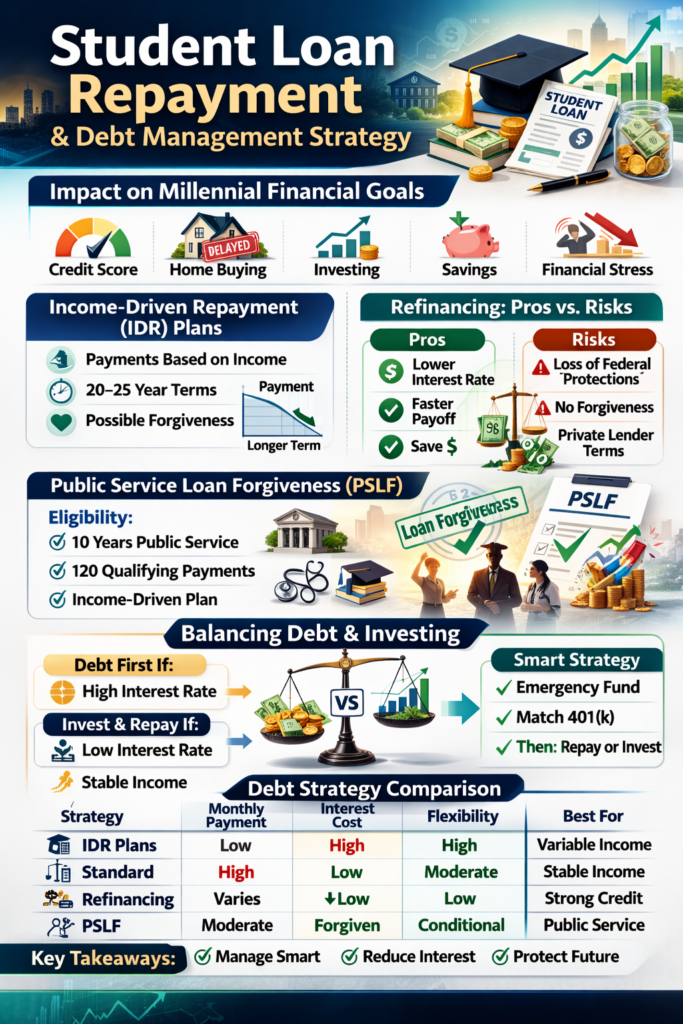
Student debt remains one of the most influential variables shaping financial goals for millennials. Education borrowing affects credit profiles, delays asset acquisition, and reduces disposable income available for investing and homeownership. Because of this structural burden, debt strategy often becomes the first major priority within financial goals for millennials before aggressive wealth expansion begins.
According to the Federal Reserve, student loan balances represent one of the largest categories of non-mortgage household debt in the United States. This sustained repayment obligation significantly influences financial goals for millennials, particularly during early and mid-career stages.
Income-Driven Repayment Plans
Income-Driven Repayment (IDR) plans adjust monthly payments based on income and household size. These programs extend repayment timelines but improve short-term cash flow flexibility.
Key characteristics include:
- Payments calculated as a percentage of discretionary income
- Extended repayment terms (20–25 years)
- Potential remaining balance forgiveness after qualification period
For borrowers with unstable or moderate income growth, IDR plans can stabilize budgeting. However, longer repayment periods may increase total interest paid. As a result, financial goals for millennials must balance cash flow relief with long-term cost efficiency.
Refinancing: Pros and Risks
Loan refinancing replaces existing loans with a new private loan at a different interest rate. Borrowers with strong credit profiles may secure lower rates, reducing lifetime interest costs.
Potential advantages:
- Lower interest rate
- Simplified payment structure
- Shorter repayment term options
Potential trade-offs:
- Loss of federal protections
- Ineligibility for forgiveness programs
- Reduced repayment flexibility
Refinancing decisions directly influence financial goals for millennials because interest savings can be redirected toward retirement contributions or investment accounts.
Public Service Loan Forgiveness (PSLF)
Public Service Loan Forgiveness (PSLF) allows eligible borrowers working in qualifying public-sector roles to receive loan forgiveness after 120 qualifying payments.
This program affects financial goals for millennials pursuing careers in education, healthcare, or government service. When properly structured, repayment strategies can align with long-term career planning and retirement contribution timelines.
Eligibility requirements include:
- Full-time employment in qualifying organizations
- Enrollment in an income-driven repayment plan
- Documented qualifying payments
Understanding eligibility details is critical to prevent disqualification.
Balancing Debt Repayment and Investing
A common financial planning question involves whether to prioritize debt repayment or investment growth. The decision depends on interest rate comparison and risk tolerance.
General framework:
- If loan interest exceeds expected investment return, prioritize repayment.
- If loan interest is relatively low, balanced investing and repayment may be optimal.
- Always maintain emergency reserves before accelerating either strategy.
This dual-track approach increasingly defines financial goals for millennials, combining disciplined debt reduction with steady asset accumulation rather than choosing one exclusively.
Debt Strategy Comparison
| Strategy | Cash Flow Impact | Long-Term Interest | Flexibility | Best For |
|---|---|---|---|---|
| Income-Driven Repayment | Lower monthly payment | Higher total interest | High | Variable income earners |
| Standard Repayment | Higher monthly payment | Lower total interest | Moderate | Stable income earners |
| Refinancing | Depends on new rate | Potentially lower | Low (private terms) | Strong credit borrowers |
| PSLF | Moderate monthly payment | Forgiveness after qualification | Conditional | Public service employees |
Summary
- Student debt significantly shapes early-stage financial planning.
- Repayment strategy influences liquidity and investment capacity.
- Refinancing reduces interest but removes federal protections.
- Forgiveness programs require strict eligibility compliance.
Key Takeaways
- Debt management is foundational within financial goals for millennials.
- Strategy selection should consider interest rate, income stability, and long-term objectives.
- Balanced repayment and investing often outperform extreme prioritization.
- Structured planning reduces long-term financial strain.
Common Financial Mistakes Younger Generations Make
Even as financial literacy improves and digital tools expand access to investing, certain behavioral patterns continue to disrupt long-term planning. Understanding these risks is essential because financial goals for millennials are often vulnerable to short-term decisions that compound over time.
While structural economic factors have reshaped financial goals for millennials, behavioral missteps can either accelerate or delay progress.
Lifestyle Inflation
Lifestyle inflation occurs when spending rises in proportion to income growth. Salary increases, bonuses, or side-income gains often lead to higher fixed expenses rather than increased savings rates.
Common patterns include:
- Upgrading housing immediately after a raise
- Increasing car payments beyond affordability thresholds
- Expanding subscription or financing commitments
- Raising discretionary spending without adjusting savings ratios
When fixed costs expand rapidly, long-term investing capacity declines. Preventing lifestyle inflation is critical to protecting financial goals for millennials, especially in high-cost urban environments.
Prevention strategies:
- Increase savings rate before upgrading lifestyle
- Allocate a fixed percentage of raises toward investments
- Maintain stable fixed expenses relative to income
Disciplined spending preserves surplus income for compounding.
Emotional Investing
Market volatility can trigger reactive decisions. Selling during downturns or chasing speculative assets during rallies reduces long-term return consistency.
Emotional investing behaviors include:
- Panic selling during market corrections
- Concentrating capital in trending assets
- Frequent short-term trading
Long-term data from institutions such as Vanguard consistently show that disciplined, diversified investing outperforms reactive strategies over time. For this reason, maintaining allocation discipline remains central to financial goals for millennials.
Delaying Retirement Contributions
Early contributions carry disproportionate long-term impact due to compound growth. Delaying even five to ten years can significantly reduce final retirement balances.
Common reasons for delay:
- Prioritizing discretionary spending
- Underestimating compounding impact
- Assuming future income increases will compensate
However, small early contributions often outperform larger late-stage deposits. Protecting long-term financial goals for millennials requires consistent participation in retirement accounts from early career stages.
Underestimating Insurance and Risk Protection
Risk management is frequently overlooked in early adulthood. Health insurance gaps, inadequate renter’s insurance, or absence of disability coverage expose households to financial shocks.
Unexpected medical bills or income disruption can rapidly deplete emergency reserves. Risk protection strengthens financial goals for millennials by preserving assets during unforeseen events.
Over-Reliance on a Single Income Source
Relying entirely on one employer creates vulnerability during economic downturns. Layoffs, restructuring, or industry disruption can immediately halt income.
Income diversification—through freelance work, digital products, consulting, or skill monetization—reduces dependency risk. Strengthening income resilience directly supports financial goals for millennials in volatile economic cycles.
Summary
- Lifestyle inflation reduces long-term investing capacity.
- Emotional investing undermines compounding returns.
- Delayed retirement contributions limit growth potential.
- Risk protection gaps increase financial vulnerability.
- Income concentration raises exposure during downturns.
Key Takeaways
- Behavioral discipline is as important as economic strategy.
- Preventing lifestyle inflation protects compounding power.
- Diversification applies to both investments and income streams.
- Risk management strengthens long-term financial stability.
The Future of Wealth Building and financial goals for millennials
The next decade will determine how sustainable wealth creation evolves across generations. Economic volatility, technological acceleration, and shifting career structures are redefining financial goals for millennials in ways that differ dramatically from previous generations.
Unlike prior models centered on lifetime employment and traditional retirement timelines, financial goals for millennials now integrate flexibility, diversification, and adaptability as core components. Long-term stability no longer depends solely on one employer, one pension, or one asset class.
The Rise of Flexible Career Models
Traditional linear career paths are being replaced by hybrid income systems. Freelancing, remote work, digital entrepreneurship, and contract-based employment are becoming normalized structures.
This shift affects financial goals for millennials in several ways:
- Income streams become less predictable
- Retirement contributions may not be employer-sponsored
- Healthcare and benefits must be self-managed
- Tax planning becomes more complex
Rather than relying on employer-sponsored security, individuals are building personal financial ecosystems that combine earned income, investments, and independent savings structures.
Technology-Driven Investing
Digital platforms have dramatically lowered the barriers to entry for investing. Fractional shares, robo-advisors, and automated portfolio tools have expanded participation among young adults.
Organizations like Robinhood and Betterment have enabled simplified account setup and automated allocation models. This accessibility has accelerated participation in equity markets, influencing financial goals for millennials by encouraging earlier engagement with capital markets.
However, increased accessibility also requires financial literacy. Automated tools simplify execution but do not replace strategic planning.
The Shift Toward Values-Based Investing
Environmental, social, and governance (ESG) considerations are increasingly integrated into portfolio decisions. Investors are aligning capital allocation with ethical priorities.
This development influences financial goals for millennials by blending personal values with financial return expectations. Rather than separating profit from principle, many young investors evaluate both simultaneously.
Values-based investing includes:
- Sustainable funds
- Clean energy equities
- Community development investments
- Corporate governance screening
While performance varies, alignment between capital and conviction has become a defining element of modern financial goals for millennials.
Redefining Retirement
Retirement itself is evolving. Instead of a single exit point at age 65, younger generations often envision phased work reduction, remote lifestyle flexibility, or entrepreneurial ventures later in life.
This redefinition impacts savings targets and asset allocation. Rather than funding a fixed 30-year retirement period, financial goals for millennials increasingly prioritize:
- Location flexibility
- Passive income generation
- Early financial independence milestones
- Flexible work-life balance
The concept of financial independence—often associated with movements like FIRE (Financial Independence, Retire Early)—reflects this structural shift in long-term planning.
Intergenerational Wealth Transfer
Significant wealth transfer from older generations is expected over the coming decades. Research from institutions such as Pew Research Center highlights how demographic shifts are reshaping generational wealth trends.
However, inheritance expectations vary widely. While some households may receive asset transfers, others remain reliant entirely on self-generated wealth.
Because of this uncertainty, financial goals for millennials increasingly emphasize self-sufficiency rather than assumed inheritance.
Strategic Outlook
The trajectory of financial goals for millennials will likely continue evolving in response to:
- Inflation dynamics
- Housing affordability trends
- Automation and AI-driven labor shifts
- Healthcare cost changes
- Tax policy adjustments
Resilience and adaptability remain central themes.
Final Perspective
Financial planning for younger generations is no longer defined by rigid milestones. Instead, it is characterized by flexibility, digital access, diversified income, and long-term risk awareness.
As saving strategies evolve, investing platforms expand, and debt structures change, financial goals for millennials continue to reflect a broader transformation in economic reality.
The defining shift is not simply how money is earned or invested—it is how stability itself is understood.
Conclusion
Millennials and Gen Z are not abandoning traditional financial planning—they are reshaping it. Economic shifts, student debt, digital investing access, and changing career models have all influenced financial goals for millennials in meaningful ways. Instead of following rigid timelines, younger generations prioritize flexibility, diversified income, controlled lifestyle inflation, and early investing.
The modern approach centers on resilience and intentional decision-making. By balancing debt repayment, disciplined saving, and long-term investing, financial goals for millennials reflect adaptation to today’s realities rather than rejection of responsibility. The definition of financial success is evolving—and so is the strategy to achieve it.
Frequently Asked Questions
Why are Millennials redefining financial planning?
Economic realities such as rising education costs, housing affordability challenges, and shifting career structures have changed traditional timelines. As a result, financial goals for millennials now prioritize flexibility, diversified income streams, and long-term resilience rather than rigid milestone ages.
How much should Millennials save each month?
A common benchmark is saving 15–20% of gross income, though this varies by location and earnings. Consistency matters more than perfection. Building emergency reserves and investing early both support financial goals for millennials over time.
Should young adults invest while paying off student loans?
It depends on interest rates. High-interest debt should generally be reduced first. However, if loan rates are moderate, balancing repayment with long-term investing can help advance financial goals for millennials without delaying compound growth.
What is lifestyle inflation and why does it matter?
Lifestyle inflation happens when spending increases alongside income. Without discipline, higher earnings do not translate into higher net worth. Managing lifestyle upgrades carefully protects financial goals for millennials and accelerates wealth accumulation.
Are Millennials financially behind previous generations?
Comparisons can be misleading due to different economic conditions. While some traditional milestones occur later, many young adults start investing earlier and use digital tools effectively. Financial goals for millennials reflect adaptation to a changing economy rather than overall decline.
Disclaimer
The information on this website is for educational and informational purposes only. I am not a licensed financial advisor, accountant, or investment professional, and the content should not be considered financial advice.
All decisions regarding investments, debt, taxes, or financial planning should be made based on your personal circumstances and, when appropriate, in consultation with a qualified professional. I do not guarantee the accuracy or completeness of the information provided, and you are responsible for your own financial decisions.