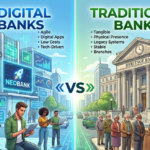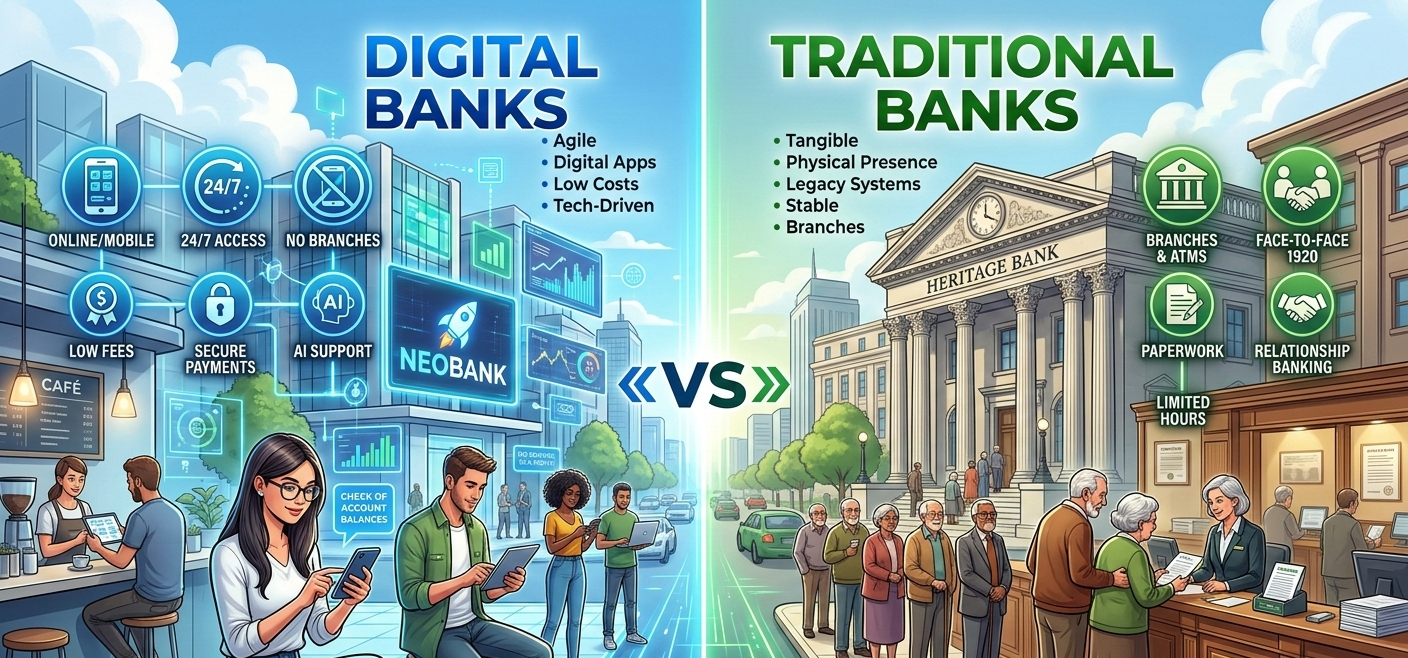
Digital-only banks are financial institutions that operate entirely through the internet. These banks provide services using mobile apps, websites, and digital platforms instead of physical branches. Customers open accounts, manage money, and apply for financial products using smartphones or computers.
Many modern fintech companies provide online banking services and lending products. Examples include platforms such as Chime and Revolut, which focus on mobile banking experiences.
Digital banks are often called neobanks. These institutions rely heavily on technology, automation, and artificial intelligence to provide financial services efficiently. Loan applications are usually completed online within minutes.
A major difference in Digital banks vs traditional banks for loans is how services are delivered. Digital banks remove physical infrastructure and focus on online platforms, which can reduce operating costs and speed up loan processing.
Some digital banks partner with licensed financial institutions to provide regulated banking services. Customer deposits in partner banks may be protected by organizations like the Federal Deposit Insurance Corporation.
Digital lending platforms are designed to make borrowing faster and simpler. Instead of manual paperwork, applications often rely on automated verification systems and digital credit checks.
Definition of Traditional Banks
Traditional banks are established financial institutions that operate through physical branches as well as online banking systems. Customers can visit local branches to speak with bank representatives, open accounts, and apply for loans.
These banks provide a wide range of financial products including:
- Personal loans
- Mortgages
- Business loans
- Credit cards
- Savings accounts
Traditional banks follow strict financial regulations and long-established lending procedures. Loan approvals typically involve credit checks, documentation review, and risk assessments conducted by financial professionals.
In the comparison of Digital banks vs traditional banks for loans, traditional banks are known for offering structured lending programs and personalized customer support. Borrowers can meet with advisors who explain loan terms and repayment options.
Many consumers trust traditional banks because of their long history, regulatory oversight, and established reputation in the financial industry. Regulatory agencies such as the Consumer Financial Protection Bureau oversee consumer protection and lending practices.
However, loan approvals at traditional banks often take longer due to detailed verification processes. This is one reason many borrowers explore digital lenders when they need faster access to funds.
How Neobanks Changed the Lending Industry
The growth of financial technology has significantly changed how people borrow money. Neobanks and online lenders have introduced faster, technology-driven lending systems.
Traditional lending often required branch visits, paperwork, and manual approvals. Digital banking platforms simplified these processes by moving applications online.
In the modern comparison of Digital banks vs traditional banks for loans, several changes have become noticeable:
- Loan applications can be completed in minutes
- Credit checks are automated
- Identity verification is digital
- Approval decisions may happen quickly
Fintech companies use algorithms and data analysis to evaluate borrower risk. These automated systems allow online banks to process many applications quickly while reducing administrative costs.
Another key difference between Digital banks vs traditional banks for loans is accessibility. Digital platforms allow borrowers to apply for financing from anywhere using a smartphone or computer.
Despite these innovations, traditional banks still play a major role in the lending market. Many borrowers prefer institutions that offer physical locations and long-term financial relationships.
Both banking models continue to evolve as financial technology advances and consumer expectations change.
Summary
Digital banks operate entirely online through mobile apps and websites, while traditional banks provide services through branch networks and online platforms. In the comparison of Digital banks vs traditional banks for loans, digital institutions emphasize speed and convenience, while traditional banks focus on structured lending processes and in-person financial services.
Key Takeaways
- Digital banks provide financial services through apps and websites.
- Traditional banks operate through branch networks and established lending systems.
- Neobanks use automated technology to process loan applications quickly.
- Traditional banks often provide more personalized customer support.
- The comparison of Digital banks vs traditional banks for loans mainly involves speed, accessibility, and service style.
Digital Banks vs Traditional Banks for Loans: Key Differences
Understanding the key differences between digital lenders and traditional banks helps borrowers choose the right option for personal financing. The comparison of Digital banks vs traditional banks for loans often focuses on application processes, approval speed, interest rates, and eligibility requirements.
Digital banks rely on technology and automated systems, while traditional banks follow established lending procedures and manual verification. These structural differences influence how quickly loans are approved and how borrowers interact with lenders.
Also Read: Credit Utilization Hacks That Actually Work
Loan Application Process
One of the most noticeable differences in Digital banks vs traditional banks for loans is the loan application process.
Digital banks provide a fully online experience. Borrowers typically complete applications through mobile apps or websites. The process usually involves:
- Creating an online account
- Submitting personal and financial details
- Uploading identification documents
- Agreeing to digital verification checks
Applications often take only a few minutes to complete.
Platforms such as Revolut allow users to apply for financial services directly through mobile applications. Digital identity verification tools confirm information quickly without requiring branch visits.
Traditional banks, on the other hand, may require more steps. Some banks offer online applications, but many still involve additional verification procedures. Borrowers may need to:
- Visit a local branch
- Submit paperwork
- Provide proof of income
- Complete manual identity verification
These additional steps can make the process slower but often provide more detailed financial assessment.
In the comparison of Digital banks vs traditional banks for loans, digital platforms focus on convenience while traditional banks emphasize thorough documentation.
Loan Approval Speed
Loan approval speed is another major difference when evaluating Digital banks vs traditional banks for loans.
Digital banks often approve applications much faster because automated systems evaluate borrower information immediately. Many fintech lenders use algorithms to review credit data and financial patterns.
As a result, approvals may happen within:
- Minutes
- A few hours
- One business day
Fast approvals are a major reason many borrowers choose digital lenders for short-term financial needs.
Traditional banks usually follow a slower approval process. Loan officers review applications manually and may require additional documentation. The evaluation process can include:
- Credit history analysis
- Income verification
- Risk evaluation
- Internal approval procedures
Because of these steps, loan approvals from traditional banks may take several days.
According to lending industry observations, automated underwriting systems have significantly reduced approval time for online lenders compared to traditional institutions.
Interest Rate Structures
Interest rates can vary depending on the lender type and the borrower’s credit profile. In the comparison of Digital banks vs traditional banks for loans, both models may offer competitive rates, but the pricing structure often differs.
Digital banks sometimes offer attractive rates because they operate with lower overhead costs. Without branch networks and large physical infrastructure, operating expenses may be reduced.
Lower operating costs can allow some online lenders to provide competitive interest rates for qualified borrowers.
However, interest rates from digital lenders can also vary widely depending on credit risk assessments performed by automated systems.
Traditional banks usually offer more standardized loan programs. Rates are often based on structured lending policies and established financial guidelines.
Borrowers with strong credit histories may qualify for competitive rates from traditional institutions because of long-term banking relationships.
Therefore, when evaluating Digital banks vs traditional banks for loans, interest rates depend heavily on borrower credit profiles and lender policies rather than the banking model alone.
Loan Eligibility Requirements
Loan eligibility requirements also differ between digital lenders and traditional banks.
Digital lenders often use automated risk models that analyze multiple data points, including:
- Credit scores
- Income information
- Banking history
- Spending patterns
These systems allow lenders to make fast decisions based on digital financial records.
Because the process is automated, some digital platforms may approve borrowers who have limited credit history but stable financial behavior.
For example, fintech platforms such as Chime focus on digital financial tools that help users manage everyday banking activities.
Traditional banks typically apply stricter eligibility requirements. Borrowers may need to provide documentation such as:
- Proof of income
- Employment records
- Credit history reports
- Financial statements
These requirements help lenders evaluate long-term repayment ability.
In the overall comparison of Digital banks vs traditional banks for loans, digital lenders prioritize speed and data automation, while traditional banks prioritize detailed financial evaluation.
Comparison Table
| Feature | Digital Banks | Traditional Banks |
|---|---|---|
| Application method | Mobile app or website | Branch or online |
| Approval speed | Minutes to 24 hours | Several days |
| Documentation | Minimal digital verification | Extensive paperwork |
| Customer interaction | Mostly online | In-person or online |
| Loan flexibility | Limited options | Broader loan programs |
Summary
The key differences in Digital banks vs traditional banks for loans involve how loan applications are processed, how quickly approvals occur, and how lenders evaluate borrower risk. Digital banks rely on automated systems and mobile platforms, while traditional banks use structured lending procedures and detailed financial verification.
Key Takeaways
- Digital banks provide faster loan applications through online platforms.
- Automated underwriting allows quicker approval decisions.
- Traditional banks often require more documentation and manual review.
- Interest rates depend mainly on borrower credit profiles.
- The comparison of Digital banks vs traditional banks for loans often centers on speed, convenience, and verification procedures.
Online Banks Personal Loans
Online banking has transformed how people access financial services. Many lenders now offer personal loans through fully digital platforms, allowing borrowers to apply, receive approval, and manage repayment without visiting a physical branch.
In the modern comparison of Digital banks vs traditional banks for loans, online lending platforms represent one of the most important developments in financial technology. These platforms simplify borrowing by using digital systems to process applications quickly and efficiently.
Online banks focus on convenience, accessibility, and speed. Borrowers can submit loan applications from a computer or smartphone, often completing the process within minutes.
How Digital Lending Platforms Work
Digital lending platforms operate through mobile apps or websites that connect borrowers directly with lending systems. These platforms collect financial data, verify identity, and analyze creditworthiness using automated tools.
When someone applies for a personal loan through an online bank, the typical process includes:
- Creating an online account
- Completing a digital application form
- Submitting personal and financial details
- Verifying identity electronically
- Receiving an automated lending decision
Many fintech institutions use modern banking apps to provide seamless financial services. Platforms such as Revolut allow users to manage banking activities directly through mobile interfaces.
These digital systems remove many traditional banking barriers, such as branch visits and lengthy paperwork. As a result, the borrowing process becomes faster and more convenient.
The evolution of digital lending has played a major role in the ongoing discussion about Digital banks vs traditional banks for loans, especially for borrowers who prioritize speed and ease of use.
Automated Loan Underwriting Systems
One of the main technologies behind online personal loans is automated underwriting. This system evaluates borrower information using algorithms and financial data analysis.
Instead of relying entirely on manual review by loan officers, automated underwriting systems analyze multiple factors at the same time, including:
- Credit scores
- Income patterns
- Transaction history
- Debt levels
- Payment behavior
This technology allows digital lenders to evaluate risk quickly and efficiently. Automated decisions may reduce processing time significantly compared with traditional lending procedures.
In the comparison of Digital banks vs traditional banks for loans, automated underwriting is one reason online banks often provide faster loan approvals.
However, automated systems also rely heavily on digital financial records. In the comparison of Digital banks vs traditional banks, borrowers with limited credit history or incomplete financial data may experience different evaluation outcomes depending on the platform’s risk algorithms.
Mobile-Based Loan Applications
Mobile technology has become central to modern online banking services. Many digital lenders design their systems specifically for smartphone users.
Mobile-based loan applications allow borrowers to:
- Apply for loans from anywhere
- Upload documents using phone cameras
- Track application status in real time
- Receive approval notifications instantly
Platforms such as Chime emphasize mobile-first banking experiences. Users can manage financial services directly from their mobile devices.
This mobile accessibility is a key factor in the broader comparison of Digital banks vs traditional banks for loans. Traditional institutions may offer online services, but many still rely on physical branches for certain financial interactions.
Online banks, by contrast, focus on creating fully digital financial ecosystems where customers can manage loans, payments, and accounts entirely through mobile platforms.
Typical Online Personal Loan Process
| Step | Digital Lending Process |
|---|---|
| Application | Completed online or through mobile app |
| Identity verification | Digital verification systems |
| Credit evaluation | Automated underwriting algorithms |
| Approval decision | Minutes to hours |
| Loan funding | Often within 1–2 business days |
Summary
Online banks personal loans are designed to simplify the borrowing process through digital platforms. Automated underwriting systems, mobile applications, and electronic verification allow lenders to evaluate applications quickly. In the comparison of Digital banks vs traditional banks for loans, online lending platforms emphasize speed, accessibility, and technology-driven decision making.
Key Takeaways
- Online banks provide personal loans through fully digital platforms.
- Borrowers can apply using websites or mobile apps.
- Automated underwriting systems analyze financial data quickly.
- Mobile banking technology allows real-time loan management.
- The comparison of Digital banks vs traditional banks for loans often highlights the efficiency of online lending systems.
Neobank Loan Comparison: Fintech vs Conventional Lending
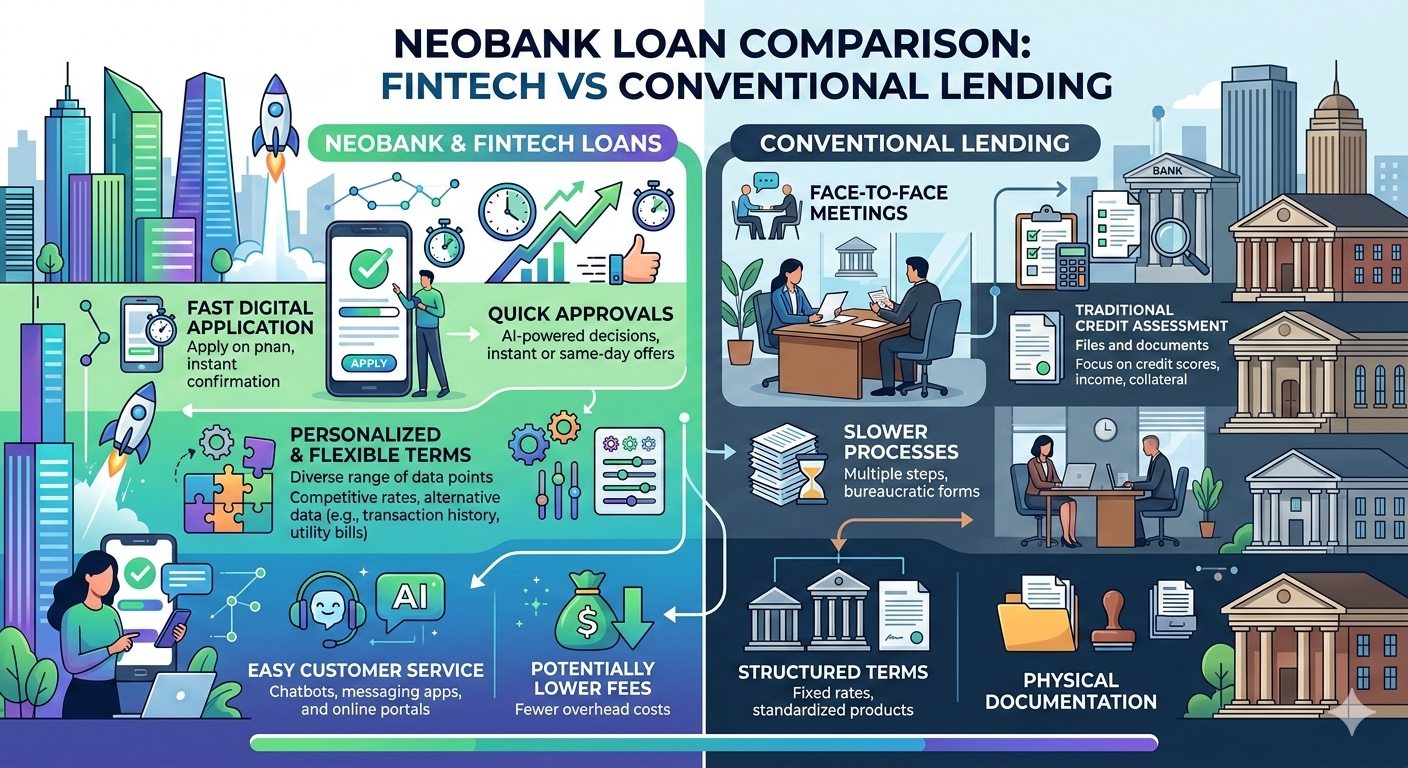
The financial industry has experienced major changes with the rise of fintech companies and neobanks. These digital institutions focus on technology-driven banking services, including personal loans and credit products. Understanding the differences between fintech lending and traditional lending is important when evaluating Digital banks vs traditional banks for loans.
Neobanks typically operate through digital platforms without physical branches. Conventional lenders, such as established banks, rely on long-standing financial systems and in-person services. Both models provide lending options, but the way they deliver those services differs significantly.
Technology Advantages of Neobanks
One of the biggest strengths of fintech lenders is their use of advanced technology. Neobanks rely on digital infrastructure that allows them to process financial transactions and loan applications quickly.
Technology advantages commonly include:
- Automated lending decisions
- Digital identity verification
- Real-time account monitoring
- Mobile banking integration
- Instant notifications for loan updates
Companies like Revolut provide financial services through mobile apps that allow customers to manage accounts, track spending, and apply for financial products in one place.
These innovations are an important factor in the comparison of Digital banks vs traditional banks for loans, because digital platforms can reduce operational costs and simplify financial processes.
Automation also reduces the need for manual paperwork. Borrowers can upload documents electronically, and financial data may be verified using secure online systems.
Accessibility and Convenience
Another major benefit of digital lending platforms is accessibility. Neobanks are designed to allow customers to access financial services at any time through internet-connected devices.
Borrowers can apply for loans:
- From home
- While traveling
- Using mobile apps
- Through online banking portals
This convenience is especially valuable for individuals who prefer managing finances digitally.
In contrast, traditional banks often require branch visits for certain financial services. Although many traditional institutions provide online applications, some processes may still involve additional documentation or in-person verification.
When comparing Digital banks vs traditional banks for loans, digital lenders typically provide greater flexibility in how and where borrowers interact with financial services.
However, accessibility also depends on reliable internet access and digital literacy. Customers who prefer face-to-face interactions may still favor conventional banking institutions.
Limitations of Digital Lending
Despite their technological advantages, digital lending platforms also have certain limitations.
Some neobanks offer a narrower range of loan products compared with traditional banks. Many fintech lenders focus primarily on small personal loans, short-term financing, or credit-building tools.
For example, platforms like Chime focus heavily on everyday banking services and financial management tools rather than a wide range of complex loan products.
Another limitation can involve customer support. Because digital banks operate online, support is often provided through:
- Chat systems
- Email support
- Help centers
Traditional banks may provide more comprehensive support through physical branches and financial advisors.
In the broader discussion of Digital banks vs traditional banks for loans, these differences highlight a key trade-off. Digital lenders emphasize speed and convenience, while traditional banks offer broader services and in-person assistance.
Comparison Table
| Feature | Fintech / Neobanks | Traditional Banks |
|---|---|---|
| Banking model | Fully digital | Branch-based + online |
| Loan processing | Automated systems | Manual review processes |
| Accessibility | Mobile and online access | Branch visits often required |
| Product range | Limited loan options | Wider financial products |
| Customer support | Online support channels | In-person financial advisors |
Summary
Neobanks use financial technology to deliver fast and convenient lending services through digital platforms. Traditional banks rely on established financial systems and branch networks. In the comparison of Digital banks vs traditional banks for loans, fintech lenders emphasize technology and accessibility, while conventional banks focus on broader services and personalized support.
Key Takeaways
- Neobanks rely on technology-driven lending systems.
- Digital platforms allow borrowers to apply for loans anytime online.
- Automated systems help fintech lenders process applications faster.
- Traditional banks typically offer a wider range of loan products.
- The comparison of Digital banks vs traditional banks for loans often highlights the trade-off between convenience and service depth.
Chime Loan Options and Features
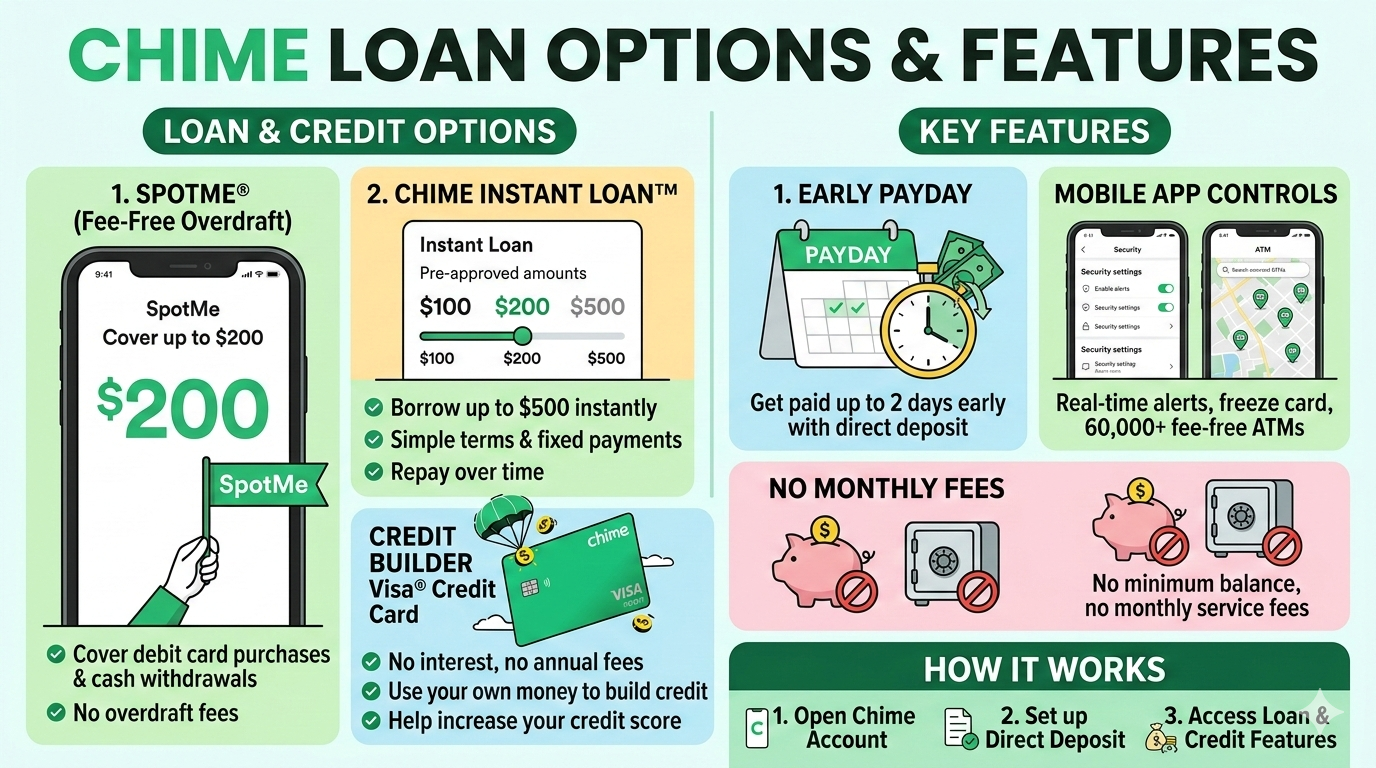
Digital banking platforms have introduced new ways for consumers to access short-term financial support. One example is Chime, a financial technology company that focuses on mobile banking services and digital financial tools. Understanding how its lending-related features work helps clarify the broader comparison of Digital banks vs traditional banks for loans.
Unlike many traditional banks that provide multiple structured loan products, Chime focuses primarily on simplified financial tools designed to help users manage everyday expenses. These tools often act as alternatives to small personal loans rather than traditional long-term lending products.
SpotMe Overdraft Feature
One of the most widely known financial features offered by Chime is SpotMe, a fee-free overdraft program designed to help customers cover small short-term spending gaps.
Instead of issuing a standard personal loan, SpotMe allows eligible users to overdraft their accounts up to a certain limit without paying traditional overdraft fees. The overdraft amount is typically repaid automatically when the next deposit enters the account.
Key characteristics of the SpotMe feature include:
- Fee-free overdraft protection
- Automatic repayment from deposits
- Small borrowing limits
- Mobile account management
This type of feature demonstrates how fintech platforms approach short-term financial assistance differently from conventional lenders. In discussions about Digital banks vs traditional banks for loans, digital banks sometimes replace traditional loan products with flexible financial tools like overdraft coverage.
Short-Term Lending Alternatives
Some digital banking platforms focus on alternatives to traditional personal loans. In the comparison of Digital banks vs traditional banks, instead of offering large multi-year loans, they may provide tools that help customers manage short-term financial needs.
These alternatives can include:
- Early access to direct deposits
- Small overdraft coverage
- Budgeting tools within mobile apps
- Credit-building financial products
These features are designed to help users avoid high-cost borrowing methods such as payday loans.
Digital platforms like Chime focus heavily on financial management features that support everyday spending rather than long-term borrowing.
In the broader comparison of Digital banks vs traditional banks for loans, this difference highlights a shift in strategy. Traditional banks generally offer structured loan products with defined repayment schedules, while some digital banks provide smaller financial assistance tools integrated into mobile banking systems.
Eligibility Requirements
Eligibility for Chime financial features is generally based on account activity rather than traditional loan application processes.
Users typically need to meet requirements such as:
- Having an active account
- Receiving regular direct deposits
- Maintaining account activity
Unlike traditional loan applications that involve extensive paperwork and credit checks, eligibility for digital financial tools may depend more on banking behavior and transaction history.
This approach reflects a key difference in Digital banks vs traditional banks for loans. Digital banking platforms often rely on account data and automated systems to determine eligibility for financial assistance.
However, borrowing limits for these tools are usually smaller than standard personal loans offered by conventional banks.
Chime Lending-Related Features
| Feature | Description |
|---|---|
| SpotMe overdraft | Allows fee-free overdrafts within a set limit |
| Early paycheck access | Allows users to access deposits earlier |
| Mobile banking tools | Financial management through mobile apps |
| Eligibility system | Based on account activity and deposits |
Summary
Chime provides digital financial tools that help customers manage short-term financial needs. Instead of traditional personal loans, the platform offers features like fee-free overdraft coverage and early paycheck access. In the comparison of Digital banks vs traditional banks for loans, this reflects how fintech companies sometimes replace standard loan products with flexible digital financial tools.
Key Takeaways
- Chime is a digital banking platform focused on mobile financial services.
- Its SpotMe feature provides small overdraft coverage instead of traditional loans.
- Eligibility often depends on account activity and direct deposits.
- Borrowing limits are usually smaller than standard personal loans.
- The comparison of Digital banks vs traditional banks for loans highlights how fintech platforms sometimes offer alternative financial tools instead of traditional lending products.
Revolut Personal Loans
Digital banking platforms increasingly offer lending services through mobile applications. One example is Revolut, a global fintech platform that provides banking, payments, and financial management services. Understanding how its loan system works helps illustrate the evolving comparison of Digital banks vs traditional banks for loans.
Revolut focuses on integrating lending products directly into its mobile banking ecosystem. Customers can apply for loans, monitor repayments, and manage financial activity through a single digital platform.
Unlike many traditional lenders that require branch visits or extensive paperwork, Revolut’s lending system is designed for speed, automation, and convenience.
Loan Application Through the App
Revolut allows eligible users to apply for personal loans directly through its mobile application. The application process is designed to be simple and fast.
A typical loan application through the app includes:
- Logging into the Revolut mobile account
- Selecting the loan option in the financial services section
- Entering the requested loan amount
- Providing financial details if required
- Reviewing and confirming the application
Because the system is fully digital, many verification steps happen automatically. Identity verification and financial data checks can be completed through secure digital systems.
In the comparison of Digital banks vs traditional banks for loans, mobile-first applications represent a major shift in how borrowers interact with lenders. Instead of filling out lengthy paperwork, customers can complete the entire process on a smartphone.
Interest Rate Structure
Interest rates for Revolut loans typically depend on the borrower’s financial profile. Factors that may influence loan pricing include:
- Credit score
- Income stability
- Existing financial obligations
- Repayment history
Digital lenders often use automated algorithms to determine interest rates based on risk analysis.
Because fintech platforms operate with lower infrastructure costs compared with traditional banks, some borrowers may receive competitive loan pricing depending on eligibility.
However, as with all lending products, rates vary by borrower and region. In discussions of Digital banks vs traditional banks for loans, interest rate differences often depend more on borrower creditworthiness than on the type of bank.
Countries Where Revolut Loans Are Available
Digital lending services are not always available in every country. Revolut offers personal loan products in selected markets where financial regulations allow these services.
Availability may depend on:
- Local banking regulations
- Licensing requirements
- Consumer lending laws
- Regional financial infrastructure
Financial services are regulated by government authorities in different regions. In many markets, consumer lending oversight is provided by regulatory organizations such as the Consumer Financial Protection Bureau or equivalent national authorities.
This regulatory framework plays an important role in shaping the comparison of Digital banks vs traditional banks for loans, since both types of lenders must comply with financial laws in the regions where they operate.
Revolut Personal Loan Features
| Feature | Description |
|---|---|
| Application method | Through mobile banking app |
| Approval process | Automated digital assessment |
| Loan management | Managed within the app |
| Interest rates | Based on borrower credit profile |
| Availability | Limited to certain countries |
Summary
Revolut offers personal loans through its mobile banking platform, allowing eligible users to apply, receive approval, and manage repayment digitally. In the broader comparison of Digital banks vs traditional banks for loans, Revolut demonstrates how fintech platforms integrate lending services into mobile banking ecosystems.
Key Takeaways
- Revolut provides personal loans through its mobile application.
- Applications are completed digitally without branch visits.
- Interest rates depend on borrower credit profiles and financial data.
- Loan availability varies depending on local financial regulations.
- The comparison of Digital banks vs traditional banks for loans highlights how fintech platforms streamline the lending process through technology.
Why Online Banks Often Offer Faster Loan Approval
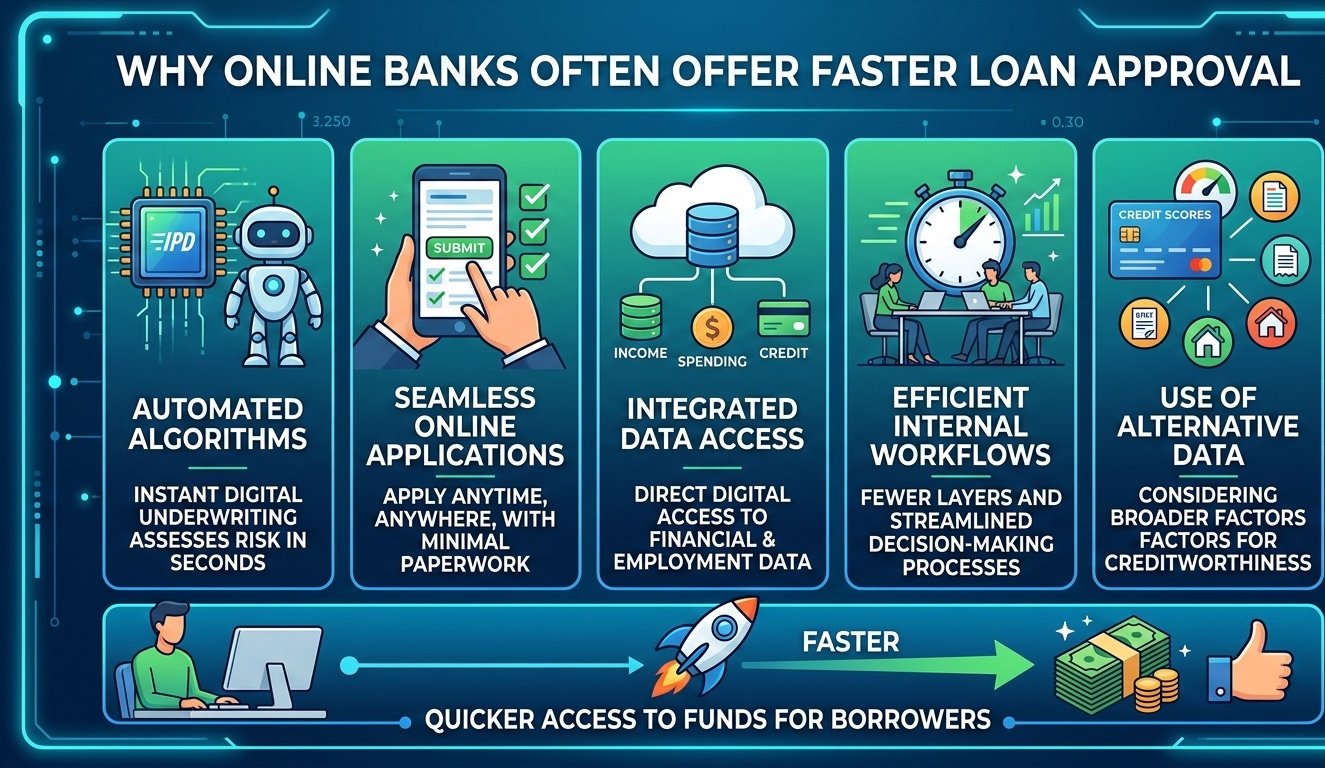
One of the key advantages of digital banks is speed. In the comparison of Digital banks vs traditional banks for loans, online lenders often provide faster loan approvals due to technology-driven systems and streamlined processes.
Traditional banks may take several days to review applications, verify documents, and make decisions. Online banks, however, leverage automated systems that can evaluate borrower information instantly, significantly reducing approval time.
Automated Credit Checks
Online banks frequently use automated credit check systems. These systems instantly pull credit information from reporting agencies to assess borrower risk.
Benefits of automated credit checks include:
- Immediate evaluation of creditworthiness
- Reduced human error
- Faster decision-making
By comparing borrower credit history, existing debts, and payment behavior, digital lenders can approve or decline loans within minutes or hours. This automation is a major factor in the speed advantage of digital platforms.
AI-Based Risk Assessment
Many fintech lenders use AI and machine learning algorithms to assess loan risk. These algorithms analyze multiple data points such as:
- Credit scores
- Banking activity
- Spending patterns
- Existing financial obligations
AI-based risk assessment allows digital banks to evaluate potential default risk more efficiently than traditional manual review processes. This helps online lenders offer faster decisions while maintaining responsible lending standards.
For borrowers, this means a quicker loan approval process when evaluating Digital banks vs traditional banks for loans compared with conventional banking institutions.
Digital Verification Systems
Identity and document verification are also automated in most online banking platforms. Digital verification tools can:
- Scan and validate IDs using mobile cameras
- Confirm employment or income digitally
- Cross-check financial records automatically
These digital verification systems reduce the time-consuming steps of in-person verification required by traditional banks. Combined with automated credit checks and AI-driven risk analysis, online banks can deliver near-instant loan decisions.
Factors Contributing to Faster Loan Approval in Online Banks
| Factor | Digital Bank Approach | Traditional Bank Approach |
|---|---|---|
| Credit check | Automated | Manual or semi-manual |
| Risk assessment | AI-based algorithms | Loan officer review |
| Identity verification | Digital tools | In-person verification |
| Approval time | Minutes to hours | Several days |
Summary
Online banks offer faster loan approval due to automation, AI-based risk assessment, and digital verification systems. In the comparison of Digital banks vs traditional banks for loans, speed is one of the most significant advantages of fintech lenders.
Key Takeaways
- Digital banks use automated credit checks to evaluate borrower risk quickly.
- AI algorithms analyze multiple data points for faster loan decisions.
- Digital verification tools reduce the need for in-person document review.
- Approval times for online banks can be minutes to hours, compared with days for traditional banks.
- The comparison of Digital banks vs traditional banks for loans highlights speed as a primary advantage of digital lenders.
Pros and Cons of Digital Banks for Borrowers
Digital banks offer a modern approach to banking, focusing on mobile platforms, automation, and convenience. In the comparison of Digital banks vs traditional banks for loans, understanding the advantages and disadvantages of digital lenders helps borrowers make informed decisions.
Advantages of Digital Banks
Digital banks provide several benefits, especially for borrowers seeking convenience and speed:
- Faster Loan Approval – Automated systems and AI-driven underwriting allow near-instant decisions.
- Convenient Application Process – Loans can be applied for entirely online via apps or websites.
- Lower Operating Costs – Fewer physical branches can translate to competitive rates or reduced fees.
- 24/7 Accessibility – Mobile banking allows borrowers to manage loans at any time.
- Innovative Financial Tools – Features like overdraft protection, early deposits, and budgeting apps enhance financial management.
These advantages make digital lenders particularly appealing for short-term financial needs and tech-savvy borrowers.
Disadvantages of Digital Banks
Despite their benefits, digital banks also have limitations:
- Limited Loan Products – Many neobanks offer fewer loan options compared with traditional banks.
- Smaller Borrowing Limits – Short-term or low-limit loans are common, making them unsuitable for large financing needs.
- Online-Only Support – Customer service is mostly digital, which can be challenging for users who prefer face-to-face assistance.
- Reliance on Technology – Internet access and digital literacy are required, which may exclude some users.
- Regulatory Differences – Some digital lenders operate under alternative regulatory frameworks, which can affect protection and dispute resolution.
These disadvantages highlight trade-offs borrowers must consider when evaluating Digital banks vs traditional banks for loans.
Situations Where Digital Banks Work Best
Digital banks are most suitable in scenarios such as:
- Borrowers needing fast approval for short-term personal loans
- Users comfortable with mobile-first banking
- Individuals seeking low-fee or convenient financial tools
- Customers with existing digital banking accounts who want integrated loan features
Understanding these use cases helps borrowers decide when a digital lender may be preferable in the context of Digital banks vs traditional banks for loans.
Table: Pros and Cons of Digital Banks
| Pros | Cons |
|---|---|
| Fast loan approvals | Limited loan products |
| Convenient online applications | Smaller borrowing limits |
| Lower operating costs | Mostly online support |
| 24/7 accessibility | Requires digital literacy |
| Innovative financial tools | Alternative regulatory oversight |
Summary
Digital banks offer fast, convenient, and technology-driven lending solutions. In the comparison of Digital banks vs traditional banks for loans, they excel in speed, accessibility, and digital features but may have smaller loan options and limited in-person support.
Key Takeaways
- Digital banks provide fast and convenient loan application processes.
- Borrowers can manage loans entirely through mobile or web platforms.
- Loan products may be limited, and borrowing amounts are often smaller.
- Customer support is mainly online.
- Digital lenders are ideal for tech-savvy borrowers needing quick financial solutions.
Pros and Cons of Traditional Banks for Personal Loans
Traditional banks offer long-established financial services through branch networks and structured lending programs. In the comparison of Digital banks vs traditional banks for loans, understanding the strengths and limitations of conventional lenders is crucial for borrowers.
Advantages of Traditional Banks
Traditional banks provide several benefits, particularly for borrowers seeking stability and broader loan options:
- Wide Range of Loan Products – Includes personal loans, mortgages, business loans, and secured lending options.
- Higher Borrowing Limits – Often capable of offering larger loan amounts compared with digital lenders.
- Personalized Customer Support – Access to loan officers and in-branch advisors helps clarify terms and repayment plans.
- Trusted Reputation – Long-standing institutions with established regulatory oversight provide confidence and security.
- Regulatory Protections – Deposits and loans are covered by regulated consumer protection frameworks.
These advantages make traditional banks appealing for larger loans, long-term financing, or borrowers who value face-to-face support when comparing Digital banks vs traditional banks for loans.
Disadvantages of Traditional Banks
Despite their strengths, traditional banks also have some limitations:
- Slower Loan Approval – Manual processing and verification can take several days.
- More Documentation Required – Borrowers must provide detailed financial records, which can slow the process.
- Less Flexible Accessibility – In-branch visits may be required for certain services.
- Higher Fees in Some Cases – Operational costs of physical branches can be reflected in fees.
- Limited Digital-First Tools – Online platforms may exist, but digital innovations are often slower compared to neobanks.
These limitations highlight why some borrowers prefer digital alternatives for quick or short-term financing.
Situations Where Traditional Banks Are Better
Traditional banks are best suited for:
- Borrowers needing large personal loans or secured loans
- Individuals who value personalized in-branch support
- Customers prioritizing reputation and regulatory security
- Borrowers with complex financial needs or long-term financing plans
In the comparison of Digital banks vs traditional banks for loans, traditional lenders excel in structured lending, stability, and comprehensive support.
| Pros | Cons |
|---|---|
| Wide range of loan products | Slower loan approval |
| Higher borrowing limits | More documentation required |
| Personalized customer support | Less flexible accessibility |
| Trusted reputation | Higher fees in some cases |
| Strong regulatory protections | Digital tools less advanced |
Summary
Traditional banks offer stability, higher borrowing limits, and personalized support for borrowers. In the comparison of Digital banks vs traditional banks for loans, conventional lenders excel in structured financing and regulatory protections but may be slower and less digitally flexible than online banks.
Key Takeaways
- Fast approval from digital banks does not always mean the best loan when comparing Digital banks vs traditional banks, as traditional lenders may offer more favorable terms.
- Regulatory compliance and deposit protections should always be verified when choosing between Digital banks vs traditional banks to ensure borrower security.
- Traditional banks provide a broad range of loan products and higher borrowing limits compared with digital banks, a key distinction in Digital banks vs traditional banks.
- Customer support and in-person advice are major advantages in the Digital banks vs traditional banks comparison.
- Loan approval can be slower in traditional banks due to manual verification and documentation, highlighting a speed difference in Digital banks vs traditional banks.
Security, Regulation, and Consumer Protection
When comparing Digital banks vs traditional banks for loans, security and regulatory compliance are critical factors. Borrowers must understand how both banking models protect funds, enforce lending rules, and ensure financial safety.
Digital banks operate primarily online, while traditional banks maintain physical branches and established regulatory frameworks. Each approach has implications for data security, deposit protection, and consumer rights.
Banking Regulations for Traditional Banks
Traditional banks are heavily regulated by government authorities. In the U.S., for example, regulations include:
- Oversight by the Federal Deposit Insurance Corporation
- Supervision by the Consumer Financial Protection Bureau
Key regulatory requirements for traditional banks include:
- Deposit insurance to protect customer funds
- Strict lending standards and documentation
- Anti-money laundering and fraud prevention measures
- Regular audits and compliance checks
These regulations ensure borrower security and provide confidence in structured loan programs, highlighting the differences in oversight between Digital banks vs traditional banks. Regulatory frameworks reduce the risk of fraud, default, or unfair lending practices in both banking models.
Fintech Regulation for Digital Banks
Digital banks are subject to evolving regulatory oversight. Many operate in partnership with licensed financial institutions to comply with legal requirements.
Key aspects of fintech regulation include:
- Licensing under national or regional financial authorities
- Data protection and cybersecurity standards
- Compliance with consumer lending laws
- Transparent disclosure of fees and terms
Regulation may vary by country, and some neobanks operate under alternative frameworks compared with traditional banks. Borrowers should confirm that the digital lender is fully compliant with local regulations before applying for loans.
Deposit Protection Systems
Deposit protection differs between banking models:
- Traditional Banks: Deposits are typically insured up to a certain amount (e.g., $250,000 in the U.S.) by federal insurance agencies.
- Digital Banks: Deposits may be insured if the fintech partner bank is FDIC-insured or under a similar government scheme. Some digital platforms use custodial accounts to protect funds, but coverage depends on the provider.
In the context of Digital banks vs traditional banks for loans, deposit protection is a crucial consideration for borrowers who want security for both loan and account funds.
Security and Regulation Comparison
| Aspect | Traditional Banks | Digital Banks |
|---|---|---|
| Regulatory oversight | Extensive, long-established | Evolving, often through partner banks |
| Deposit protection | Federal insurance (e.g., FDIC) | Partner bank insurance or custodial coverage |
| Lending rules | Strict documentation and compliance | Automated verification with regulatory compliance |
| Fraud & risk management | Manual + automated | Digital-first, AI-enabled |
Summary
Security and regulation play a key role in the comparison of Digital banks vs traditional banks for loans. Traditional banks follow strict government oversight and deposit insurance programs, while digital banks rely on evolving fintech regulations and partnerships with insured institutions.
Key Takeaways
- Traditional banks are heavily regulated with deposit insurance and strict lending rules.
- Digital banks operate under fintech regulations, often partnering with insured institutions.
- Security includes fraud prevention, data protection, and transparent lending practices.
- Borrowers should verify the regulatory compliance of digital lenders.
- In Digital banks vs traditional banks for loans, regulation and security are key factors for financial safety.
Which Loan Option Is Better for Different Borrowers
Choosing between digital banks and traditional banks depends on individual financial needs, priorities, and comfort with technology. In the comparison of Digital banks vs traditional banks for loans, borrower profiles often determine which option is most suitable.
Borrowers Who Benefit Most from Digital Banks
Digital banks are ideal for borrowers who value speed, convenience, and digital access. Typical profiles include:
- Tech-Savvy Users: Comfortable managing banking entirely through mobile apps or online platforms.
- Short-Term Loan Seekers: Need fast approval for smaller personal loans or short-term financial gaps.
- Cost-Conscious Borrowers: Prefer lower fees or minimal overhead costs often offered by neobanks.
- Younger Consumers: Millennials and Gen Z may favor mobile-first banking solutions integrated with financial management tools.
Digital lenders excel in scenarios requiring quick access to funds, real-time account management, and automated decision-making.
Borrowers Who Benefit Most from Traditional Banks
Traditional banks are better suited for borrowers who prioritize stability, long-term financing, and in-person support. Typical profiles include:
- Large Loan Applicants: Need higher borrowing limits or secured loans, such as for home renovation or debt consolidation.
- Long-Term Financing Needs: Prefer structured repayment schedules and long-term personal loans.
- Individuals Seeking Personalized Guidance: Value direct interaction with loan officers and financial advisors.
- Risk-Averse Borrowers: Trust institutions with long histories, regulated frameworks, and deposit insurance coverage.
Traditional banks are preferred when borrowers need comprehensive services, strong regulatory oversight, or face complex financial situations.
Factors to Consider When Choosing
When deciding between digital and traditional loans, consider these factors:
- Loan Amount Needed: Large amounts may favor traditional banks.
- Approval Speed: Urgent funds may favor digital banks.
- Product Variety: Traditional banks typically offer more loan types.
- Customer Support Preference: Online chat vs in-person advice.
- Comfort with Technology: Willingness to manage loans digitally.
These considerations allow borrowers to choose the best fit based on personal circumstances when evaluating Digital banks vs traditional banks for loans.
Borrower Profiles and Recommended Loan Type
| Borrower Type | Recommended Loan Option | Reason |
|---|---|---|
| Tech-savvy, short-term needs | Digital banks | Fast, online applications and approvals |
| Requires large personal loans | Traditional banks | Higher borrowing limits and structured programs |
| Prefers in-person guidance | Traditional banks | Personalized advice and support |
| Cost-conscious, smaller loans | Digital banks | Lower fees, minimal overhead |
| Complex financial situations | Traditional banks | Comprehensive services and regulatory protections |
Summary
Loan choice depends on borrower priorities. In the comparison of Digital banks vs traditional banks for loans, digital lenders are ideal for speed and convenience, while traditional banks are better for larger loans, long-term financing, and in-person guidance.
Key Takeaways
- Digital banks suit borrowers needing fast, convenient, and smaller loans.
- Traditional banks suit borrowers needing larger, structured loans or personalized support.
- Factors like loan amount, approval speed, and technology comfort influence the choice.
- Regulatory security and customer support style are key considerations.
- Understanding personal financial needs is critical in choosing the best lending option.
Common Mistakes When Choosing Between Digital and Traditional Loans
Borrowers often make mistakes when deciding between digital banks and traditional banks. In the comparison of Digital banks vs traditional banks for loans, understanding common pitfalls helps avoid costly errors and ensures better financial outcomes.
Focusing Only on Speed
Many borrowers choose digital banks solely because they offer faster approval. While quick access to funds is convenient, it may not always be the best decision.
Mistakes include:
- Overlooking interest rates or fees
- Ignoring repayment terms
- Applying for loans that are too small or too short-term for actual needs
In the long run, prioritizing speed over suitability can lead to financial stress.
Ignoring Regulatory Protections
Some borrowers underestimate the importance of security and regulation when using digital banks. Not all digital platforms have full deposit insurance or operate under local financial regulations.
Mistakes include:
- Assuming all deposits are insured
- Using unregulated platforms for significant loans
- Overlooking the risk of limited dispute resolution
Checking a lender’s regulatory compliance is essential in the Digital banks vs traditional banks for loans comparison.
Overestimating Borrowing Limits
Digital banks often have smaller loan limits compared with traditional banks. Borrowers may apply expecting larger sums and face rejection or insufficient funds.
Common errors include:
- Planning budgets based on maximum anticipated loans
- Choosing digital lenders for high-value financing needs
- Ignoring structured loan programs from traditional banks
Neglecting Long-Term Costs
Some borrowers focus on upfront convenience and fail to evaluate long-term financial implications.
Mistakes include:
- Ignoring interest rate variability
- Not considering fees or penalties
- Overlooking repayment schedules
Traditional banks may have higher upfront requirements, but they often offer predictable and manageable long-term repayment plans.
Common Borrower Mistakes
| Mistake | Explanation |
|---|---|
| Choosing speed over suitability | Prioritizing fast approval without checking rates or terms |
| Ignoring regulation | Using lenders without deposit insurance or proper compliance |
| Overestimating loan limits | Expecting large loans from digital lenders with smaller limits |
| Neglecting long-term costs | Failing to account for interest, fees, and repayment obligations |
Summary
Borrowers often make mistakes by prioritizing speed, ignoring regulatory protections, overestimating loan limits, or neglecting long-term costs. Awareness of these pitfalls helps make informed decisions in the Digital banks vs traditional banks for loans comparison.
Key Takeaways
- Fast approval does not always mean the best loan.
- Verify digital banks’ regulatory compliance and deposit protections.
- Digital lenders may have lower borrowing limits than traditional banks.
- Consider total cost, including interest and fees, before borrowing.
- Avoid common mistakes to make smarter financial decisions.
Conclusion
In the evolving financial landscape, both digital banks and traditional banks offer viable options for personal loans, but the best choice depends on borrower needs. Digital banks stand out for speed, convenience, and mobile-first services, making them ideal for short-term loans or tech-savvy users. Traditional banks, however, provide stability, higher borrowing limits, structured repayment options, and in-person support, making them suitable for larger or long-term financing needs.
When comparing Digital banks vs traditional banks for loans, borrowers should consider factors such as:
- Loan amount and purpose
- Approval speed
- Comfort with digital tools
- Regulatory protections and deposit security
- Customer support preferences
Ultimately, informed decision-making requires balancing speed, accessibility, cost, and security to choose the lender that best fits individual financial circumstances.
FAQs
Q1: What are digital banks?
A: Digital banks, also called neobanks, operate entirely online or through mobile apps. They offer banking services like deposits, payments, and personal loans without physical branches, often using automated systems and AI-driven tools.
Q2: How fast can I get a loan from a digital bank?
A: Many digital banks approve loans within minutes to a few hours, thanks to automated credit checks, AI-based risk assessment, and digital verification systems.
Q3: Are digital banks safe for borrowing?
A: Yes, if the digital bank is regulated and partners with insured financial institutions. Borrowers should verify regulatory compliance and deposit protection before applying.
Q4: When is a traditional bank better than a digital bank?
A: Traditional banks are preferable for larger loans, long-term financing, or when borrowers want personalized guidance, structured repayment plans, and strong regulatory protections.
Q5: Do digital banks offer the same loan products as traditional banks?
A: Not always. Digital banks often focus on small personal loans, overdraft tools, or short-term financing, while traditional banks provide a wider range of loan types, including secured loans and larger amounts.
Q6: What is the main advantage of traditional banks over digital banks?
A: The main advantages are higher borrowing limits, in-person support, regulatory protections, and long-term stability.
Q7: How do I decide which bank type is right for me?
A: Consider your loan amount, urgency, preference for digital vs in-person service, regulatory security, and comfort with technology. Aligning these factors with your financial goals will guide your choice.
Disclaimer
This content provides general information on Digital banks vs traditional banks for loans and is intended for educational purposes only. It does not constitute financial advice, investment guidance, or professional consultation. Readers should independently verify information and consult licensed financial advisors before making any lending or banking decisions.