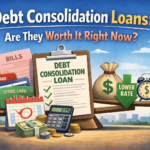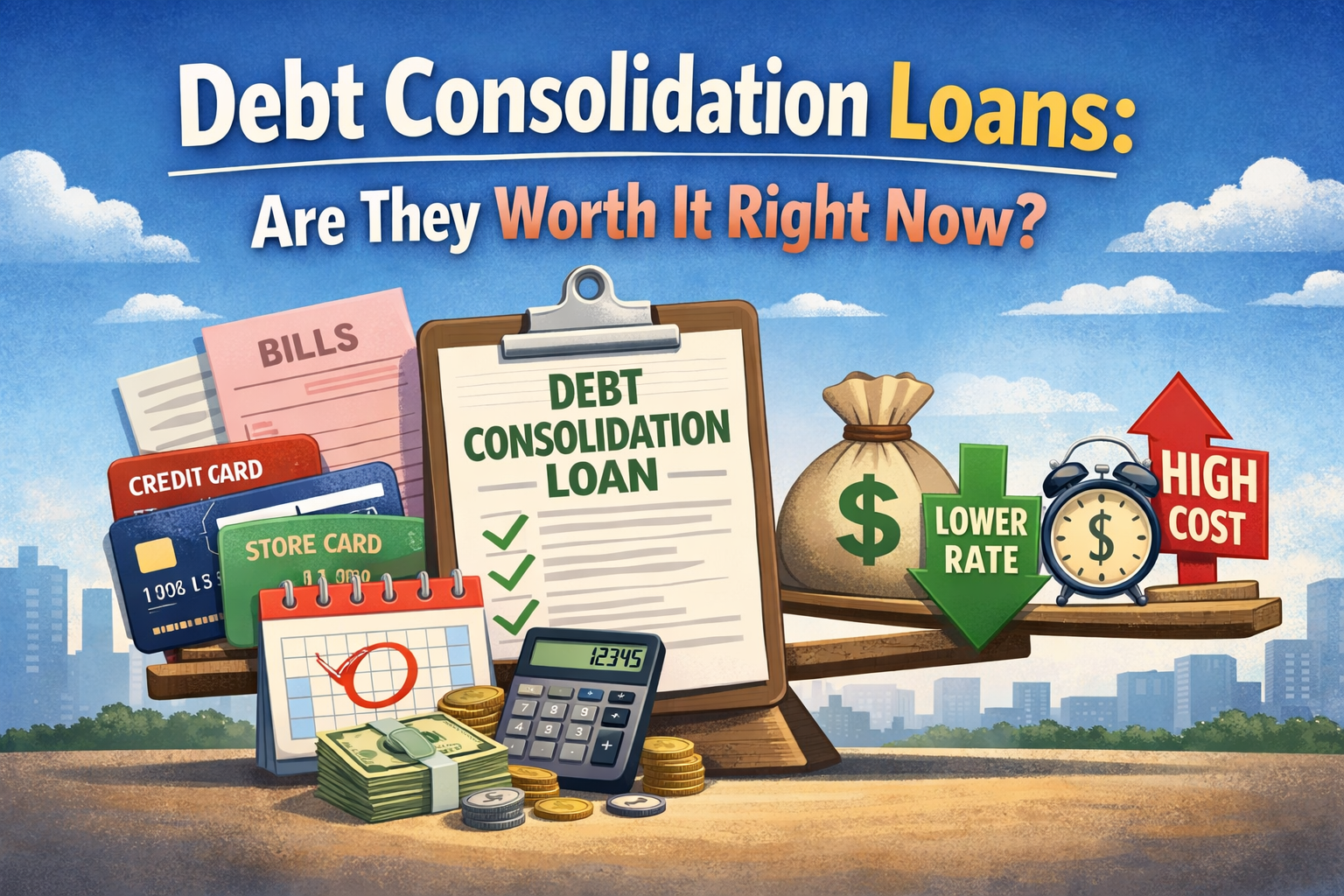
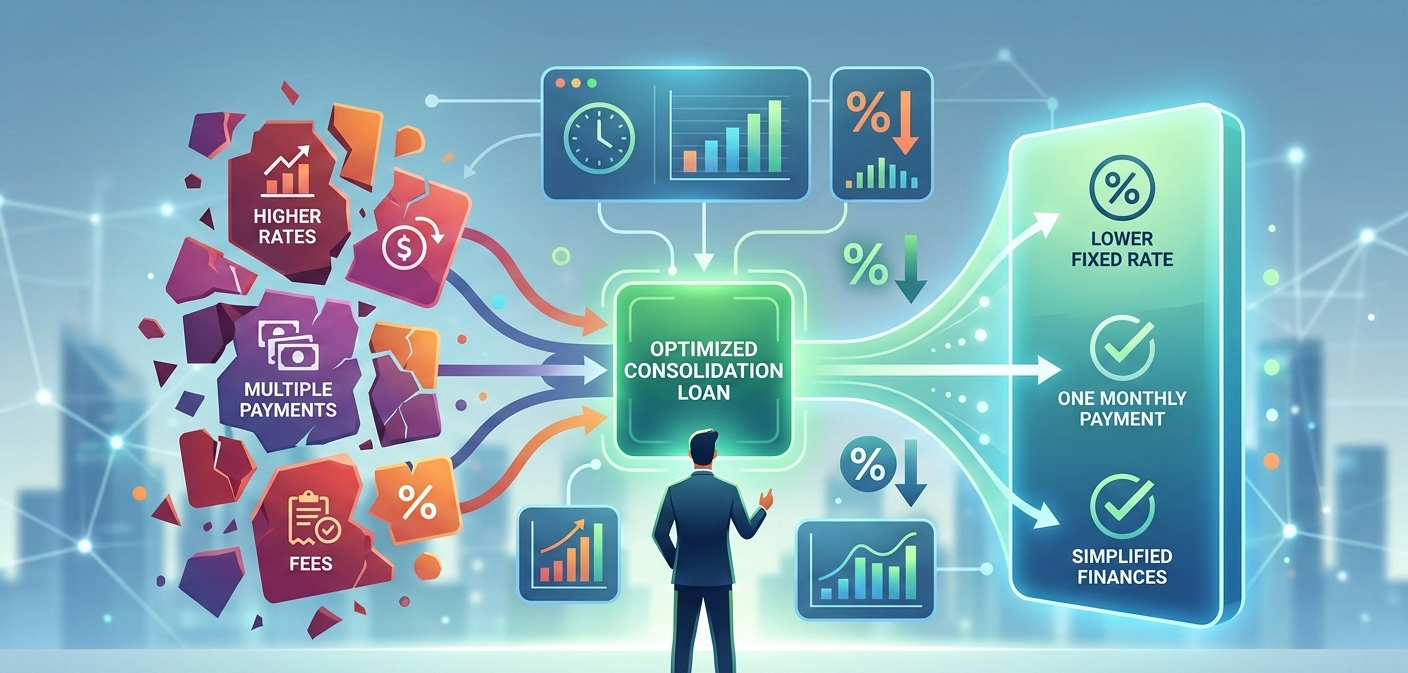
Debt consolidation loans are personal installment loans used to combine multiple debts into one single payment. Instead of paying several credit cards with different interest rates, borrowers use debt consolidation loans to pay them off and repay one fixed monthly loan.
These loans are commonly used to consolidate credit card debt because credit cards often carry higher interest rates than installment loans. The main goal of debt consolidation loans is to reduce monthly debt payments, lower interest costs, and simplify repayment.
When approved, the lender either pays your creditors directly or deposits funds into your account. You then repay the new loan in fixed monthly installments over a set term.
How Debt Consolidation Loans Reduce Monthly Debt Payments
Debt consolidation loans can reduce monthly debt payments in three main ways:
- Lower interest rate compared to credit cards
- Extended repayment term
- Fixed repayment structure
If you qualify for low interest consolidation loans, your total interest may decrease. A longer term can also reduce monthly pressure, though it may increase total interest over time.
When Debt Consolidation Loans Increase Total Cost
Debt consolidation loans are not always cheaper. Costs may increase when:
- The interest rate is not lower than your current rates
- The loan term is extended significantly
- Origination fees are added
- Variable rates increase over time
If the new APR is higher or the term is too long, debt consolidation loans may result in paying more overall, even if monthly payments are smaller.
Summary
They combine multiple debts into one fixed monthly payment. They can lower interest and make repayment easier but may increase total cost if rates or fees are high.
Key Takeaways
- Debt consolidation loans simplify multiple debts into one payment.
- They may reduce monthly debt payments.
- Qualification determines access to low interest consolidation loans.
- Longer terms reduce monthly cost but may raise total interest.
Pros and Cons
Pros
- Single fixed payment
- Predictable repayment schedule
- Potential interest savings
- Credit utilization improvement if cards are paid off
Cons
- Possible origination fees
- Risk of longer repayment period
- Approval depends on credit score
- May increase total interest if misused
Interest Rate Trends and Their Impact on Debt Consolidation Loans
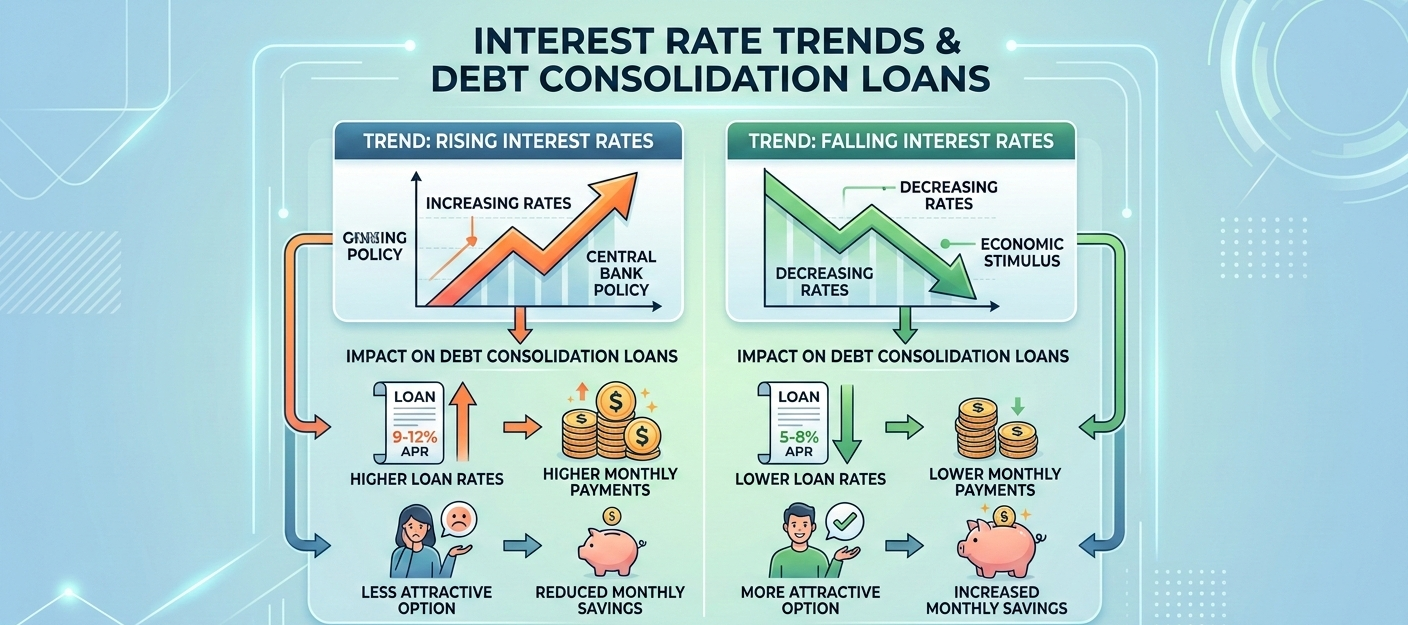
Interest rates directly affect how affordable debt consolidation loans are. When benchmark rates rise, personal loan APRs typically increase. When rates fall, borrowers may qualify for lower-cost options.
Lenders price debt consolidation loans based on market conditions, credit score, income stability, and debt-to-income ratio. Because of this, the broader rate environment plays a major role in determining whether consolidation is financially beneficial right now.
Federal Reserve Rate Environment
The Federal Reserve influences overall borrowing costs by adjusting benchmark interest rates. When the Federal Reserve increases rates to control inflation, banks and online lenders usually raise APRs on personal loans, including debt consolidation loans.
In a high-rate environment:
- Average APRs increase
- Qualification becomes stricter
- Low interest consolidation loans become harder to access
In a stable or declining rate cycle:
- Borrowers with strong credit may secure better fixed terms
- Monthly savings potential improves
Average APR for Debt Consolidation Loans
APR typically depends on credit profile:
| Credit Profile | Typical APR Range | Impact on Savings |
|---|---|---|
| Excellent | Lower range | Higher savings potential |
| Good | Moderate range | Possible savings |
| Fair | Higher range | Limited benefit |
| Poor | Highest range | May not reduce cost |
If your new APR is significantly lower than your credit card rates, debt consolidation loans can reduce monthly debt payments and total interest. If the rate difference is small, savings may be minimal.
Low Interest Consolidation Loans – Who Qualifies?
Low interest consolidation loans are generally available to borrowers who:
- Have strong credit scores
- Maintain stable income
- Show low debt-to-income ratio
- Have consistent payment history
Lenders such as SoFi and Marcus by Goldman Sachs evaluate these factors carefully before approving debt consolidation loans.
In higher-rate periods, even well-qualified borrowers may see elevated APRs compared to previous years. This means timing matters when evaluating whether debt consolidation loans are worth it.
Summary
Interest rate trends significantly influence the cost of debt consolidation loans. Higher benchmark rates increase APRs, while stable or declining rates improve savings potential for qualified borrowers.
Key Takeaways
- Debt consolidation loans become more expensive when benchmark rates rise.
- APR depends on credit score and financial stability.
- Low interest consolidation loans require strong qualification.
- Comparing current rates to your existing debt rates is essential.
Pros and Cons in a High-Rate Environment
Pros
- Still simplifies multiple debts
- Fixed structure protects against future rate increases
- May reduce monthly debt payments if APR is lower
Cons
- Savings margin may shrink
- Qualification standards tighten
- Total interest may remain high if rate difference is small
Fixed vs Variable Consolidation Loan – Which Is Better?
When choosing debt consolidation loans, borrowers must decide between fixed and variable interest rates. This choice affects long-term cost, stability, and monthly payment predictability.
Most debt consolidation loans are structured as fixed-rate installment loans. However, some lenders may offer variable-rate options tied to market benchmarks.
Fixed Interest Debt Consolidation Loans
Fixed-rate debt consolidation loans maintain the same interest rate for the entire loan term. Monthly payments remain consistent from start to finish.
Benefits of fixed debt consolidation loans:
- Predictable monthly payment
- Protection from future rate increases
- Easier budgeting
- Clear total repayment amount
In a rising rate environment, fixed debt consolidation loans provide stability and financial certainty.
Variable Interest Debt Consolidation Loans
Variable-rate debt consolidation loans have interest rates that can change over time based on market conditions. Payments may increase or decrease depending on benchmark movements.
Risks of variable debt consolidation loans:
- Payment uncertainty
- Potential cost increase if rates rise
- Difficult long-term budgeting
If benchmark rates increase, total repayment cost may exceed original projections.
Also Read: How to Increase Credit Score by 100 Points in 6 Months
Fixed vs Variable Consolidation Loan Comparison
| Factor | Fixed Rate | Variable Rate |
|---|---|---|
| Payment Stability | Consistent | Can change |
| Budget Predictability | High | Low to Moderate |
| Risk in Rising Rate Market | Low | High |
| Long-Term Cost Certainty | Clear | Uncertain |
Which Option Is Better Right Now?
In uncertain or elevated rate environments, fixed debt consolidation loans are generally safer because they lock in repayment costs. Variable options may only benefit borrowers if rates are expected to decline and if they can tolerate payment fluctuations.
The better choice depends on:
- Current interest rate trends
- Personal risk tolerance
- Income stability
- Financial planning horizon
Summary
Fixed debt consolidation loans offer stable payments and predictable costs, while variable loans carry interest rate risk. In higher-rate periods, fixed options typically provide stronger financial protection.
Key Takeaways
- Most debt consolidation loans are fixed-rate.
- Fixed loans provide payment certainty.
- Variable loans may increase in cost over time.
- Rate environment plays a critical role in decision-making.
Pros and Cons
Fixed Debt Consolidation Loans
Pros
- Stable monthly payments
- No surprise rate increases
- Easier financial planning
Cons
- May start with slightly higher rate than variable
- No benefit if rates decline
Variable Debt Consolidation Loans
Pros
- Potential lower starting rate
- Possible savings if rates fall
Cons
- Payment unpredictability
- Higher risk in volatile markets
SoFi Personal Loans vs Marcus by Goldman Sachs for Debt Consolidation Loans
When comparing debt consolidation loans, two widely recognized online lenders are SoFi and Marcus by Goldman Sachs. Both offer unsecured personal loans designed to consolidate credit card debt and reduce monthly debt payments.
Understanding differences in APR, fees, qualification, and flexibility is essential before choosing between these debt consolidation loans.
APR Comparison
APR determines the total borrowing cost. Both lenders set rates based on credit score, income, and debt-to-income ratio.
| Feature | SoFi Personal Loans | Marcus by Goldman Sachs |
|---|---|---|
| APR Structure | Fixed-rate | Fixed-rate |
| Rate Based On | Credit profile | Credit profile |
| Discount Options | Autopay discount | Autopay discount |
Borrowers with strong credit profiles may qualify for low interest consolidation loans from either lender. Higher credit scores typically secure better APR ranges.
Fees and Origination Costs
Fees directly affect the real cost of debt consolidation loans.
| Fee Type | SoFi | Marcus by Goldman Sachs |
|---|---|---|
| Origination Fee | Generally none | Generally none |
| Late Fees | May apply | May apply |
| Prepayment Penalty | None | None |
No prepayment penalties allow borrowers to pay off debt consolidation loans early without additional cost, which can reduce total interest paid.
Credit Score Requirements
| Factor | SoFi | Marcus |
|---|---|---|
| Minimum Credit | Good to Excellent | Good to Excellent |
| Income Stability | Required | Required |
| DTI Consideration | Yes | Yes |
Both lenders typically favor borrowers with strong credit histories and stable income.
Loan Terms and Flexibility
Loan terms affect repayment strategy.
| Feature | SoFi | Marcus |
|---|---|---|
| Repayment Terms | Multiple term options | Multiple term options |
| Direct Creditor Payment | Available | Available |
| Hardship Support | Offered | Offered |
Flexible repayment terms can help reduce monthly debt payments by spreading repayment over a structured installment period.
Summary
SoFi and Marcus by Goldman Sachs both offer fixed-rate personal loans with competitive structures. Qualification strength largely determines APR and overall savings potential.
Key Takeaways
- Both lenders offer fixed-rate debt consolidation loans.
- Strong credit increases access to low interest consolidation loans.
- No prepayment penalties improve flexibility.
- APR comparison is critical before selecting a lender.
Pros and Cons Comparison
SoFi Personal Loans
Pros
- Competitive fixed rates
- No prepayment penalty
- Structured repayment flexibility
Cons
- Higher qualification standards
- Rates vary significantly by credit profile
Marcus by Goldman Sachs
Pros
- Transparent loan structure
- No prepayment penalty
- Fixed repayment terms
Cons
- Strong credit required
- APR depends heavily on credit quality
Best Lenders for Debt Consolidation – What to Look For
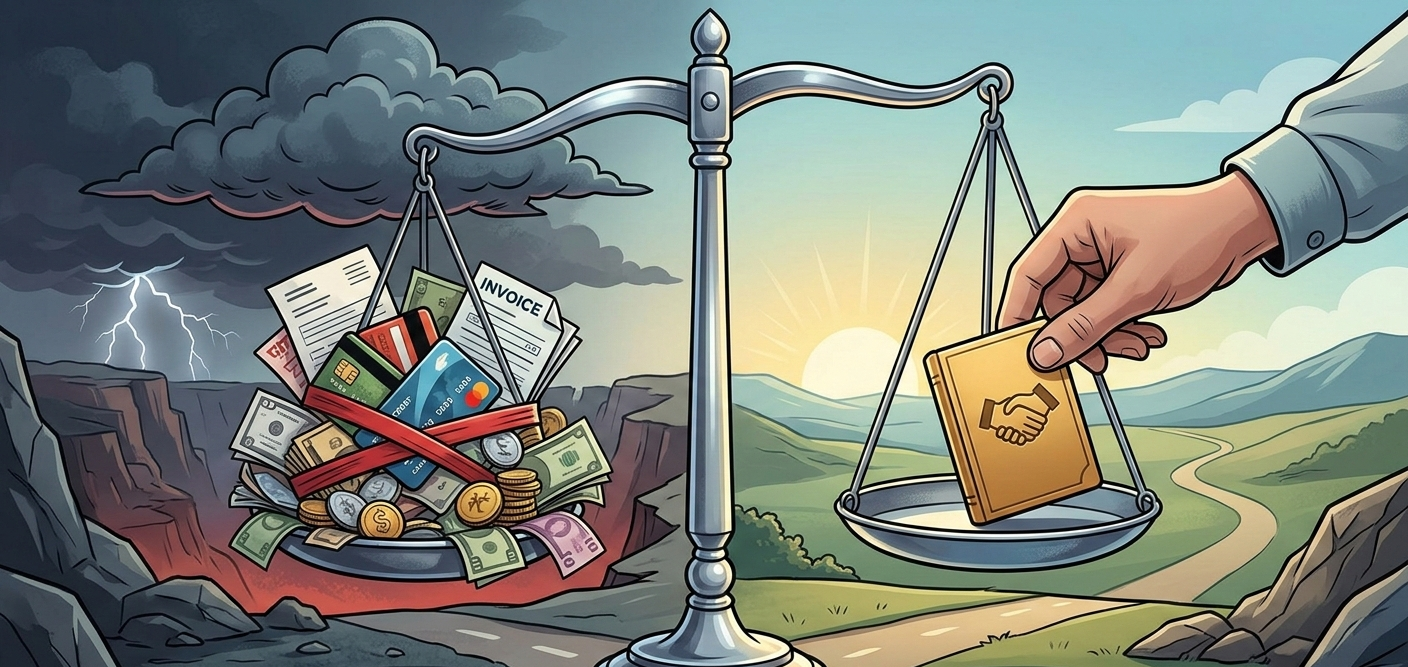
Choosing the best lenders for debt consolidation loans requires careful evaluation of cost, qualification standards, and repayment structure. Not all debt consolidation loans provide real savings, so comparing specific lender criteria is essential before applying.
1. APR and Total Loan Cost
The most important factor in debt consolidation loans is the Annual Percentage Rate (APR). A lower APR increases the likelihood of reducing total interest and helping reduce monthly debt payments.
When reviewing lenders, compare:
- Advertised APR range
- Whether rates are fixed or variable
- Total repayment amount over full term
Even small APR differences can significantly affect the overall cost of debt consolidation loans.
2. Fees and Hidden Charges
Some debt consolidation loans include additional costs that reduce potential savings.
Common fees to review:
- Origination fees
- Late payment penalties
- Returned payment fees
- Administrative charges
Lenders that minimize extra fees provide clearer cost transparency.
3. Qualification Requirements
Access to low interest consolidation loans depends on borrower strength.
Best lenders for debt consolidation typically assess:
- Credit score
- Debt-to-income ratio (DTI)
- Income consistency
- Payment history
Stronger financial profiles increase approval chances and improve offered terms for debt consolidation loans.
4. Loan Term Flexibility
Repayment term length directly affects monthly obligations.
| Term Length | Monthly Payment | Total Interest |
|---|---|---|
| Short Term | Higher | Lower overall |
| Long Term | Lower | Higher overall |
Longer terms may help reduce monthly debt payments, but they can increase total interest paid over time.
5. Direct Creditor Payment Option
Some lenders send funds directly to credit card issuers. This structure ensures proper consolidation and prevents accidental spending of loan proceeds.
6. Fixed vs Variable Structure
For most borrowers, fixed-rate debt consolidation loans provide stability. Variable-rate loans may carry risk in uncertain rate environments.
Summary
The best lenders offer competitive APRs, clear fees, flexible repayment options, and stable fixed rates. Comparing these factors carefully helps you save money.
Key Takeaways
- APR is the most critical factor in debt consolidation loans.
- Fee transparency prevents unexpected costs.
- Strong credit improves access to low interest consolidation loans.
- Term length affects both monthly payments and total cost.
Common Mistakes to Avoid
- Choosing debt consolidation loans based only on monthly payment
- Ignoring origination fees
- Extending repayment too long
- Selecting variable rates without understanding risk
Is Debt Consolidation Worth It Right Now?
Whether debt consolidation loans are worth it right now depends on three main factors: current interest rates, your credit profile, and the rate difference between your existing debt and the new loan.
They are generally worth it when they lower your APR, reduce your monthly payments, and provide a clear repayment plan that helps prevent ongoing credit card debt from growing.
When Debt Consolidation Loans Make Financial Sense
It may be beneficial if:
- Your credit card interest rates are significantly higher than available loan APR
- You qualify for low interest consolidation loans
- You need predictable fixed monthly payments
- You want to consolidate credit card debt into one structured installment
If the new loan offers a meaningfully lower rate, debt consolidation loans can reduce both interest costs and financial stress.
When Debt Consolidation Loans May Not Be Worth It
They may not be effective when:
- Your credit score does not qualify you for competitive APR
- The new interest rate is similar to current rates
- The repayment term is extended too long
- Fees offset potential savings
In these cases, total repayment may increase even if monthly payments decrease.
Cost-Benefit Snapshot
| Scenario | Are Debt Consolidation Loans Worth It? |
|---|---|
| Lower APR than current debt | Likely Yes |
| Similar APR to current debt | Possibly No |
| Longer term with small rate drop | Depends on total cost |
| Strong credit profile | Higher benefit potential |
| Weak credit profile | Limited savings |
Summary
They are worth it when they clearly lower your interest rate and help you follow a structured repayment plan that saves money. They are less helpful if the rate difference is small or the repayment term is extended too long.
Key Takeaways
- Compare your current average interest rate to the new APR.
- Qualification strength determines savings potential.
- Fixed-rate debt consolidation loans provide stability.
- Focus on total repayment cost, not just monthly payment.
Pros and Cons
Pros
- Single predictable payment
- Potential lower APR
- Reduced financial complexity
- May improve credit utilization
Cons
- Approval depends on credit strength
- Fees may reduce savings
- Longer terms increase total interest
- Risk of accumulating new debt after consolidation
Conclusion
Debt consolidation loans can be a practical financial tool when used strategically. If you qualify for a significantly lower APR and choose appropriate repayment terms, debt consolidation loans may reduce monthly debt payments and lower total interest costs. However, savings depend entirely on interest rate comparison, fees, and loan duration. Careful evaluation of total repayment cost is essential before committing.
FAQs
1. Is debt consolidation worth it right now?
Debt consolidation loans are worth it if the new APR is clearly lower than your current credit card rates and fees are minimal. The larger the rate difference, the stronger the financial benefit.
2. Do debt consolidation loans hurt your credit score?
Applying may cause a small temporary drop in your credit score due to a credit check. However, paying off credit cards and lowering your usage can improve your score over time if you make payments on time.
3. What credit score is needed for low interest consolidation loans?
Low interest consolidation loans typically require good to excellent credit. Higher credit scores increase approval chances and access to better APR ranges.
4. Are fixed or variable debt consolidation loans better?
Fixed debt consolidation loans are generally safer because payments remain stable. Variable loans carry interest rate risk and may increase in cost if market rates rise.
5. Can debt consolidation loans reduce monthly debt payments?
Yes, debt consolidation loans can reduce monthly debt payments by offering lower interest rates or longer repayment terms. However, longer terms may increase total interest paid.
6. Is SoFi or Marcus better for debt consolidation loans?
Both lenders offer fixed-rate debt consolidation loans. The better option depends on your credit profile, APR offer, and repayment flexibility. Comparing total loan cost is essential before deciding.
Disclaimer
This content is for informational purposes only and does not constitute financial, investment, or legal advice. I am not a licensed financial advisor. Always consult a qualified professional before making financial decisions.