
A crypto investment strategy is a structured plan for allocating, managing, and securing cryptocurrency holdings based on financial goals, risk tolerance, and long-term portfolio diversification principles. It treats digital assets as part of an overall investment portfolio rather than speculative trading instruments.
Cryptocurrencies and blockchain-based assets now function as an emerging financial asset class alongside equities, bonds, and commodities. Everyday investors increasingly incorporate digital assets into portfolios to access technological growth and alternative market exposure.
Digital assets derive value from decentralized blockchain networks that verify ownership without centralized intermediaries.
What Are Digital Assets?
Digital assets are blockchain-secured financial instruments that represent ownership, value, or access rights stored electronically and verified through cryptographic systems.
They include multiple investment categories:
| Digital Asset Category | Function | Role in Investment Planning |
|---|---|---|
| Cryptocurrencies | Digital money networks | Growth and store of value |
| Stablecoins | Fiat-linked tokens | Liquidity management |
| NFTs | Unique ownership tokens | Digital property exposure |
| Utility Tokens | Platform access assets | Ecosystem participation |
| Tokenized Assets | Real-world assets on blockchain | Fractional investing |
A modern crypto investment strategy evaluates these assets differently based on volatility, liquidity, and adoption maturity.
How Blockchain Enables Investment Ownership
Blockchain technology records transactions across decentralized networks, allowing investors to own and transfer digital assets securely without relying on banks or centralized custodians.
Core investment advantages include:
- Immutable ownership records
- Transparent transaction verification
- Reduced settlement delays
- Automated execution via smart contracts
According to financial infrastructure standards adopted across distributed ledger systems, blockchain reduces counterparty risk by enabling direct asset ownership verification.
Crypto vs Traditional Investments
Cryptocurrency differs from traditional investments primarily in decentralization, accessibility, and volatility characteristics.
| Investment Feature | Cryptocurrency | Stocks | Bonds | Real Estate |
|---|---|---|---|---|
| Market Access | Global, 24/7 | Exchange hours | Limited | Illiquid |
| Ownership Control | Direct wallet ownership | Broker custody | Institutional | Legal title |
| Entry Barrier | Low capital | Moderate | Moderate | High |
| Volatility Level | High | Medium | Low | Medium |
| Settlement Speed | Minutes | Days | Days | Weeks |
A responsible crypto investment strategy positions crypto as a complementary allocation rather than a replacement for diversified investments.
Why Everyday Investors Are Adding Crypto to Portfolios
Investors add cryptocurrency to portfolios primarily for diversification, technological exposure, and long-term growth potential within digital financial infrastructure.
Digital assets introduce return drivers that differ from traditional markets.
Portfolio Diversification Benefits
Diversification with crypto reduces dependence on single asset classes by introducing exposure to decentralized financial networks and emerging technology ecosystems.
Research in portfolio theory shows that combining assets with different market behaviors can improve risk-adjusted performance.
Benefits include:
- Exposure to blockchain innovation
- Alternative performance cycles
- Global liquidity participation
- Technology-sector growth access
A balanced crypto investment strategy typically limits exposure while preserving diversification advantages.
Inflation Protection Considerations
Some cryptocurrencies operate with fixed supply mechanisms, which investors view as potential protection against currency inflation over long periods.
However, market data indicates crypto prices remain sensitive to liquidity cycles and investor sentiment.
Therefore, crypto functions more accurately as a growth-oriented asset rather than a short-term inflation hedge.
Growth Potential vs Market Volatility
Cryptocurrency markets offer higher potential returns compared with traditional assets but experience significantly greater price fluctuations.
| Asset Class | Typical Annual Volatility |
|---|---|
| Government Bonds | 3–6% |
| Global Stocks | 12–18% |
| Gold | 10–15% |
| Cryptocurrency Market | 50–80% |
An effective crypto investment strategy manages volatility through allocation discipline rather than market timing.
Building a Responsible Crypto Investment Strategy
A crypto investment strategy becomes effective when investment decisions follow predefined rules covering allocation, time horizon, and acceptable risk exposure.
Unstructured investing increases emotional decision-making and loss probability.
Define Investment Objectives
Investment objectives determine how cryptocurrency fits within overall financial planning.
Common objectives include:
- Long-term capital appreciation
- Portfolio diversification
- Participation in blockchain innovation
- Digital asset accumulation
Clear objectives allow investors to evaluate performance using measurable outcomes rather than short-term price movements.
Assess Risk Tolerance Before Investing
Risk tolerance defines how much portfolio volatility an investor can sustain without disrupting financial stability.
Factors influencing tolerance include:
- Income reliability
- Emergency savings availability
- Investment experience
- Psychological response to market declines
Industry portfolio management practices commonly recommend limiting crypto exposure to a manageable percentage of total investable assets.
Long-Term vs Short-Term Crypto Approaches
Long-term investing generally reduces timing risk compared with short-term speculative trading.
| Strategy Approach | Description | Investor Suitability |
|---|---|---|
| Long-Term Holding | Multi-year ownership | Everyday investors |
| Dollar-Cost Averaging | Fixed periodic purchases | Beginners |
| Active Trading | Frequent buying/selling | Advanced investors |
| Yield Strategies | Staking or lending | Experienced users |
A disciplined crypto investment strategy favors consistency over prediction.
Digital Asset Allocation Models
Asset allocation determines portfolio risk more than individual asset selection.
Investors typically adjust crypto exposure according to financial goals and volatility tolerance.
Conservative Allocation
- 1–3% cryptocurrency exposure
- Focus on established networks
- Capital preservation priority
Balanced Allocation
- 5–10% digital assets
- Diversified blockchain exposure
- Periodic rebalancing
Growth-Oriented Allocation
- 15–25% crypto exposure
- Emerging ecosystem participation
- Higher volatility acceptance
Example Portfolio Allocation
| Investor Type | Crypto | Stocks | Bonds | Cash |
|---|---|---|---|---|
| Conservative | 3% | 55% | 35% | 7% |
| Balanced | 8% | 60% | 25% | 7% |
| Growth | 20% | 65% | 10% | 5% |
A structured crypto investment strategy maintains allocation discipline regardless of market hype cycles.
Also Read: AI Tools for Personal Finance 2026: What to Use and What to Avoid
Cryptocurrency for Beginners: Safe Entry Framework
Beginners should enter cryptocurrency markets through regulated platforms, secure storage practices, and gradual investment deployment rather than large initial purchases.
Operational mistakes often create greater losses than market volatility.
Choosing a Crypto Exchange
Investors evaluate platforms using:
- Regulatory compliance
- Security audits
- Liquidity availability
- Transparent fee structures
- Asset custody safeguards
Reliable infrastructure significantly reduces counterparty risk.
Wallet Types and Security Levels
Crypto wallets store private keys that provide ownership access to digital assets.
| Wallet Type | Connectivity | Security | Best Use |
|---|---|---|---|
| Exchange Wallet | Online | Moderate | Trading |
| Software Wallet | Online | High | Active use |
| Hardware Wallet | Offline | Very High | Long-term holding |
| Paper Backup | Offline | High | Recovery storage |
Secure custody remains central to any sustainable crypto investment strategy.
Beginner Risk Prevention Checklist
Essential investor safeguards:
- Use two-factor authentication
- Store recovery phrases offline
- Avoid unsolicited investment offers
- Diversify purchases over time
- Verify transaction addresses
Maintain backup access records
Digital Asset Management Fundamentals
Digital asset management involves monitoring, securing, and periodically adjusting cryptocurrency holdings to maintain intended portfolio exposure.
Custody Models
Investors typically choose between:
- Self-custody ownership
- Institutional custodians
- Hybrid management systems
Self-custody increases control but requires technical responsibility.
Security Best Practices
Industry cybersecurity standards recommend:
- Hardware wallet storage
- Device-level protection
- Phishing prevention awareness
- Dedicated transaction environments
- Multi-layer authentication systems
Security failures remain among the most common causes of crypto asset loss globally.
Portfolio Rebalancing
Rebalancing restores original allocation percentages after market price changes.
Standard process:
- Review portfolio quarterly
- Identify overweight assets
- Reallocate excess exposure
- Maintain predefined risk limits
Consistent rebalancing strengthens long-term outcomes within a disciplined crypto investment strategy.
Key Takeaways
- Cryptocurrency functions as an emerging investment asset class
- Allocation discipline matters more than market timing
- Security planning is fundamental to ownership protection
- Diversification improves risk management
- Long-term planning supports sustainable digital asset growth
Blockchain Investing Beyond Cryptocurrency

Blockchain investing refers to allocating capital into blockchain-based networks, applications, and tokenized ecosystems that enable decentralized finance, digital ownership, and automated financial infrastructure. A complete crypto investment strategy expands beyond buying coins and includes exposure to blockchain innovation layers driving long-term adoption.
Many investors incorrectly equate crypto investing only with price speculation. In reality, blockchain represents underlying financial infrastructure comparable to early internet technologies.
A mature crypto investment strategy evaluates blockchain ecosystems according to utility, adoption, and network sustainability.
Major Blockchain Investment Categories
Digital finance now operates across several investment layers.
| Blockchain Sector | Function | Investment Role |
|---|---|---|
| Layer-1 Networks | Core blockchain infrastructure | Market foundation |
| Smart Contract Platforms | Application development networks | Innovation exposure |
| Decentralized Finance (DeFi) | Lending, trading, payments | Yield opportunities |
| NFTs & Digital Ownership | Tokenized identity/assets | Ownership economy |
| Tokenized Real Assets | Physical assets on-chain | Diversification |
Investors increasingly diversify across blockchain sectors rather than concentrating capital in a single cryptocurrency.
Infrastructure vs Speculative Assets
Infrastructure-based blockchain investments typically demonstrate stronger long-term sustainability compared with purely speculative tokens lacking real network usage.
Evaluation factors include:
- Active developer ecosystem
- Transaction volume growth
- Institutional adoption
- Security track record
- Real-world application demand
According to digital asset market analysis frameworks used by institutional portfolio managers, network utility strongly correlates with long-term asset resilience.
A disciplined crypto investment strategy prioritizes functional ecosystems over short-term market trends.
Crypto Tax Planning and Regulatory Awareness
Crypto tax planning involves tracking transactions, calculating capital gains or losses, and maintaining compliance with national financial reporting requirements related to digital asset ownership. Proper tax planning protects investors from penalties and unexpected liabilities.
Tax obligations apply even when assets remain entirely digital.
Common Taxable Crypto Events
| Transaction Type | Typically Taxable | Explanation |
|---|---|---|
| Selling cryptocurrency | Yes | Capital gain or loss realized |
| Crypto-to-crypto trade | Yes | Disposal event |
| Using crypto for purchases | Yes | Value change recognized |
| Staking rewards | Often Yes | Income classification |
| Receiving payments in crypto | Yes | Income recognition |
Based on international financial reporting standards, most jurisdictions treat cryptocurrency as property rather than currency.
A compliant crypto investment strategy includes transaction tracking from the first investment.
Importance of Record Keeping
Investors should maintain:
- Purchase dates
- Cost basis values
- Transaction fees
- Wallet transfers
- Exchange records
Accurate documentation simplifies reporting and prevents valuation disputes.
Industry accounting practices recommend automated tracking tools for active investors managing multiple wallets.
Capital Gains Considerations
Capital gains occur when cryptocurrency is sold at a higher value than its purchase price.
Two classifications commonly apply:
| Holding Period | Typical Treatment |
|---|---|
| Short-term | Higher tax rate |
| Long-term | Preferential rate |
Long-term holding frequently aligns with efficient tax outcomes, reinforcing disciplined investment behavior within a structured crypto investment strategy.
Risk Management in Cryptocurrency Investing
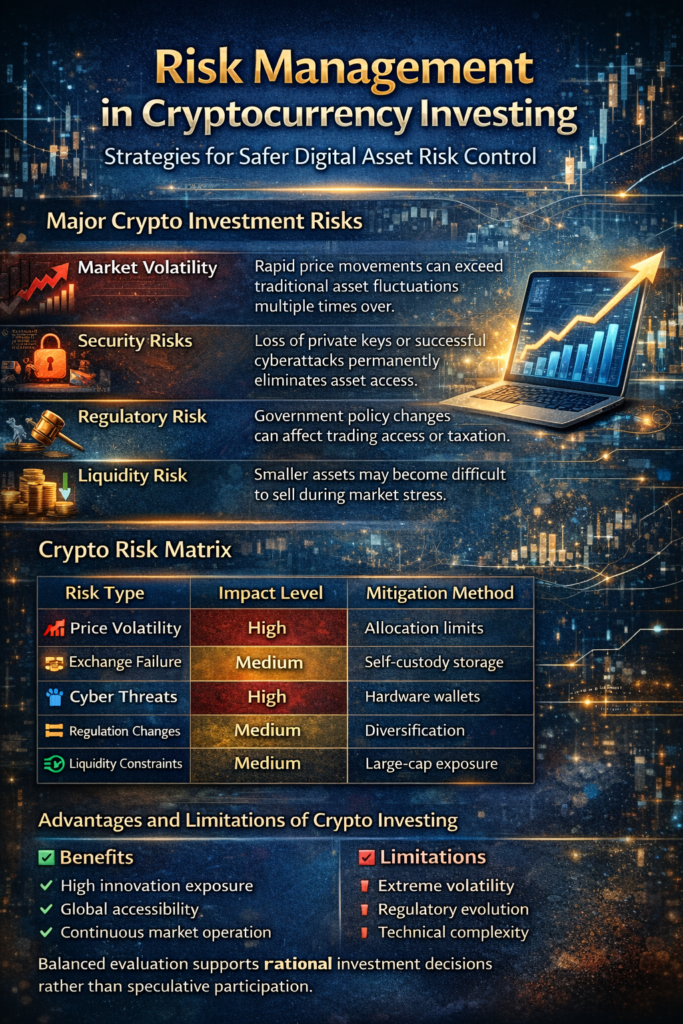
Risk management in crypto investing involves controlling exposure to volatility, technological threats, liquidity limitations, and regulatory uncertainty through predefined investment rules.
Digital assets introduce unique risks not present in traditional markets.
Major Crypto Investment Risks
Market Volatility
Rapid price movements can exceed traditional asset fluctuations multiple times over.
Security Risks
Loss of private keys or successful cyberattacks permanently eliminates asset access.
Regulatory Risk
Government policy changes can affect trading access or taxation.
Liquidity Risk
Smaller assets may become difficult to sell during market stress.
Crypto Risk Matrix
| Risk Type | Impact Level | Mitigation Method |
|---|---|---|
| Price Volatility | High | Allocation limits |
| Exchange Failure | Medium | Self-custody storage |
| Cyber Threats | High | Hardware wallets |
| Regulation Changes | Medium | Diversification |
| Liquidity Constraints | Medium | Large-cap exposure |
A resilient crypto investment strategy reduces dependency on any single platform, asset, or jurisdiction.
Advantages and Limitations of Crypto Investing
Benefits
- High innovation exposure
- Global accessibility
- Continuous market operation
- Portfolio diversification potential
Limitations
- Extreme volatility
- Regulatory evolution
- Technical complexity
- Security responsibility
Balanced evaluation supports rational investment decisions rather than speculative participation.
How to Diversify With Crypto Responsibly
Diversifying with crypto involves spreading investment exposure across asset types, blockchain sectors, and stability mechanisms to reduce concentration risk within digital portfolios.
Diversification remains one of the most effective risk-management tools.
Asset-Level Diversification
Investors typically distribute holdings across:
- Large-cap cryptocurrencies
- Smart contract ecosystems
- Stablecoins
- Emerging blockchain sectors
Overconcentration increases portfolio vulnerability.
Stablecoin Allocation Strategy
Stablecoins provide liquidity and volatility control.
Common uses include:
- Temporary capital storage
- Market re-entry preparation
- Portfolio stabilization
- Transaction settlement
Within a balanced crypto investment strategy, stable assets help manage market downturns without exiting digital markets entirely.
Diversification Framework Example
| Allocation Category | Suggested Role |
|---|---|
| Core Crypto Assets | Portfolio foundation |
| Growth Ecosystems | Innovation exposure |
| Stablecoins | Risk buffer |
| Emerging Projects | Limited upside allocation |
Periodic evaluation ensures diversification remains aligned with investment goals.
Long-Term Digital Finance Planning

Long-term digital asset planning integrates cryptocurrency holdings into broader financial goals such as retirement planning, wealth transfer, and future participation in tokenized financial systems.
Digital finance increasingly overlaps with traditional wealth management.
Crypto in Retirement Planning
Investors may incorporate small crypto allocations into retirement portfolios to capture technological growth over extended time horizons.
Long investment horizons help absorb volatility cycles.
Financial planning models emphasize:
- Limited allocation percentages
- Periodic rebalancing
- Long-term holding discipline
A sustainable crypto investment strategy aligns crypto exposure with lifetime financial objectives.
Estate and Digital Asset Transfer
Digital ownership introduces inheritance challenges.
Essential planning steps include:
- Secure seed phrase storage instructions
- Legal asset documentation
- Trusted beneficiary access planning
- Multi-signature custody solutions
Without transfer planning, digital assets may become permanently inaccessible.
The Future of Tokenized Finance
Blockchain systems increasingly enable:
- Tokenized securities
- Digital identity verification
- Automated contracts
- Fractional ownership markets
According to financial technology adoption trends, tokenization may significantly reshape asset ownership and global investment accessibility over the coming decades.
Investors adopting structured planning today position themselves for participation in evolving digital economies.
A responsible approach to digital assets emphasizes structure over speculation.
Core principles of an effective crypto investment strategy include:
- Treat crypto as a portfolio allocation
- Maintain strict exposure limits
- Secure asset custody
- Track tax obligations carefully
- Diversify across blockchain sectors
- Rebalance holdings periodically
- Focus on long-term adoption trends
Disciplined planning transforms cryptocurrency from a speculative activity into a managed financial asset class.
Frequently Asked Questions
Is cryptocurrency suitable for beginner investors?
Yes. Beginners can participate safely by starting with small allocations, using regulated exchanges, and following long-term investment approaches rather than active trading.
How much crypto should be included in a portfolio?
Many portfolio management models suggest allocating between 1% and 10% depending on risk tolerance and investment objectives.
What is the safest crypto investment strategy?
The safest crypto investment strategy combines diversification and secure storage practices.
Are crypto transactions taxable?
In most jurisdictions, selling, trading, or earning cryptocurrency triggers taxable events requiring reporting of gains or income values.
Can cryptocurrency improve diversification?
Yes. Crypto assets may provide alternative return drivers that differ from stocks and bonds when integrated responsibly.
Should investors hold crypto long term?
Long-term holding historically reduces timing risk and aligns with technological adoption cycles within blockchain markets.
Conclusion
Digital assets represent a structural shift in how value, ownership, and financial systems operate globally. Everyday investors can participate responsibly by applying allocation discipline, security awareness, and regulatory compliance through a well-structured crypto investment strategy.
A well-designed crypto investment strategy focuses on education, diversification, and long-term planning rather than short-term speculation. Investors who integrate crypto thoughtfully into broader financial planning frameworks are better positioned to navigate both opportunity and risk within digital finance.
References
- International Monetary Fund — Digital Currency & Crypto-Asset Reports
https://www.imf.org/en/Topics/fintech - Digital Asset & CBDC Framework Reports
https://www.bis.org/topic/fintech.htm - Blockchain & Digital Asset Studies
https://www.jbs.cam.ac.uk/faculty-research/centres/alternative-finance/
Disclaimer:
The information provided in this article is for educational and informational purposes only and should not be considered financial, investment, tax, or legal advice. The author is not a licensed financial advisor. Readers should conduct their own research and consult a qualified financial professional before making any financial or investment decisions.