Credit utilization is the percentage of your available revolving credit that you are currently using. It is calculated by dividing your credit card balance by your credit limit and multiplying by 100.
For example:
- Credit limit: $10,000
- Current balance: $2,000
- Utilization rate: 20%
This percentage shows lenders how much of your available credit you rely on. It does not measure total debt. It only applies to revolving accounts like credit cards and lines of credit.
According to industry scoring standards, revolving balance behavior is a major risk indicator. A lower percentage signals responsible usage. A higher percentage signals higher borrowing risk.
In simple terms, it shows whether you are stretching your limits or managing them carefully.
How credit utilization affects score
Credit utilization affects score because it reflects borrowing behavior and repayment risk. Major scoring systems treat revolving usage as a strong predictive factor.
When balances increase relative to limits:
- Risk perception rises
- Score may decline
- Future lenders may view the profile as stressed
When balances decrease:
- Risk perception improves
- Score stability increases
- Lending confidence improves
Models developed by Fair Isaac Corporation and used under the FICO framework consider revolving utilization highly influential.
High usage can reduce a score even if payments are made on time. This is because scoring models measure both payment history and usage patterns.
Where credit utilization fits in FICO scoring
Under widely adopted scoring structures, payment history carries the highest weight. However, utilization ranks immediately after payment history in impact.
Within the FICO model:
- Payment history ≈ highest influence
- Utilization ≈ second strongest influence
- Length of history
- Credit mix
- New inquiries
The importance assigned by FICO explains why small balance changes can move scores quickly.
Scoring systems from VantageScore also evaluate revolving balance behavior, though sensitivity levels vary.
Because this factor updates whenever balances are reported to credit bureaus such as Experian, Equifax, and TransUnion, score fluctuations can occur monthly.
Does credit utilization affect score immediately?
Credit utilization affects score as soon as new balances are reported to credit bureaus. It does not require months of history to change impact.
Here is how timing works:
- Credit card issuer closes billing cycle
- Statement balance is reported
- Credit bureaus update report
- Scoring models recalculate
If balances drop before reporting, score improvements may appear within days of the report update.
If balances rise before reporting, score decreases may also appear quickly.
This makes utilization one of the fastest-changing components in credit scoring.
Summary
Credit utilization measures how much revolving credit is being used compared to available limits. It is one of the most influential credit score factors after payment history. It updates whenever balances are reported, meaning it can cause rapid score increases or decreases.
Key Takeaways
- It applies only to revolving accounts.
- Lower percentages signal lower risk.
- Updates occur after each reporting cycle.
- Small balance changes can shift scores quickly.
- It is second only to payment history in influence.
Best Credit Utilization Percentage Explained
The best credit utilization percentage is the range that signals low borrowing risk while still showing active account usage. Scoring systems reward lower percentages because they indicate financial stability and controlled spending behavior.
There is no single universal number, but data patterns across major scoring systems show that lower usage generally produces stronger results.
30% credit rule explained
The 30% rule is a widely referenced guideline. It suggests keeping revolving balances below 30% of total credit limits.
Example:
- Credit limit: $5,000
- 30% threshold: $1,500
If balances exceed this level, scoring models may begin to treat the account as higher risk.
However, the 30% threshold is not an optimization target. It is a safety ceiling. Staying below 30% helps avoid major score penalties, but it does not necessarily maximize score potential.
Many consumers misunderstand this rule as ideal. In practice, it is a minimum standard, not a performance strategy.
Is 30% really optimal?
Thirty percent is considered acceptable, not optimal.
Scoring data patterns show:
- 0% usage may appear inactive
- 1–9% usage often produces stronger scoring outcomes
- 10–29% usage is generally stable
- 30%+ usage increases risk perception
Maintaining very low usage demonstrates that available credit is not heavily relied upon. This signals stronger financial control.
Therefore, while 30% prevents damage, lower levels typically improve scoring efficiency.
Best credit utilization percentage for excellent scores
For high-scoring profiles, the strongest performance typically occurs between 1% and 9%.
Why not 0%?
If all revolving accounts report zero balances, some scoring systems may treat the profile as inactive. Showing a small reported balance on one account can demonstrate active management.
General performance tiers:
| Utilization Level | Expected Score Impact |
|---|---|
| 0% | Neutral to slightly positive |
| 1–9% | Strong positive |
| 10–29% | Stable |
| 30–49% | Negative |
| 50%+ | Strong negative |
Lower percentages consistently correlate with stronger risk assessments under models used by FICO and VantageScore.
Ideal utilization for premium credit profiles
Premium credit profiles — typically those above 760 — often maintain:
- Overall usage under 10%
- Individual card usage under 10%
- No card above 30%
- One small reporting balance
This structure reflects advanced management of revolving credit exposure.
Important distinction:
There are two measurements evaluated:
- Overall usage across all cards
- Per-card usage on each individual account
Maxing one card while keeping others low can still reduce scores because per-card concentration increases risk signals.
Premium optimization focuses on:
- Even balance distribution
- Low total usage
- Consistent reporting timing
Summary
The 30% rule is a safety guideline, not an optimization target. Stronger score performance typically occurs below 10%. Both overall and per-card percentages matter. Maintaining very low usage while keeping one small reported balance often produces the most stable scoring results.
Key Takeaways
- 30% prevents damage but does not maximize scoring.
- 1–9% often produces stronger outcomes.
- Both overall and per-card ratios are evaluated.
- One small balance may be better than zero balances.
- High individual card usage can hurt even if total usage is low.
How Credit Utilization Is Calculated
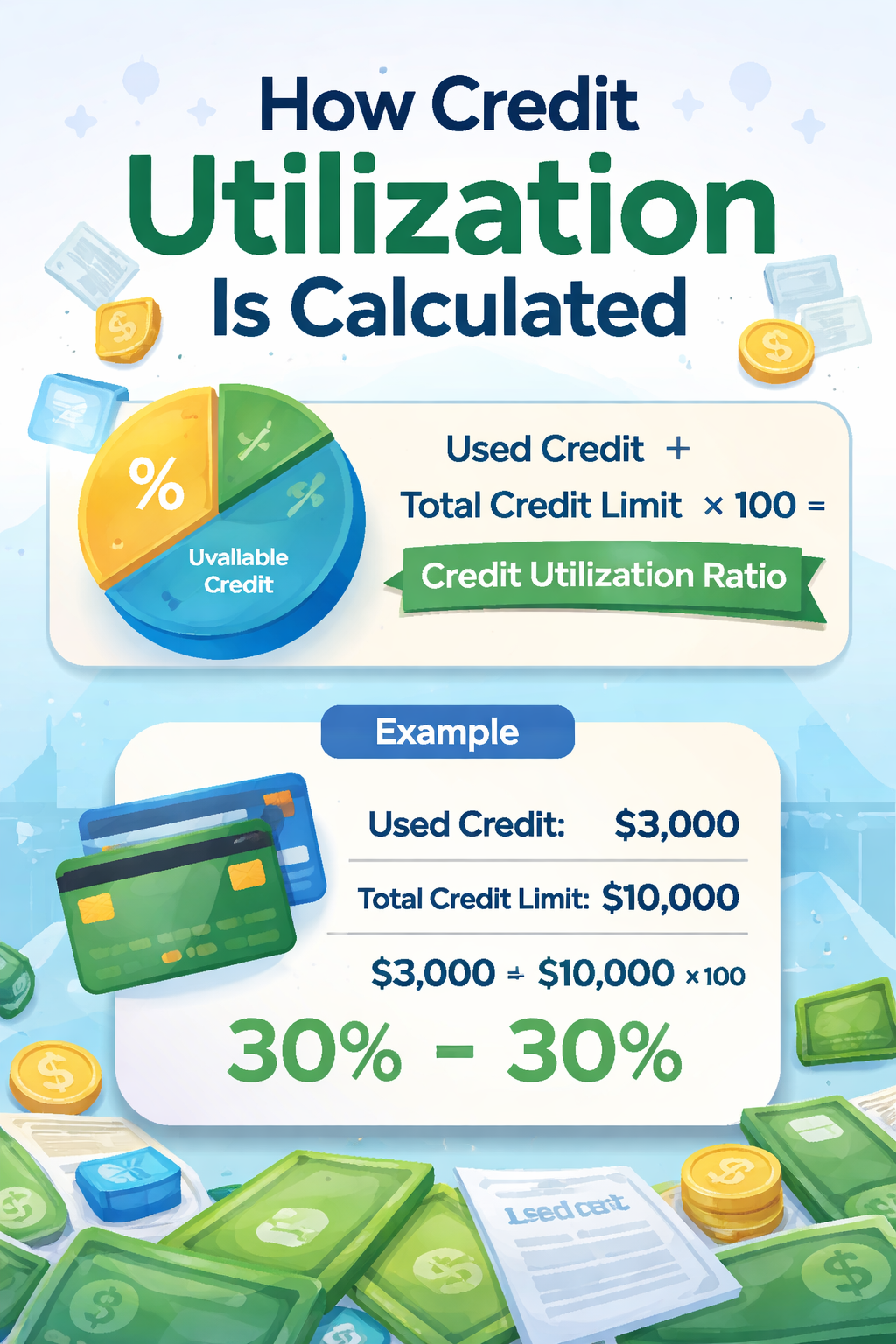
Credit utilization is calculated by dividing revolving balances by total available credit limits. The result is expressed as a percentage. Scoring systems evaluate both overall and per-card calculations.
Understanding the calculation method allows precise control over optimization strategies.
Per-Card Credit Utilization Calculation
Per-card utilization measures the balance on a single credit card compared to that card’s limit.
Formula:
Balance ÷ Credit Limit × 100 = Percentage
Example:
- Card limit: $4,000
- Balance: $1,000
- Per-card percentage: 25%
If that same card carries a $3,000 balance, the percentage becomes 75%, which signals elevated risk even if other cards have low balances.
Scoring systems evaluate individual accounts separately because concentrated borrowing on one account increases perceived default probability.
Key principle:
A single maxed-out card can reduce scores even when total usage across all accounts appears moderate.
Overall Credit Utilization Calculation
Overall utilization measures total balances across all revolving accounts compared to total combined limits.
Formula:
Total Revolving Balances ÷ Total Credit Limits × 100
Example:
- Card A: $1,000 balance / $5,000 limit
- Card B: $500 balance / $5,000 limit
- Card C: $0 balance / $5,000 limit
Total balances: $1,500
Total limits: $15,000
Overall percentage: 10%
Even if one card is slightly elevated, strong total capacity can stabilize scoring outcomes.
However, scoring models weigh both overall and individual metrics. Managing only one while ignoring the other reduces optimization effectiveness.
Statement Balance vs Current Balance
Many consumers confuse current balance with reported balance.
Important distinction:
- Current balance = Real-time amount owed
- Statement balance = Amount reported at cycle closing
Credit card issuers typically report the statement balance to bureaus such as Experian, Equifax, and TransUnion.
If a payment is made after the statement closing date but before the due date, the higher statement amount may still be reported.
This means:
Paying before the statement closing date is more effective for lowering reported percentages than paying only before the due date.
Timing directly influences what scoring models from FICO evaluate.
Reporting Cycle Timing
Each credit card has:
- Billing cycle start date
- Statement closing date
- Payment due date
The statement closing date is the most important for optimization.
Timeline example:
- Cycle closes on the 20th
- Balance is reported shortly after
- Payment due on the 15th of next month
If balances are reduced before the 20th, lower percentages are reported.
If balances are reduced after the 20th, improvement may not appear until the next cycle.
Because reporting occurs monthly, strategic timing allows measurable score adjustments within 30 days.
Summary
Utilization is calculated both per-card and overall by dividing balances by credit limits. Statement balances — not current balances — are typically reported. Managing balances before the statement closing date allows precise control over reported percentages.
Key Takeaways
- Both individual and total calculations matter.
- High usage on one card can reduce scores.
- Statement balance determines reported percentage.
- Paying before closing date is more effective than paying before due date.
- Reporting cycles control timing of score changes.
How to Lower Credit Utilization Fast
Lowering credit utilization quickly is possible because scoring models update when new balances are reported. Unlike payment history, which builds over time, revolving balance adjustments can influence scores within a single reporting cycle.
Fast improvement depends on timing, payment structure, and balance distribution.
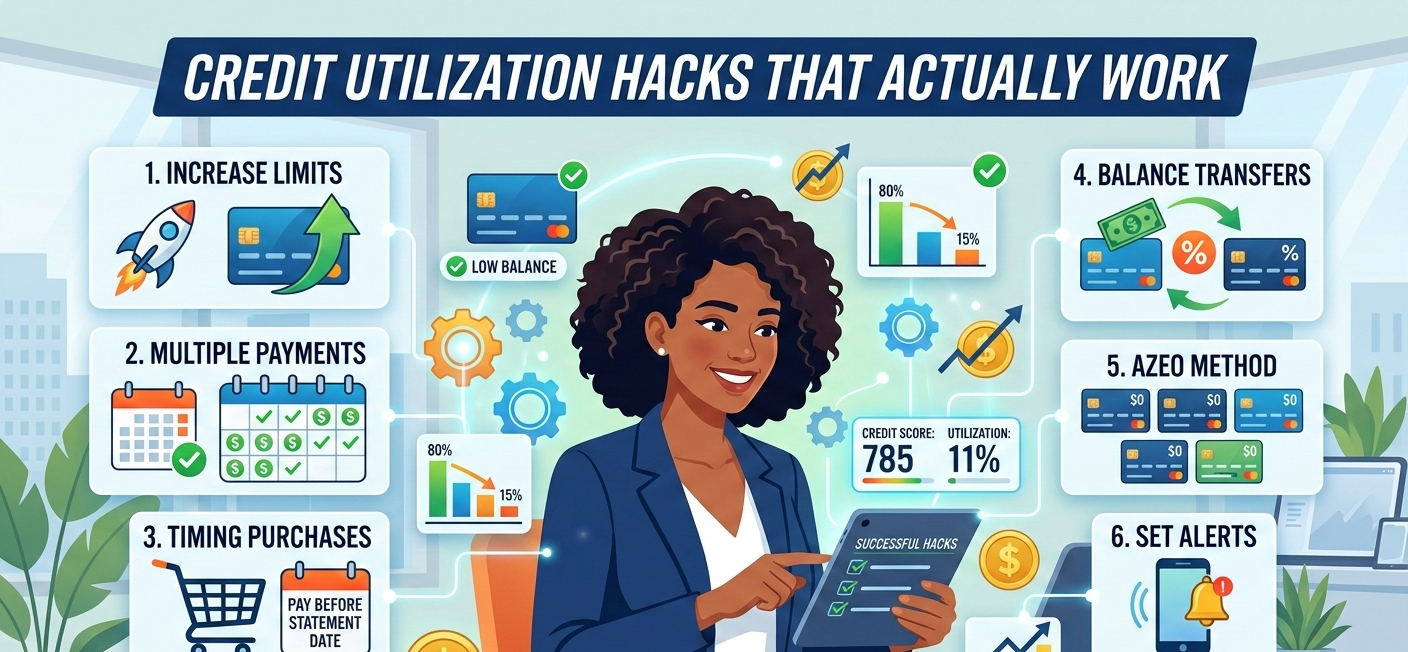
Pay Before the Statement Closing Date
The fastest way to reduce credit utilization is to pay balances before the statement closing date, not just before the due date.
Why this works:
- Issuers report the statement balance
- Lower reported balance = lower percentage
- Scoring models recalculate after update
Example:
- Limit: $6,000
- Balance on the 18th: $2,400
- Closing date: 20th
If $1,800 is paid before the 20th, the reported balance becomes $600 instead of $2,400.
This immediately reduces the percentage from 40% to 10%.
Key principle:
Payment timing controls reported data.
Make Multiple Payments Per Month
Instead of one large monthly payment, spreading payments across the billing cycle stabilizes credit utilization.
This strategy:
- Keeps balances consistently low
- Prevents temporary spikes
- Reduces risk of crossing 30% threshold
Example structure:
- Pay after large purchases
- Pay mid-cycle
- Pay again before closing
Multiple smaller payments smooth out usage patterns and minimize reporting risk.
Strategic Balance Distribution
If one card is heavily used while others are unused, overall percentages may look acceptable, but per-card percentages may be elevated.
Scoring systems evaluate both.
Strategy:
- Shift spending to lower-utilized cards
- Avoid maxing any single card
- Keep individual accounts under 30%
- Preferably keep each under 10%
Example:
Instead of:
- Card A: 70%
- Card B: 0%
Distribute:
- Card A: 20%
- Card B: 20%
Balanced distribution reduces concentrated risk signals.
Balance Transfer Timing
A balance transfer can lower credit utilization if it increases total available credit or reduces high per-card percentages.
However, timing matters.
Before transferring:
- Confirm new limit
- Calculate resulting percentages
- Avoid transferring in a way that creates another high-percentage account
Temporary spike risk:
Opening a new account may create a short-term inquiry impact, but the increased limit may reduce overall usage.
Net effect depends on structure.
Temporary Utilization Reset Strategy
If preparing for:
- Mortgage application
- Auto loan
- Credit line review
A short-term optimization plan can reduce percentages within one cycle.
Steps:
- Pay balances down to under 10%
- Leave one small balance reporting
- Avoid new charges before closing date
- Confirm reporting update
Because utilization recalculates monthly, this reset can improve scores within 30 days.
This makes it one of the most responsive credit score factors.
Summary
Fast improvement is possible because scoring models respond to newly reported balances. Paying before statement closing dates, distributing balances evenly, and controlling reporting timing can reduce percentages within a single billing cycle.
Key Takeaways
- Pay before statement closing date, not just due date.
- Multiple payments stabilize percentages.
- Avoid high usage on a single card.
- Balance transfers must be calculated carefully.
- Short-term optimization works within one reporting cycle.
Multiple Credit Cards Strategy for Optimization
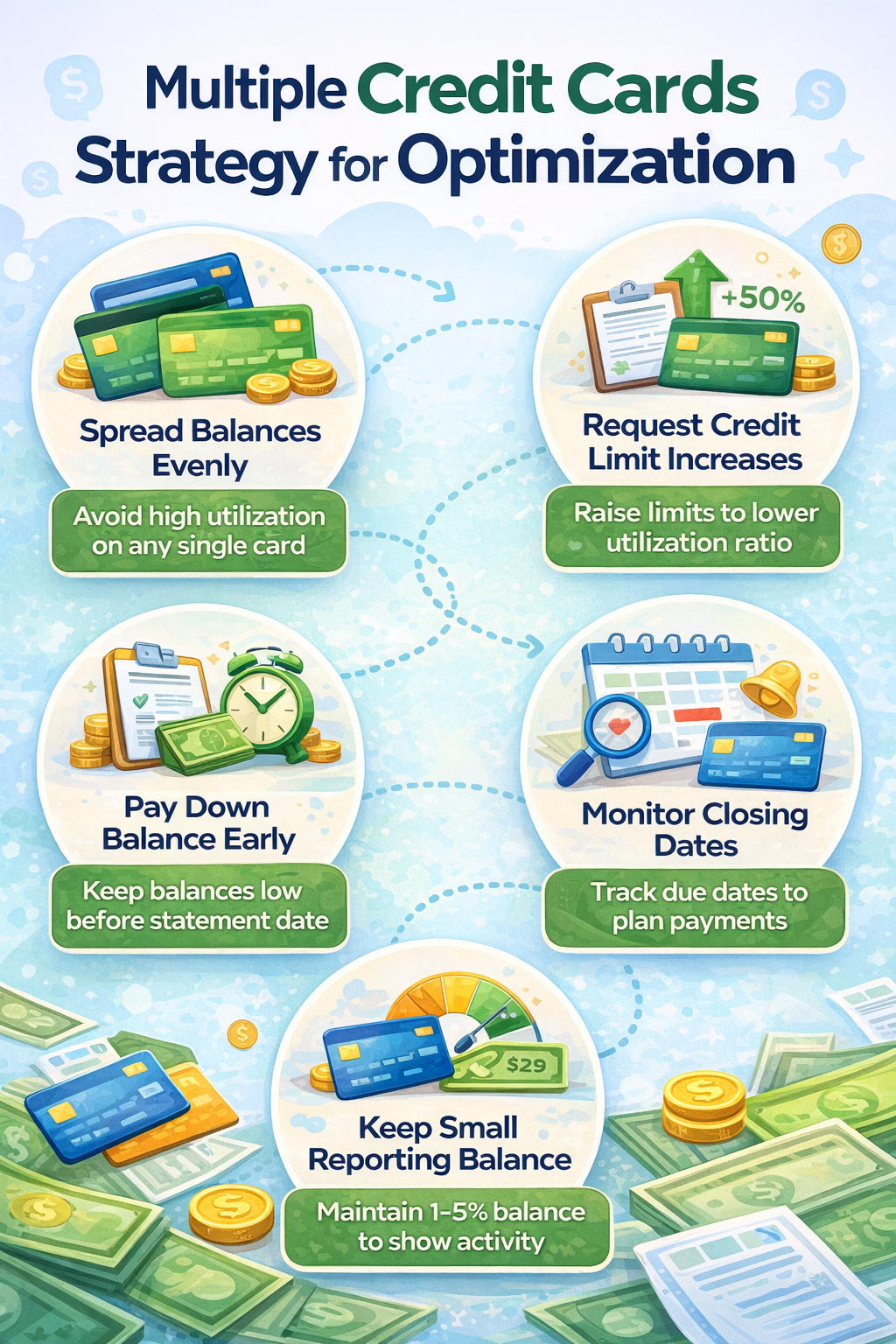
Using multiple credit cards strategically can improve credit utilization management when balances are controlled correctly. Scoring models evaluate both total revolving exposure and per-account behavior. Proper distribution across cards reduces concentration risk and improves stability.
A structured multi-card approach focuses on balance spacing, reporting control, and percentage management.
Spreading Balances Across Accounts
When one card carries a high percentage while others show zero usage, scoring systems may interpret that concentration as elevated risk.
Example:
- Card A: $4,000 balance / $5,000 limit = 80%
- Card B: $0 balance / $5,000 limit
- Card C: $0 balance / $5,000 limit
Overall percentage = 26%
Per-card percentage on Card A = 80%
Even though total usage is below 30%, the high single-card usage can reduce score performance.
Improved structure:
- Card A: $1,300 / $5,000
- Card B: $1,300 / $5,000
- Card C: $1,400 / $5,000
Overall percentage remains similar, but per-card exposure is balanced and lower.
Balanced distribution supports stronger credit utilization optimization.
Keeping One Card Reporting a Small Balance
Some scoring patterns reward active usage rather than full inactivity.
If all revolving accounts report zero balances, certain models may interpret the profile as inactive. A common optimization method is:
- All cards report $0
- One card reports 1–5%
This shows active management without signaling risk.
Example:
- Total limit: $20,000
- One card reports $200
- Overall percentage = 1%
This structure demonstrates control while maintaining activity.
Zero Balance vs Small Balance Impact
Zero balances are not harmful. However, strategic small balances may produce slightly stronger outcomes in some scoring environments.
Comparison:
| Reporting Structure | Risk Signal | Typical Outcome |
|---|---|---|
| All cards at 0% | Very low | Stable |
| One card 1–5% | Optimal | Strong |
| Several cards 25%+ | Elevated | Negative |
| One card 70%+ | High | Strong negative |
The objective is not to carry debt. The objective is to control reported percentages.
Risk of Closing Cards
Closing cards can unintentionally increase credit utilization.
Example:
- Total limits before closure: $30,000
- Balances: $3,000
- Percentage: 10%
If a $10,000-limit card is closed:
- New total limits: $20,000
- Balances: $3,000
- Percentage: 15%
Even without new spending, percentages increase.
Additional impact:
- Reduced total available credit
- Shortened average account age
- Possible score reduction
Before closing accounts, calculate how the change affects total limits.
Keeping unused accounts open — when no annual fee is involved — may preserve optimization flexibility.
Summary
A structured multi-card strategy focuses on balanced distribution, low per-card percentages, and maintaining total available limits. Concentrated high balances reduce scoring performance even when overall percentages appear safe.
Key Takeaways
- Avoid high usage on a single card.
- Balance percentages across accounts.
- Consider keeping one small reporting balance.
- Closing cards can increase overall percentages.
- Multi-card structure supports stronger credit utilization control.
Increase Credit Limit to Boost Score
Increasing a credit limit can improve credit utilization because it expands total available revolving capacity without increasing balances. When limits rise and balances stay the same, the percentage automatically decreases.
This method works best when spending habits remain stable.
How a Credit Limit Increase Changes the Math
The formula for utilization is:
Total Balance ÷ Total Credit Limit × 100
If the denominator (total limit) increases while the balance stays constant, the percentage drops.
Example before increase:
- Total limits: $10,000
- Total balances: $3,000
- Percentage: 30%
After a $5,000 limit increase:
- Total limits: $15,000
- Total balances: $3,000
- Percentage: 20%
No debt was repaid, but the percentage improved significantly.
Scoring models used by FICO and VantageScore evaluate revolving ratios dynamically, so this structural change can positively influence score calculations after reporting updates.
Soft Pull vs Hard Pull Requests
When requesting a limit increase, issuers may perform:
- Soft inquiry (no score impact)
- Hard inquiry (temporary minor impact)
A soft inquiry reviews account history without affecting scores. A hard inquiry appears on credit reports and may cause a small temporary decrease.
Before requesting an increase, confirm:
- Whether a hard inquiry will be performed
- Eligibility requirements
- Minimum time since last increase
The benefit from lower utilization often outweighs a small inquiry impact, but planning matters.
When Limit Increases Work Best
A credit limit increase is most effective when:
- Payment history is strong
- Balances are already controlled
- Income has increased
- Account age is stable
Issuers evaluate risk before approving increases. Consistent on-time payments and low previous usage improve approval probability.
Limit increases are less effective if spending rises proportionally. If balances increase after the limit is raised, the percentage advantage disappears.
The strategy depends on discipline.
Income Updates and Utilization Optimization
Issuers often base limit decisions on reported income.
Updating income information may:
- Improve approval chances
- Increase offered limit size
- Expand total available credit
Example:
- Balance: $2,000
- Limit before update: $4,000 → 50%
- Limit after increase to $8,000 → 25%
Without reducing debt, the ratio improves dramatically.
This approach supports structural improvement without requiring lump-sum payments.
Risks of Aggressive Limit Requests
While increasing limits can help, excessive or repeated requests may:
- Trigger risk reviews
- Result in hard inquiries
- Lead to temporary score fluctuations
Additionally, higher limits may increase spending temptation, which can reverse progress.
Strategic timing is important:
- Avoid requesting increases shortly before applying for major loans
- Confirm inquiry type
- Maintain spending discipline after approval
The goal is structural improvement, not expanded borrowing.
Summary
Increasing a credit limit lowers utilization percentages by expanding total available credit. When balances remain stable, this structural change can improve score calculations. Confirm whether a soft or hard inquiry applies before requesting an increase.
Key Takeaways
- Higher limits reduce percentages if balances stay constant.
- Soft inquiries do not affect scores.
- Hard inquiries may cause small temporary drops.
- Income updates may support higher approvals.
- Spending discipline determines long-term benefit.
Common Credit Utilization Mistakes
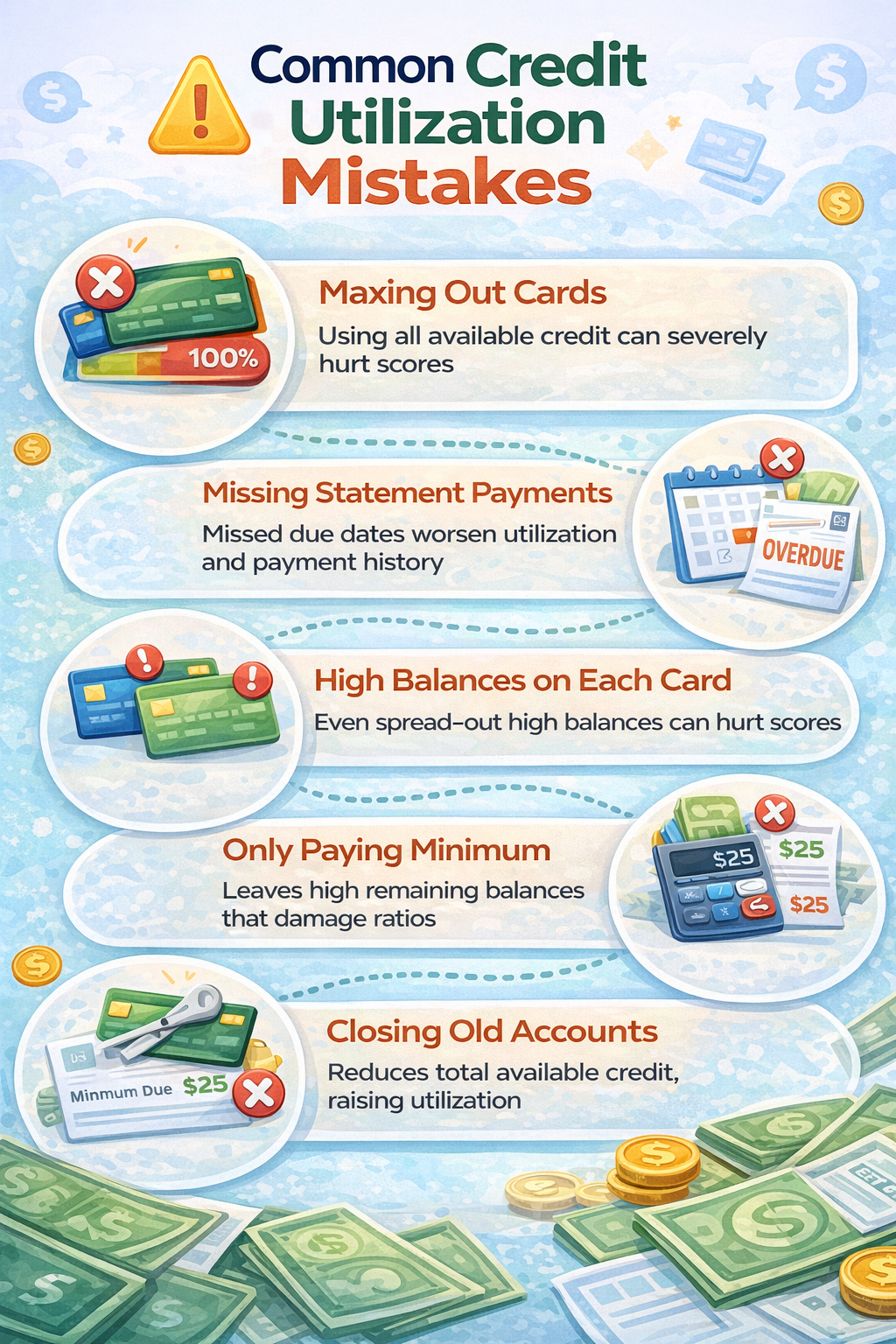
Managing credit utilization requires precision. Small missteps can reduce score performance even when payments are made on time. Many score declines occur not because of missed payments, but because of structural balance mistakes.
Understanding common errors prevents unnecessary point losses.
Maxing One Card While Others Are Empty
One of the most frequent mistakes is concentrating spending on a single card while leaving others unused.
Example:
- Card A: $4,500 / $5,000 = 90%
- Card B: $0 / $5,000
- Card C: $0 / $5,000
Overall percentage = 30%
Even though total usage appears controlled, the 90% per-card level signals high risk.
Scoring models evaluate:
- Overall revolving ratio
- Individual account ratios
High concentration increases perceived financial stress.
Balanced distribution across accounts produces stronger stability signals.
Ignoring Statement Closing Dates
Many users focus only on due dates. This creates reporting problems.
Important distinction:
- Due date = payment deadline
- Statement closing date = reporting trigger
If a large balance exists on the closing date, that amount is typically reported to bureaus such as Experian, Equifax, and TransUnion.
Even if the balance is paid a few days later, the higher reported figure may temporarily reduce score performance.
Failing to track closing dates prevents effective control of reported percentages.
Closing Old Credit Cards
Closing accounts reduces total available revolving limits. When limits decrease and balances remain unchanged, the percentage increases.
Example:
Before closure:
- Total limits: $25,000
- Total balances: $2,500
- Ratio: 10%
After closing a $10,000-limit card:
- New limits: $15,000
- Balances: $2,500
- Ratio: 16.6%
No new debt was added, yet the ratio rises.
In addition to utilization effects, closing accounts may reduce average age of accounts, which can influence scoring models from FICO.
Closing cards should be calculated carefully, especially when no annual fee exists.
Confusing Utilization With Debt-to-Income Ratio
Another common misunderstanding is mixing up utilization with debt-to-income (DTI) ratio.
Key differences:
- Utilization = revolving balances divided by credit limits
- Debt-to-income = total monthly debt payments divided by gross income
Scoring models focus heavily on revolving ratios, not DTI.
Mortgage lenders, however, evaluate DTI during underwriting.
Improving one metric does not automatically improve the other. They are separate risk measurements.
Understanding this difference prevents misdirected optimization efforts.
Summary
Common mistakes include maxing one card, ignoring statement dates, closing accounts without calculation, and confusing utilization with debt-to-income ratio. Most score declines occur from structural errors rather than missed payments.
Key Takeaways
- High per-card percentages can reduce scores even if overall ratio is moderate.
- Statement closing dates determine reported balances.
- Closing cards may increase ratios instantly.
- Utilization and DTI are different metrics.
- Structural awareness prevents unnecessary score drops.
Advanced Credit Utilization Optimization Framework
An advanced credit utilization optimization framework focuses on precision control rather than general guidelines. Instead of simply staying below 30%, this approach targets specific reporting structures that scoring models reward more consistently.
This framework is commonly used before major loan applications or when trying to move from a good score range to an excellent range.
The 10% Strategy for Prime Borrowers
The 10% strategy aims to keep both overall and per-card credit utilization under 10%.
Structure:
- Total revolving usage below 10%
- No single card above 10%
- No card above 30% at any time
Example:
- Total limits: $40,000
- Target maximum total balance: $4,000
- Individual card usage ideally under 10%
Why 10%?
Scoring systems often show measurable performance improvements when usage moves from the 20–30% range down into single digits.
The 10% strategy provides a strong safety buffer below the 30% threshold.
AZEO Method (All Zero Except One)
AZEO stands for “All Zero Except One.”
This advanced credit utilization technique follows this reporting structure:
- All revolving accounts report $0
- One account reports a small balance (1–5%)
Example:
- Card A: $0
- Card B: $0
- Card C: $150 balance on $5,000 limit (3%)
This produces:
- Very low overall percentage
- Active usage signal
- No concentration risk
Some scoring behaviors suggest that showing activity on one account may perform slightly better than showing inactivity across all accounts.
Important: The small balance must remain controlled and paid off after reporting.
Reporting Date Manipulation
Reporting date manipulation means aligning payments with statement closing dates to control what is reported.
Steps:
- Identify statement closing date for each card
- Calculate desired target percentage
- Pay down balances 3–5 days before closing
- Avoid new charges until after statement posts
Because credit utilization recalculates when balances are reported, this technique can produce rapid score adjustments within one billing cycle.
This strategy is commonly used before:
- Mortgage applications
- Auto financing
- Credit line reviews
Precision timing is critical.
Strategic Card Usage Calendar
An advanced framework includes a usage calendar.
Example monthly structure:
Week 1:
- Use primary card for routine expenses
- Keep balance under 10%
Week 2:
- Make mid-cycle payment
Week 3:
- Shift spending to secondary card if primary approaches 10%
Week 4:
- Pay down all cards except one small balance before closing
This structure ensures:
- No card spikes above 30%
- Per-card usage remains balanced
- Reporting percentages stay optimized
A written calendar reduces accidental over-reporting.
Summary
Advanced optimization focuses on keeping overall and per-card credit utilization below 10%, using the AZEO structure, aligning payments with statement closing dates, and maintaining a structured spending calendar. These techniques emphasize precision rather than general guidelines.
Key Takeaways
- Under 10% often performs better than simply under 30%.
- AZEO means all zero except one small reporting balance.
- Payment timing controls reported data.
- Avoid any single card exceeding 30%.
- Structured planning improves consistency.
Credit Utilization and Different Scoring Models
Credit utilization impacts scores differently depending on the scoring model used. While the general principles remain the same — lower percentages improve risk perception — each model evaluates sensitivity, thresholds, and reporting nuances differently. Understanding these differences allows for more precise optimization.
FICO Scoring Sensitivity
Under FICO models:
- Credit utilization is the second most influential factor after payment history.
- Overall utilization is heavily weighted, but per-card ratios are also considered.
- Utilization above 30% begins to negatively affect scores, while 10% or below often produces strong optimization.
- Short-term fluctuations are reflected after the statement reporting cycle.
Example:
- Total limits: $20,000
- Balance: $6,000 → 30% → neutral-to-slightly-negative impact
- Reducing balance to $2,000 → 10% → strong positive impact
FICO models value controlled revolving credit, with a clear performance gradient as utilization decreases.
VantageScore Sensitivity
Under VantageScore:
- Overall credit utilization is slightly less sensitive than per-card concentration.
- 0–9% utilization is optimal.
- Reporting timing is important, but small fluctuations are less dramatic than in FICO scoring.
- Activity patterns may favor small ongoing balances rather than complete inactivity.
Example:
- One card 25%, overall 15% → minor negative signal
- Spread balances evenly across multiple cards → preferred outcome
VantageScore often emphasizes credit utilization usage patterns more than raw balances alone.
Mortgage Underwriting Considerations
Mortgage lenders evaluate credit differently than scoring models alone.
- Both FICO and VantageScore influence automated underwriting systems.
- Utilization over 30% on any single account may trigger manual review.
- Lenders may request statements to confirm balances at application time.
- High utilization may be temporarily offset by rapid payoff before reporting.
Key insight:
Optimizing credit utilization before major applications can prevent delays or additional scrutiny during underwriting.
Summary
Different scoring models weigh credit utilization slightly differently. FICO emphasizes both overall and per-card ratios, while VantageScore favors activity patterns and small balances. Mortgage lenders review per-card spikes, overall ratios, and recent reporting behavior. Understanding model differences improves strategic planning.
Key Takeaways
- FICO models value both per-card and overall ratios.
- VantageScore favors small ongoing balances.
- 0–10% is generally optimal for strong scoring performance.
- High per-card balances may trigger underwriting reviews.
- Aligning balances before reporting cycles improves score response.
Timeline — How Fast Can Credit Utilization Improve a Score?
Credit utilization is one of the fastest-moving factors in credit scoring. Unlike payment history or account age, which build slowly, utilization adjustments can produce measurable score changes within days to a few weeks after reporting. Understanding the timeline allows borrowers to plan optimization strategically.
7-Day Impact Scenario
If a balance is paid down immediately before the statement closing date:
- The reported statement balance drops.
- Credit bureaus such as Experian, Equifax, and TransUnion receive updated information.
- FICO and VantageScore models recalculate scores after the report is processed.
Example:
- Card limit: $5,000
- Original balance: $2,500 → 50% utilization
- Payment: $1,750 before closing date → reported balance: $750 → 15% utilization
Score improvement can be reflected as quickly as 3–7 days after reporting, depending on the bureau processing speed.
30-Day Impact Scenario
Within one full billing cycle, multiple strategic actions can compound improvements:
- Multiple payments reduce reported balances across several cards.
- Distribution of spending prevents per-card spikes.
- Credit limit increases can further lower overall percentages.
Example:
- Initial overall utilization: 35%
- Strategic payments and limit increases: drop to 8–10%
- Score improvements can appear on the next cycle report, usually 30 days after optimization steps begin.
This scenario demonstrates how consistent management across a month produces more stable and measurable improvements.
Long-Term Optimization Strategy
For sustained benefits:
- Maintain overall utilization below 10–15%.
- Keep individual cards under 30%, ideally under 10%.
- Use one small reporting balance to demonstrate activity.
- Track statement closing dates to prevent spikes.
- Avoid unnecessary card closures that reduce total limits.
Long-term benefits:
- Gradual movement from good to excellent scores.
- Reduced risk of volatility due to high balances.
- Stronger approval chances for loans and credit lines.
Over 3–6 months of disciplined management, utilization optimization can permanently improve credit profile strength.
Summary
Credit utilization is responsive and can influence scores within days. Fast adjustments occur when balances are paid before statement closing dates, while long-term control ensures sustained improvements. Timing, distribution, and limit management determine the pace of score change.
Key Takeaways
- Paying before closing dates can yield score improvements in 7 days.
- Full billing cycle optimization can show results in ~30 days.
- Long-term utilization management ensures stable, excellent scores.
- Individual card percentages matter as much as overall percentages.
- Planning around reporting cycles maximizes impact.
Conclusion
Managing credit utilization is one of the most effective ways to improve and maintain a strong credit score. By understanding how percentages are calculated, timing payments with statement closing dates, strategically distributing balances across multiple cards, and increasing credit limits responsibly, borrowers can optimize their credit profile. Following structured, actionable strategies ensures both short-term gains and long-term financial stability.
FAQs
1. Does credit utilization affect my score immediately?
Yes. Credit utilization impacts scores as soon as balances are reported to credit bureaus. Paying down balances before the statement closing date can reflect improvements within 3–7 days.
2. What is the best credit utilization percentage?
Keeping overall and per-card usage under 10% is optimal for strong scoring outcomes, though staying below 30% is generally safe.
3. Should I keep a small balance on one card?
Yes. Maintaining a small reporting balance (1–5%) can demonstrate active management without increasing risk.
4. Can increasing my credit limit improve my score?
Yes. Raising limits while keeping balances stable lowers overall utilization percentages, which can improve scores.
5. How fast can my score improve by lowering utilization?
Score improvements can appear within a week if balances are paid before statement closing. Full optimization over a billing cycle (~30 days) can yield more stable results.
6. Does closing old credit cards hurt my credit utilization?
Closing cards reduces total available credit, which can increase utilization percentages and potentially lower scores. Evaluate impact before closing accounts.
7. How does per-card utilization differ from overall utilization?
Per-card utilization measures the balance against a single card’s limit, while overall utilization measures total balances against total credit limits. Both affect scoring, and high per-card ratios can hurt scores even if overall usage is low.
Disclaimer
The information provided regarding credit utilization is for educational and informational purposes only. It is not financial advice or a recommendation for any individual situation. Readers should consult a qualified financial professional before making decisions about credit, loans, or other financial matters.